Solutions  /  Artificial intelligence

Enterprise AI architecture that keeps your data in Canada

BEEM puts one governed data foundation under every AI tool your team uses. Ask questions in plain language, generate dashboards from a sentence, and keep confidential data inside your dedicated AWS environment in Canada.

Runs on AWS in Canada (ca-central-1). Your data never trains the models.

750+ connectors to the accounting, CRM, payroll and ERP systems you already run.

First live dashboards on your real data in as little as 2 weeks.

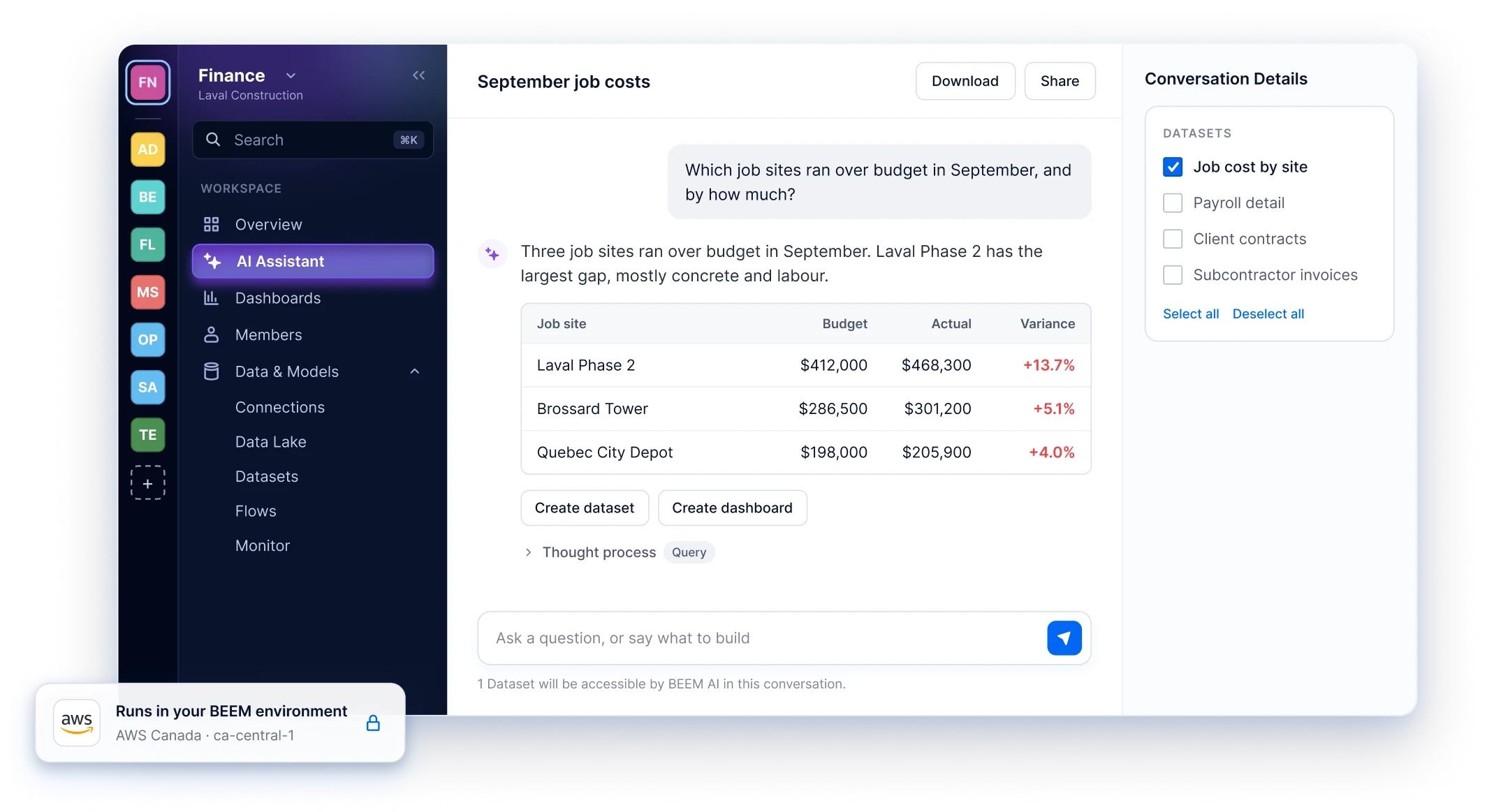
BEEM AI Assistant answering which job sites ran over budget in September, with a budget versus actual table by job site, next to a badge reading Runs in your BEEM environment, AWS Canada · ca-central-1

Companies running on BEEM

Coffrages SynergyEMD BatimoGroupe GeyserDemers BeaulneLe Groupe MauriceMG Construction
Résidences des BâtisseursGroupe PetraPopeye's Supplements

“With BEEM, we already have this ready-made solution with internal specialists. We can go directly to analysis without having to build a project that could take years.”

Hughes Gagnon, VP Innovation & Technology, Coffrages Synergy

The short answer

What is enterprise AI architecture?

Enterprise AI architecture is the way a company connects AI to its data: which systems the AI reads, where the data travels, who controls access, and how answers stay consistent from one tool to the next.

  1. Which systems the AI reads
  2. Where the data travels
  3. Who controls access
  4. How answers stay consistent
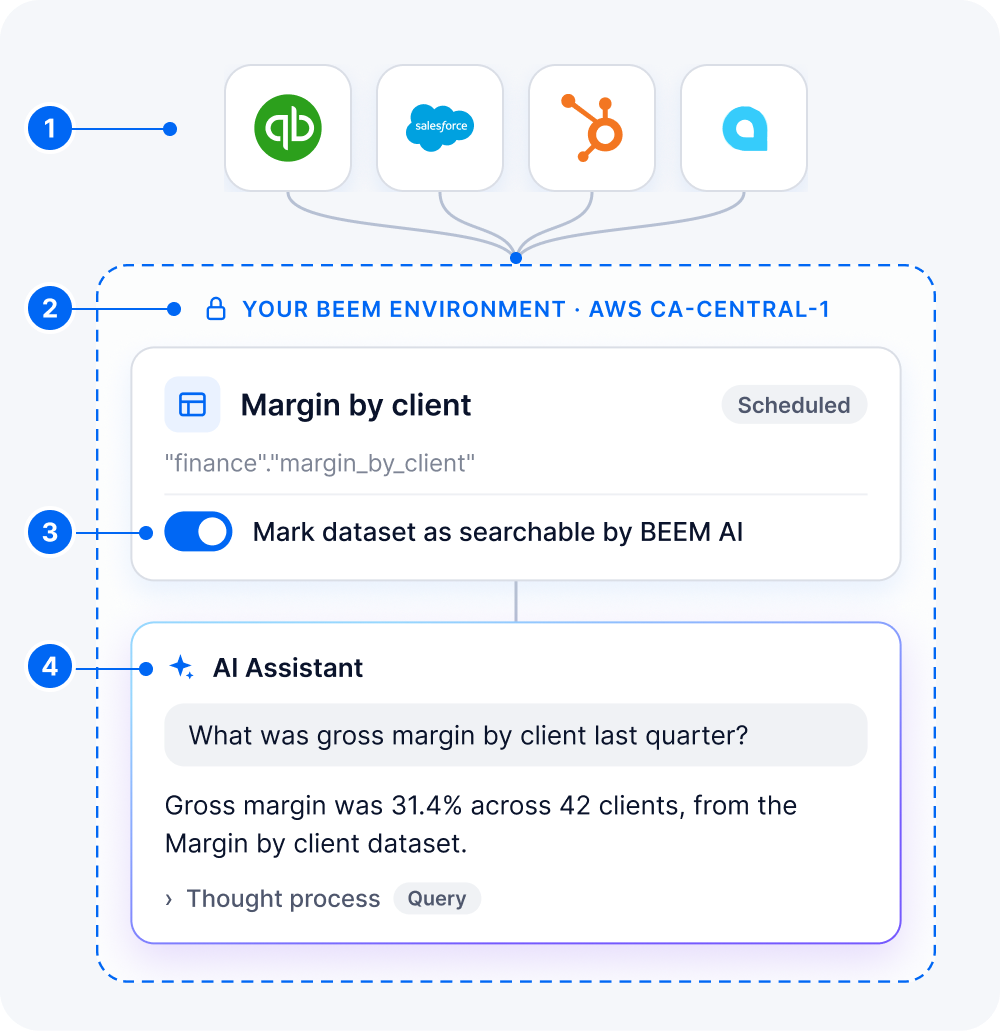
Diagram of enterprise AI architecture in BEEM: QuickBooks, Salesforce, HubSpot and Acumatica (1) feed into your BEEM environment on AWS ca-central-1 (2), where the Margin by client dataset is marked as searchable by BEEM AI (3), and the AI Assistant answers “What was gross margin by client last quarter?” from that dataset (4).

There are three common models: AI plugged into each business system separately, a general assistant like Claude or ChatGPT connected to one governed data platform, or AI deployed inside that platform so the data never leaves your environment. BEEM is a managed data platform that supports the last two, on AWS in Canada, with 750+ connectors to the systems you already run.

Why it matters

The problem with unmanaged AI in the enterprise

Most companies did not choose an AI architecture. They got one by accident.

The accounting package added an assistant. The CRM added another. Someone in operations pasted a sales export into a chat window to get a summary before a meeting. Each of these is reasonable on its own. Together they create three problems that show up in the same place: the management meeting.

Five tools, five versions of the truth.

Each assistant sees only the system it lives in. The CRM’s AI answers from bookings, the accounting AI answers from recognized revenue, and the two never agree. Nobody can tell which one to trust, so the meeting goes back to the spreadsheet.

Data leaves by the side door.

A copy-and-paste into a public chat tool sends customer names, margins and payroll to a provider nobody reviewed. There is no log of what went out, and no way to take it back.

Access rules that exist nowhere.

Every tool has its own permissions, set by whoever installed it. The question “who can ask the AI about salaries” has no single answer, which is exactly the question an auditor or a board will ask.

Governed AI is the opposite: one clean source of data, one set of access rules, and a clear record of where the data goes. It is less about which model you pick and more about the architecture you put under it.

Compare the models

The 3 AI deployment models compared

The difference between the three models comes down to two questions: does the AI read one governed source of data, and does that data leave your environment to produce an answer? Only AI deployed inside your BEEM environment answers yes and no.

Criterion

1. AI in each source system

2. Claude or ChatGPT connected to BEEM by MCP

3. AI deployed inside your BEEM environment

What the AI sees

One system at a time

Your connected, cleaned data in BEEM

Your connected, cleaned data in BEEM

Are the numbers consistent

No, each tool answers from its own silo

Yes, one source

Yes, one source

Who controls access

Each tool, separately

Your BEEM permissions

Your BEEM permissions, plus the datasets you enable for AI

Where the data goes

To each vendor’s AI

To the assistant’s provider, for the rows it retrieves

Nowhere. It stays in your dedicated AWS environment in Canada

Audit trail

Scattered or none

BEEM logs the queries

BEEM logs every question

Lock-in

One per vendor

Low. MCP is an open standard

Low. Your data and rules stay in BEEM, the model can change

Best for

Quick tasks inside one tool

Teams already working in Claude, Copilot or ChatGPT

Finance, HR, client data, anything confidential

How each model works

How each AI deployment model works

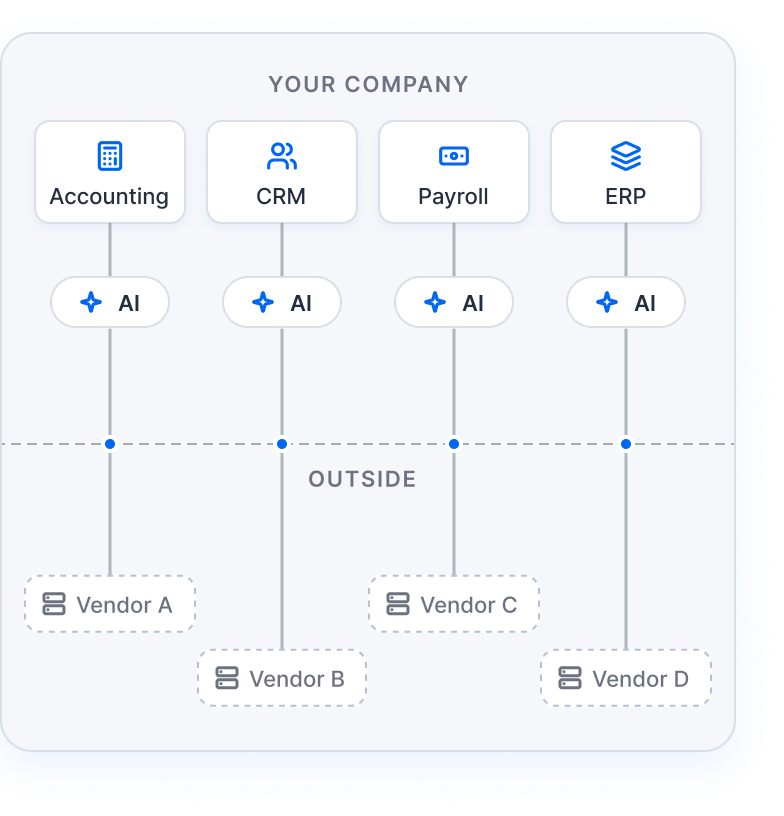
Diagram: Accounting, CRM, Payroll and ERP each have their own AI, and each AI sends data outside the company to a separate vendor (Vendor A, B, C and D).

1

AI plugged directly into your source systems

This is the model most companies have today, without having chosen it. Each business application ships its own AI, or someone connects a chat assistant to each system one at a time.

It works for tasks that live inside one tool: drafting an email in the CRM, categorizing a transaction in the accounting software. It breaks down the moment a question crosses two systems, which is most of the questions a leader asks. “Which clients are profitable” needs billing, time and cost data together. No single application has them, so no single application’s AI can answer.

It also multiplies the places your data goes. Each vendor processes it under its own terms, and each one is a separate contract to review.

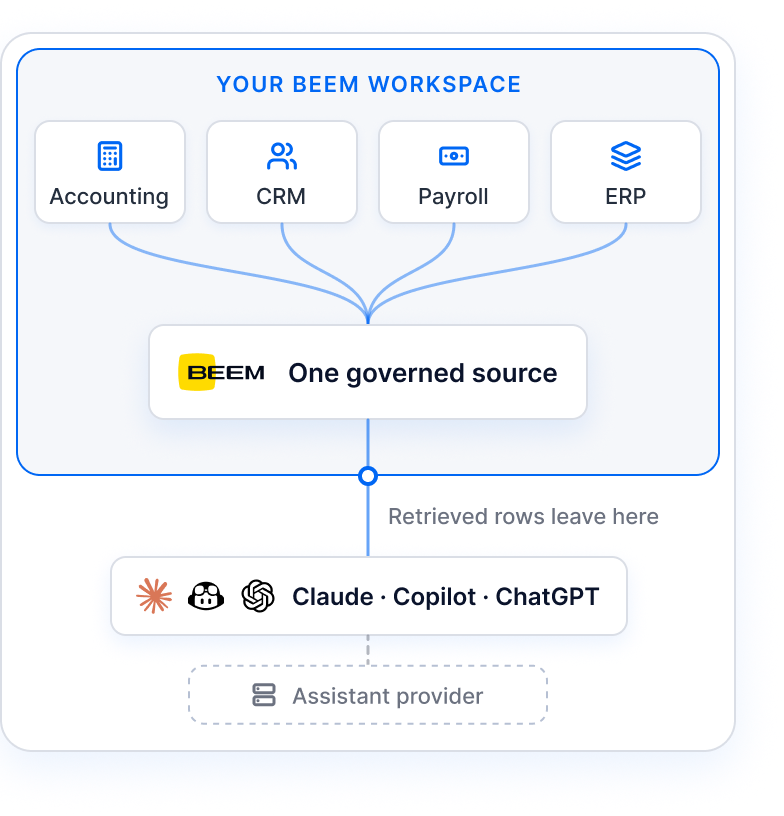
Diagram: Accounting, CRM, Payroll and ERP flow into BEEM as one governed source inside your BEEM workspace; Claude, Copilot or ChatGPT connect to it, and the retrieved rows leave the workspace to the assistant provider.

2

Claude or ChatGPT connected to BEEM by MCP

MCP, the Model Context Protocol, is an open standard that lets an AI assistant connect to a data source and use it through defined tools. BEEM’s MCP Server connects Claude, GitHub Copilot, ChatGPT and other MCP-compatible assistants, six or more in all, to your BEEM workspace with one URL and your existing login.

The assistant stops guessing across silos. It works from the connected, cleaned data in BEEM, through 56 tools: browse datasets, run a query, check whether last night’s sync succeeded, set up a data quality test. Permissions follow the person’s BEEM account, so the assistant sees only what that person is allowed to see, and BEEM keeps a record of the queries.

One thing to know plainly. The assistant itself runs at its provider, so the rows it retrieves to answer a question go to that provider, under the agreement you have with them. This model suits teams that already live in one of these assistants and want it to work from the right numbers. For your most confidential data, the third model is the safer one.

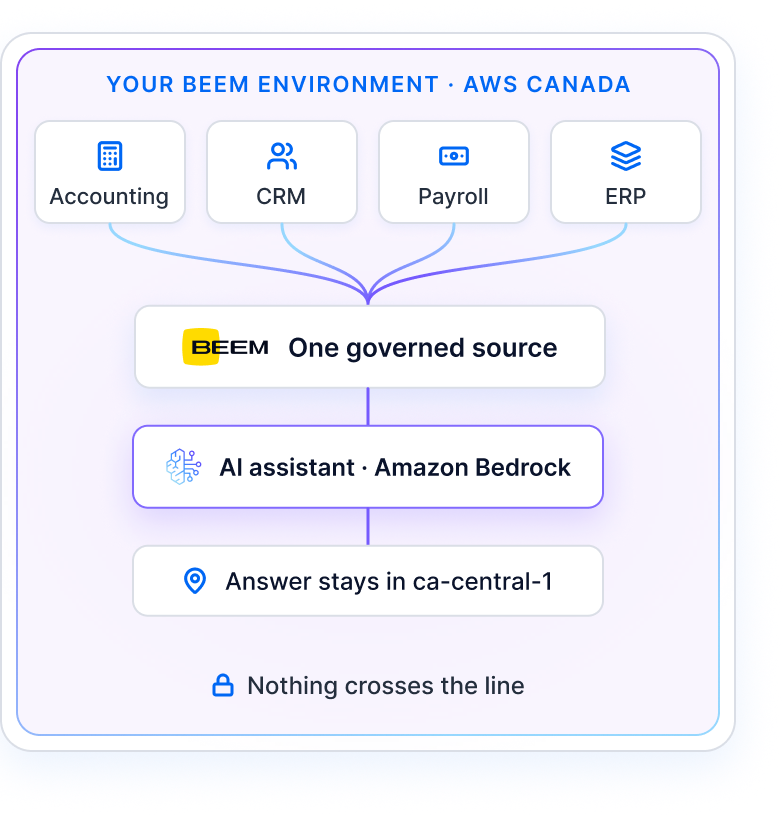
Diagram: inside your BEEM environment in AWS Canada, Accounting, CRM, Payroll and ERP flow into BEEM as one governed source, then to the AI assistant on Amazon Bedrock; the answer stays in ca-central-1 and nothing crosses the line.

3

AI deployed in your BEEM environment

Here the AI comes to the data, not the other way around. BEEM’s AI assistant and AI Dashboards run on AWS Bedrock inside your dedicated BEEM environment, in AWS’s Canadian region. Your data does not leave that environment to produce an answer.

The assistant answers questions in plain language by writing and running the query on your datasets, and shows the SQL if someone wants to check it. AI Dashboards generate a complete dashboard from a one-sentence description, wired to your live data, with drill down to the rows behind every total. Both only reach the datasets you have enabled for AI, both respect workspace isolation, and every question is recorded in the Monitor audit trail.

This is the model we recommend for anything confidential: financial statements, payroll, client files, resident or patient operations data.

How it works

How to deploy AI on your data with BEEM

Three steps, from scattered systems to AI answers you can trust. Most teams see first live dashboards in as little as 2 weeks.

  1. 1

    Connect your systems

    Pick from 750+ connectors for your accounting, CRM, payroll and ERP. BEEM loads and cleans the data in your own warehouse.

  2. 2

    Choose what the AI can see

    Enable the datasets the AI can use, workspace by workspace. Payroll can stay out of scope while receivables are in.

  3. 3

    Ask, build and share

    Ask questions in plain language, generate AI Dashboards from a sentence, or connect Claude, Copilot or ChatGPT by MCP.

Security and data residency

Is enterprise AI safe for confidential data?

Yes, when the AI runs where the data lives. In BEEM, the AI assistant and AI Dashboards run inside your dedicated AWS environment in Canada, only reach the datasets you enable, and log every question.

Does the AI train on our data?

No. BEEM’s AI runs on AWS Bedrock inside your dedicated environment, and your data is not used to train the models. The AI reads your data to answer a question, then the answer stays with you.

Where does our data live when we use AI in BEEM?

In a dedicated AWS environment in Canada, in the ca-central-1 region. The AI runs inside that environment, so answering a question does not send your data anywhere else. BEEM follows SOC2 processes, is PIPEDA and GDPR compliant, and has had zero customer data breaches.

Who decides what the AI can see?

You do, dataset by dataset. The AI assistant only reaches the datasets you have enabled for it. Payroll can stay out of scope while receivables are in. On top of that, people only see the workspaces they are invited to, roles are set at the workspace level (Organization Admin, Editor, Viewer), and results can be shared without exposing the query behind them. Every question is logged in the Monitor audit trail.

AWS ca-central-1

SOC 2 processes

PIPEDA

GDPR

No model training on your data

Monitor audit trail

No vendor lock-in

Avoid AI vendor lock-in: change models without rebuilding

AI models improve every few months. The one you choose today will not be the best one in two years. An architecture that ties your data and your business rules to one model means rebuilding each time.

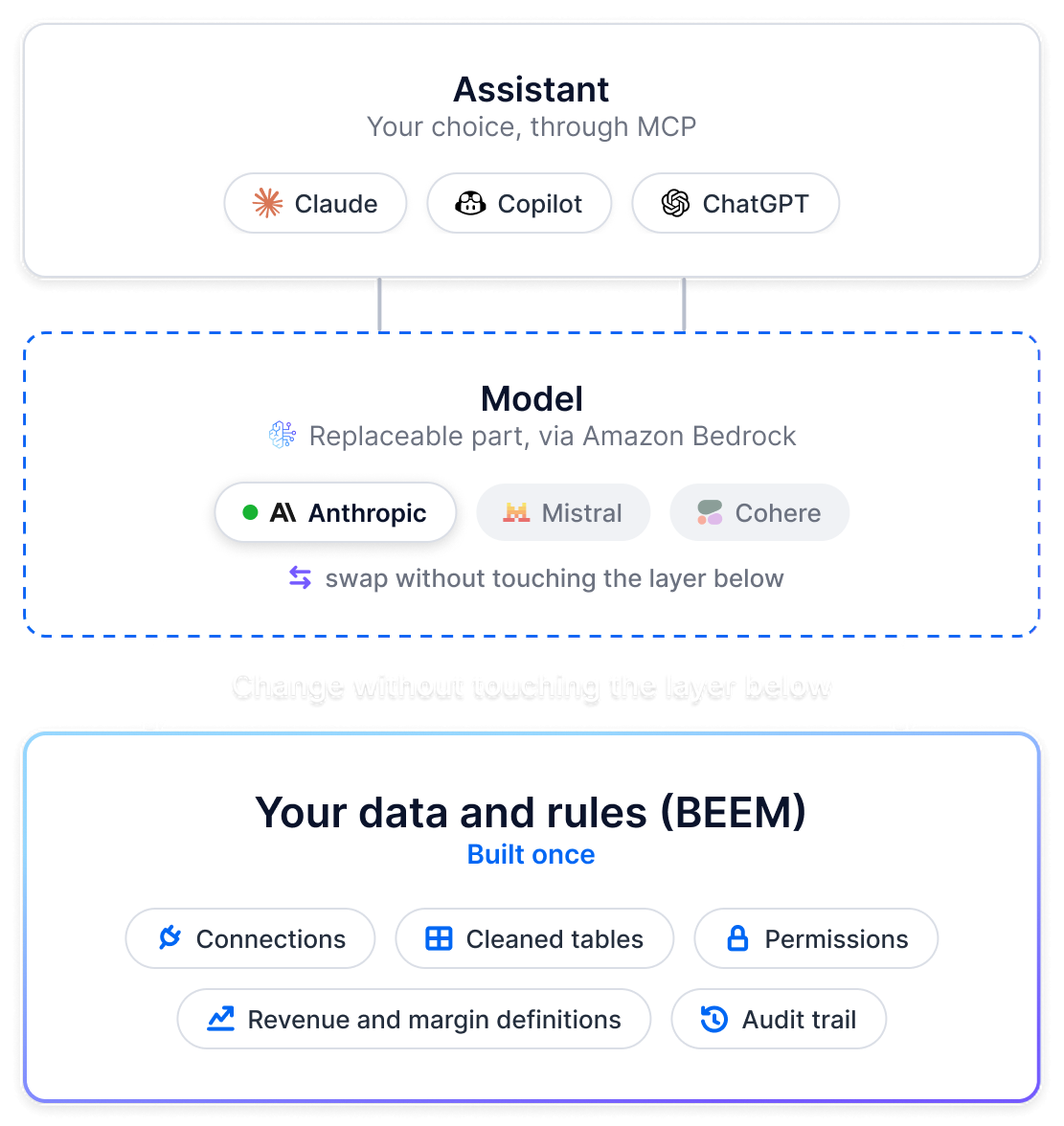
BEEM separates the two layers.

Three-layer diagram: the assistant layer (Claude, Copilot or ChatGPT through MCP) sits on a replaceable model layer via Amazon Bedrock (Anthropic, Mistral, Cohere), which sits on your data and rules in BEEM, built once: connections, cleaned tables, permissions, revenue and margin definitions, audit trail.

Your data and your rules live in BEEM. The connections to your systems, the cleaned tables, the definitions of revenue and margin, the permissions and the audit trail all sit in the platform. None of it is written into a model.

The model is a replaceable part. BEEM’s AI runs on AWS Bedrock, which gives access to several model families, including Anthropic, Mistral and Cohere. When a better model becomes available, the model underneath can change while your datasets, dashboards and access rules stay exactly as they are.

The assistant is your choice too. Because MCP is an open standard, the team that prefers Claude and the team that prefers Copilot can both work from the same governed data. Changing assistant later does not mean moving your data.

Your data is never trapped. It sits in your own warehouse in BEEM, and results can be exported at any time.

That is what avoiding vendor lock-in means in practice: the expensive part, your data foundation, is built once, and the part that changes fastest can change without touching it.

Why BEEM

Why BEEM for enterprise AI

Most self-serve AI platforms sell you a tool and leave running, securing and adopting it to you. BEEM ships the data foundation, the governance and the AI together, so a mid-market company without a data team can deploy AI safely.

Governance from day one

One warehouse for your connected data, access rules at the workspace and dataset level, and AI that runs inside your environment. Nothing to bolt on later.

A data team when you want one

BEEM’s data team can set up the connections, activate the right datasets and follow the results with you. Priced separately, optional.

Built around your industry’s numbers

Job costing in construction, rent rolls in real estate, compliance-ready figures in finance and accounting, sales and inventory in retail. Same governance everywhere.

Testimonials

Trusted by the teams who run on BEEM

Speed
2 weeks~

from kickoff to first live dashboards

Cost
40 to 60%↓

less than an in-house team or an outside consultant

Reporting
75%↓

less time spent on reporting for a finance client

By industry

Enterprise AI by industry

The architecture is the same everywhere. The questions are not. Each page below shows what AI looks like on the data one industry actually runs on.

Finance

Where does cash stand before the quarter ends?

AI in finance →

Accounting firms

Which clients are profitable after write-offs?

Construction

Which projects are actually making money, every week?

Real estate

Every property and every metric, from one place

Manufacturing

What is the margin by product line after scrap?

Ecommerce

What is the margin after ads and returns, by channel?

Retail

Sales, margin and stock by store, before the weekly call

Healthcare operations

Where is capacity lost between the schedule and the invoice?

Hospitality

Labour, covers and revenue per location, each morning

Transportation

Cost per kilometre and margin by lane

Distribution and wholesale

Which products and customers drive the margin?

Senior living

Occupancy, services and staffing per residence

Enterprise AI architecture: frequently asked questions

Frequently Asked Questions

What is enterprise AI architecture?

It is the way a company connects AI to its data: which systems the AI reads, where the data travels, who controls access and how answers stay consistent. A good architecture puts one governed data foundation under every AI tool, instead of letting each tool read its own silo.

What is the difference between connecting Claude or ChatGPT to BEEM by MCP and deploying AI directly in BEEM?

With MCP, your assistant works from the governed data in BEEM and follows your BEEM permissions, but it runs at its own provider, so the rows it retrieves go to that provider. With AI deployed in BEEM, the AI runs inside your environment and the data does not leave it. Many companies use both: MCP for everyday questions, the in-platform AI for confidential data.

What is a private AI deployment?

A private AI deployment runs the model inside an environment the company controls, so prompts and data are not sent to a public AI service. In BEEM, the AI assistant and AI Dashboards run on Amazon Bedrock inside your dedicated AWS environment in Canada (ca-central-1), and your data is not used to train the models.

Is it safe to use ChatGPT or Claude with company data?

It depends on where the data goes. Connected to BEEM by MCP, the assistant follows your BEEM permissions and works from governed data, but the rows it retrieves go to the assistant's provider under your agreement with them. For confidential data, use the AI deployed inside your BEEM environment, where the data does not leave.

Does the AI in BEEM train on our data?

No. The AI runs on AWS Bedrock inside your dedicated BEEM environment, and your data is not used to train the models. It reads your data to answer a question, and the answer stays with you.

Can we change AI models without rebuilding our architecture?

Yes. Your connections, cleaned data, business definitions and permissions live in BEEM, not in a model. BEEM's AI runs on AWS Bedrock, which offers several model families, so the model can change underneath while your datasets and dashboards stay as they are.

What is MCP, the Model Context Protocol?

MCP is an open standard that lets an AI assistant connect to a data source through defined tools. BEEM's MCP Server exposes 56 tools and works with Claude, GitHub Copilot, ChatGPT and other MCP-compatible clients, six or more in all. It is added with one URL and your existing BEEM login.

How do we avoid vendor lock-in with AI?

Keep your data and your business rules in a platform you control, separate from the model and the assistant. In BEEM, your data sits in your own warehouse, the model runs through AWS Bedrock and can change, MCP is an open standard, and results can be exported at any time.

Do we need a data team or an AI architect?

No. BEEM connects your systems with 750+ pre-built connectors and provides the warehouse, the governance and the AI in one platform. BEEM's data team is available separately if you want help with setup or a specific analysis.

How long before we see AI working on our own data?

First live dashboards on your real data in as little as 2 weeks. The AI assistant works on the same datasets as soon as they are enabled for it.

What does it cost?

Plans start at $899/mo, plus usage-based processing from $0.60/DPU and storage at $0.10/GB. The data team's services are priced separately.

Keep reading about AI on your data