
A mid-market company rarely lacks data. What it lacks is agreement on what to do with it. Finance runs its own reporting, marketing has its dashboards, operations keeps three spreadsheets nobody else opens, and every quarter someone asks why two systems disagree on the same revenue number.
Closing the gap between owning data and running the business on it is what data strategy consulting is supposed to do. The work is less technical than most vendors let on. It starts with deciding which business questions deserve a reliable answer, then sequencing the technical work that makes those answers possible.
What data strategy consulting actually covers
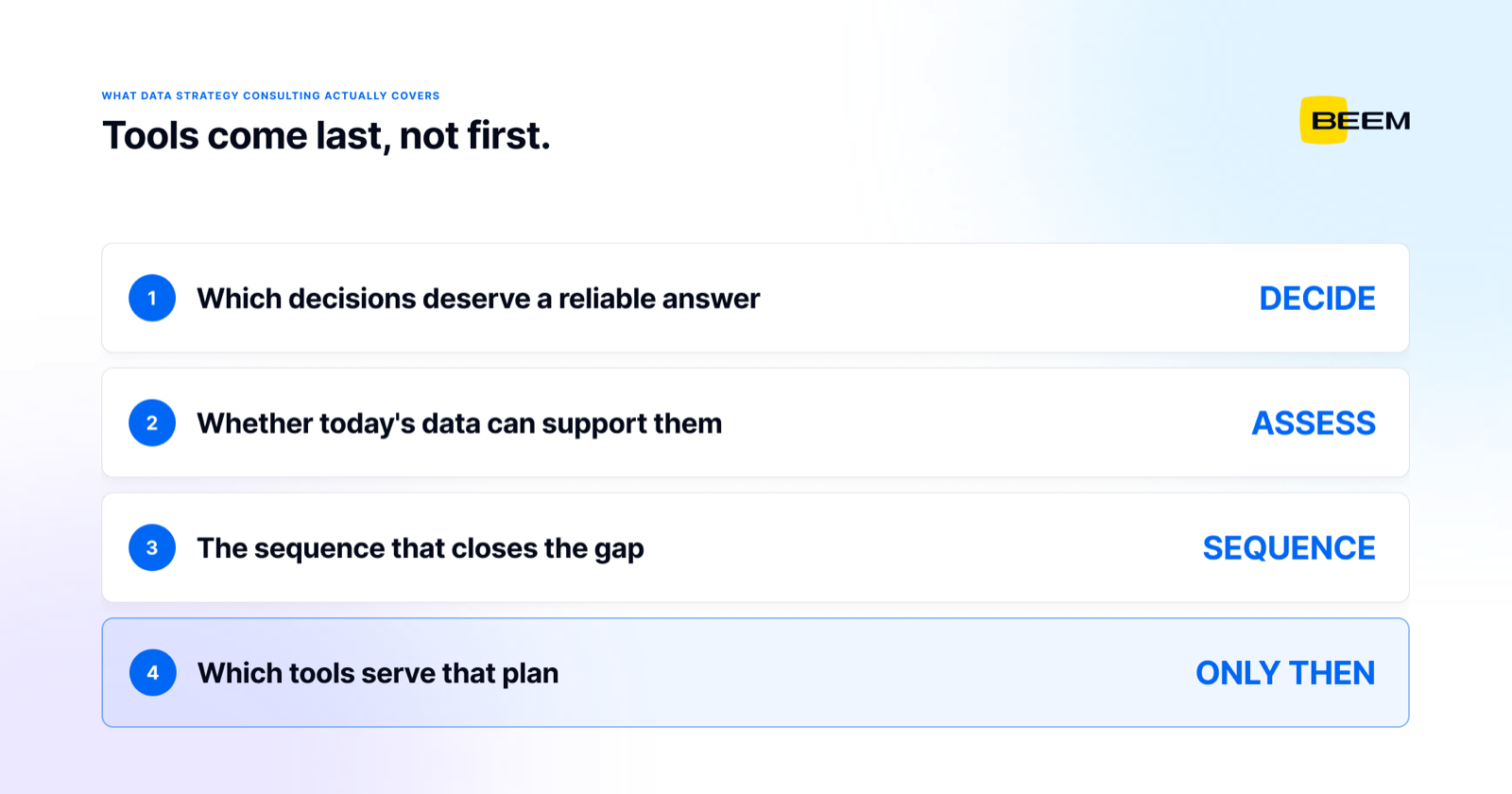
The label stretches from a two-week diagnostic to a year of embedded work, but the sequence is always the same: understand what the business is trying to decide, check whether the current data can support those decisions, then define the path between the two. Tool selection comes at the end of that sequence, not the beginning.
A serious engagement leaves you with three things. An honest map of your sources, their owners and their known quality problems. An enterprise data strategy that ties data work to business objectives, with priorities a CFO would recognize as their own. And a data roadmap: the sequenced plan that turns the strategy into quarters of work, with dependencies and owners attached to each item.
What it is not is a shopping exercise. Choosing a warehouse before knowing which decisions need support is the shortest path to paying for a platform nobody logs into. A modern data platform is far easier to justify, and to configure, once you know what it has to serve.
Why data roadmaps stall in mid-market companies
Most roadmaps that die on the shelf die for reasons that have nothing to do with technology.
Scope is the first one. A plan promising a single source of truth across every system in eighteen months is a plan nobody follows past month four. Ambition is not the issue. The issue is the absence of a first deliverable that visibly changes someone's Monday morning.
Ownership is the second. Companies name a project sponsor, then forget to name data owners. So who owns the definition of an active customer? When sales and finance count it differently, the project does not fail loudly, it simply slows to a halt in a meeting that gets rescheduled twice.
The pattern worth recognizing looks like this. A company budgets a year of platform work while its two most damaging reporting problems are a customer field typed by hand into the ERP and a product hierarchy nobody has updated in three years. Neither problem needs new technology. Both need a decision and an owner. Roadmaps that survive tend to fix that kind of thing in the first six weeks, then earn the right to spend on architecture.
The third reason is that the plan outlives its assumptions. A new market opens, an acquisition lands, a reporting requirement changes, and the roadmap stays a static deck from last spring. This is the most common mistake we see in otherwise well-run companies: the strategy is written once, presented once, and never checked against what actually shipped.
Start with an honest data maturity assessment
You cannot sequence work without knowing where you stand. A data maturity model gives that conversation a shared vocabulary, though its value lies in the discussion it forces, not in the score it produces.
The levels most companies move through
The progression is fairly consistent. Manual reporting rebuilt in spreadsheets each month. Consolidated reporting from a few connected sources. Automated pipelines with quality checks and defined ownership. Governed self-serve access, where teams answer their own questions without breaking anything. And finally data feeding operations directly, from forecasting to automated segmentation.
Many mid-market companies sit somewhere between the second and third level, with one advanced pocket. The trap is claiming the level of your best team. If finance has clean automated reporting while operations still emails workbooks, your real maturity is the second one, not the fourth.
What the assessment should produce
An inventory of sources with an owner and a refresh frequency for each. The list of reports the business actually depends on, and whether anyone trusts them. Known quality problems, named rather than politely implied. And the documented state of the connections between your systems, including the ones held together by a script on somebody's laptop. An assessment that ends at a maturity score does not tell you where to start.
One question exposes the real level faster than any questionnaire: if the person who built the monthly reporting left tomorrow, how long before the numbers stopped arriving? An answer measured in days tells you the maturity is lower than the tooling suggests.
Building the roadmap: a data strategy framework that holds up
Most advice on how to build a data strategy opens with a vision statement. Start instead with a list of decisions the business currently makes badly, or slowly, or on instinct. That list is the backbone of any data strategy framework worth following, because it gives every technical task a reason to exist.
Sequence by decision, not by data source
Pick three to five decisions: which accounts are at risk of churn, which product line is genuinely profitable once delivery costs are included, which receivables need attention this week. Work backwards from each one to the data it requires. Every decision becomes a vertical slice of the roadmap that can ship without waiting for the rest.
Make the dependencies explicit
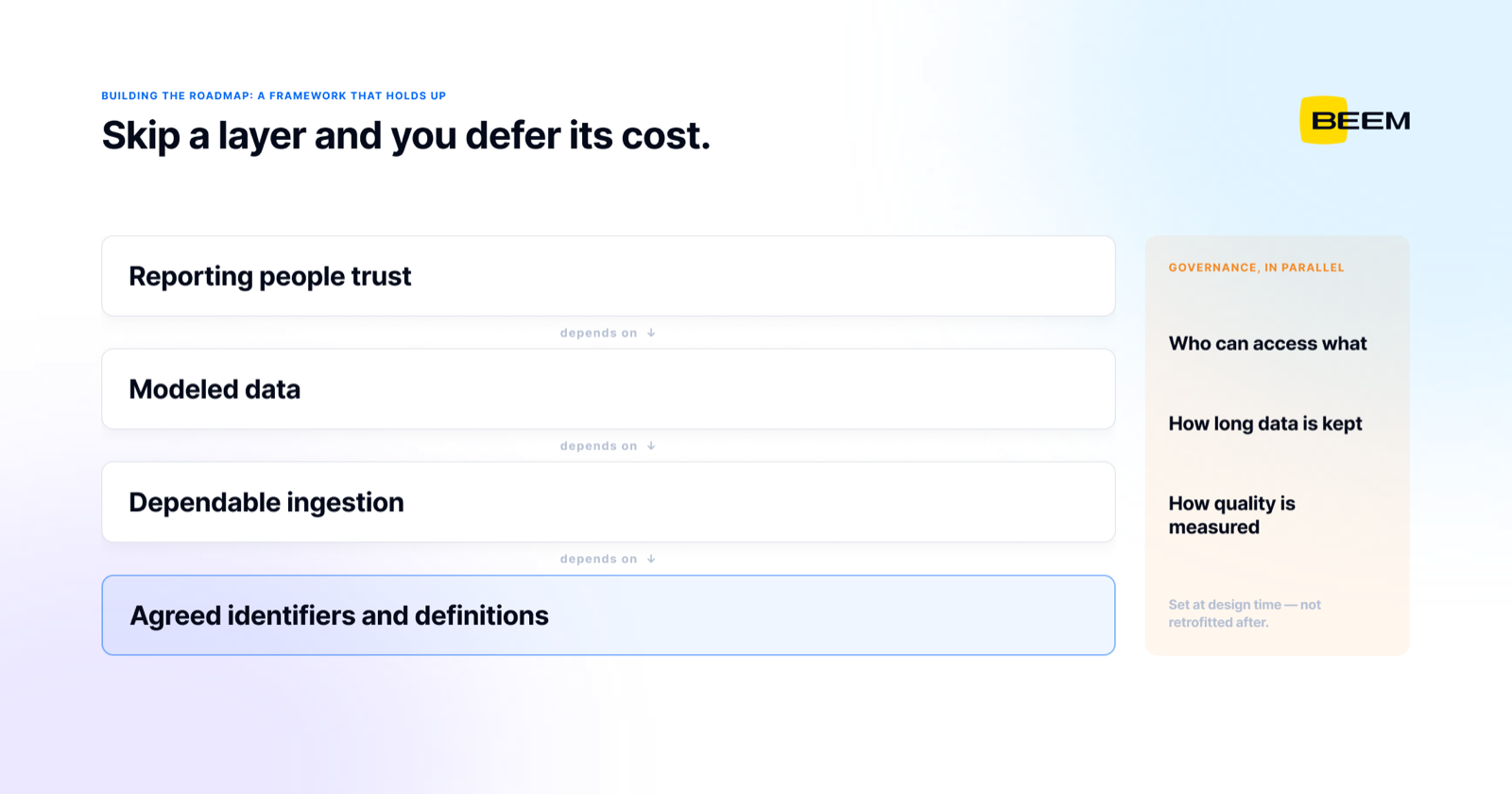
Reliable reporting depends on modeled data, which depends on dependable ingestion, which depends on agreement about identifiers and definitions. Skipping a layer does not remove its cost, it defers it, usually to the quarter when leadership starts paying attention. Mapping the transformation work each use case implies before committing to a date is what keeps a roadmap from promising quarters it cannot deliver.
A documented case in manufacturing shows what underestimating that layer costs. To make SAP data usable in Power BI, building the semantic model across SAP tables took hours of manual work each cycle, tied up analysts on preparation rather than analysis, and left room for inconsistencies in the reports. Automating that step brought the work down to minutes. The bottleneck sat in data preparation, not in the visualization tool.
Governance runs alongside the build, not after it
A data governance roadmap answers three questions in parallel with the technical work: who can access what, how long data is kept, and how quality is measured. Treated as a later phase, it rarely happens. Gartner expects 80% of data and analytics governance initiatives to fail by 2027, largely because they are run without a business outcome that makes them matter to anyone outside the data team.
For Canadian organizations there is a second reason to sequence it early. Quebec's Law 25 sets requirements on consent, retention and access to personal information, and retrofitting access controls and retention rules onto pipelines already in production means revisiting each one that has shipped, work that does not exist when the rules are set at design time.
What makes a data roadmap scalable
Scalable gets used loosely. In practice it means three specific things: adding a source should not require rebuilding what already works, adding users should not require a new tool, and adding a rule for a new market or regulation should not mean rewriting your pipelines.
Conventions are what make that possible, and they are almost free early on. Naming, identifiers, time zones, currency handling, how you record a deleted record: trivial decisions across three sources, expensive archaeology across thirty.
The second condition is automated verification. A pipeline that fails loudly is much cheaper than one that fails quietly. Automated data testing at each stage catches a renamed column or a broken join before it reaches a board report. Caught at the source, the error stays a technical incident. Found by an executive in a report, it becomes a question about whether the numbers can be trusted.
Where the BI roadmap fits
A BI roadmap is a subset of the data roadmap, not a synonym for it. It covers which reports get built, for whom, in which tool, and in what order. Dashboards tend to jump the queue because they are the visible part, which is backwards when the data underneath has no owner and no test.
One rule saves a lot of rework: no dashboard on a source without an owner and a quality check. One report finance trusts is worth more than twelve nobody opens. And reporting is not the end state. Once data is modeled and reliable, the same foundation feeds operational uses such as customer segmentation that updates on its own, with no team rerunning the calculation every week.
Sequencing applies inside the BI work too. Reports that support a recurring decision come first, exploratory dashboards later, and self-serve access only once definitions are documented well enough that two teams computing the same metric land on the same number. Skipping that last condition is how a company ends up with three versions of monthly revenue that nobody can reconcile in a meeting.
In-house team, consultant or managed partner?
Once the roadmap exists, someone has to execute it, and that choice deserves as much thought as the plan itself.
Building an internal team gives full control, but hiring and keeping data engineers is a real commitment at mid-market scale, and a team of two carries a bus-factor problem that only shows up at the worst possible moment.
An independent data strategy consultant brings method and an outside read on your situation, which is exactly what the assessment and the roadmap need. The limit is structural: most engagements end when the document is delivered, and the execution risk stays entirely with you.
A managed platform and service covers both the technology and its daily operation, which fits companies that want dependable results without building a data function from scratch. That is the approach BEEM favors, with platform and human support in the same engagement.
The calendar gap is the most concrete argument. In a documented construction project, the company estimated six to twelve months to build a predictive capability in-house, plus the specialist hiring that implies. Centralizing the data and putting it to work took one month, an implementation time roughly twelve times shorter than standing up a full internal infrastructure.
Four criteria usually settle it: total cost including maintenance time, the technical skills genuinely available in-house, the complexity of your current stack, and whether the arrangement can absorb the next three systems you adopt.
Sitting on a data strategy nobody has sequenced yet? See how BEEM turns it into a working data roadmap and takes on the platform and its operation, without tying up an internal technical team.
