
A dashboard flashes the wrong revenue number ten minutes before a board meeting. Someone traces it back to a marketing report built on duplicate customer records that never got flagged. Data is everywhere in most companies now, but trust in that data is rare, and the gap between the two is where bad decisions get made.
Data quality assurance is the discipline that closes that gap. It is not a one-time cleanup project, it is the systematic process of checking, monitoring, and enforcing the reliability of data before it reaches the people making decisions with it. Done well, it turns "I think this number is right" into "I know this number is right."
This guide walks through what data quality assurance actually means, the six dimensions worth measuring, and a three-step framework for building data quality checks into your pipeline instead of bolting them on after something breaks.
What Data Quality Assurance Actually Means
Data Quality vs. Data Quality Assurance: Why the Distinction Matters
Data quality is a property, a snapshot of how accurate, complete, or consistent a dataset happens to be right now. Data quality assurance is the process that keeps that property in good shape over time: the rules, checks, and monitoring that catch problems before they spread. The distinction matters because a lot of teams treat data quality reactively, fixing errors after a report goes out wrong, instead of proactively, catching them before the data is used at all.
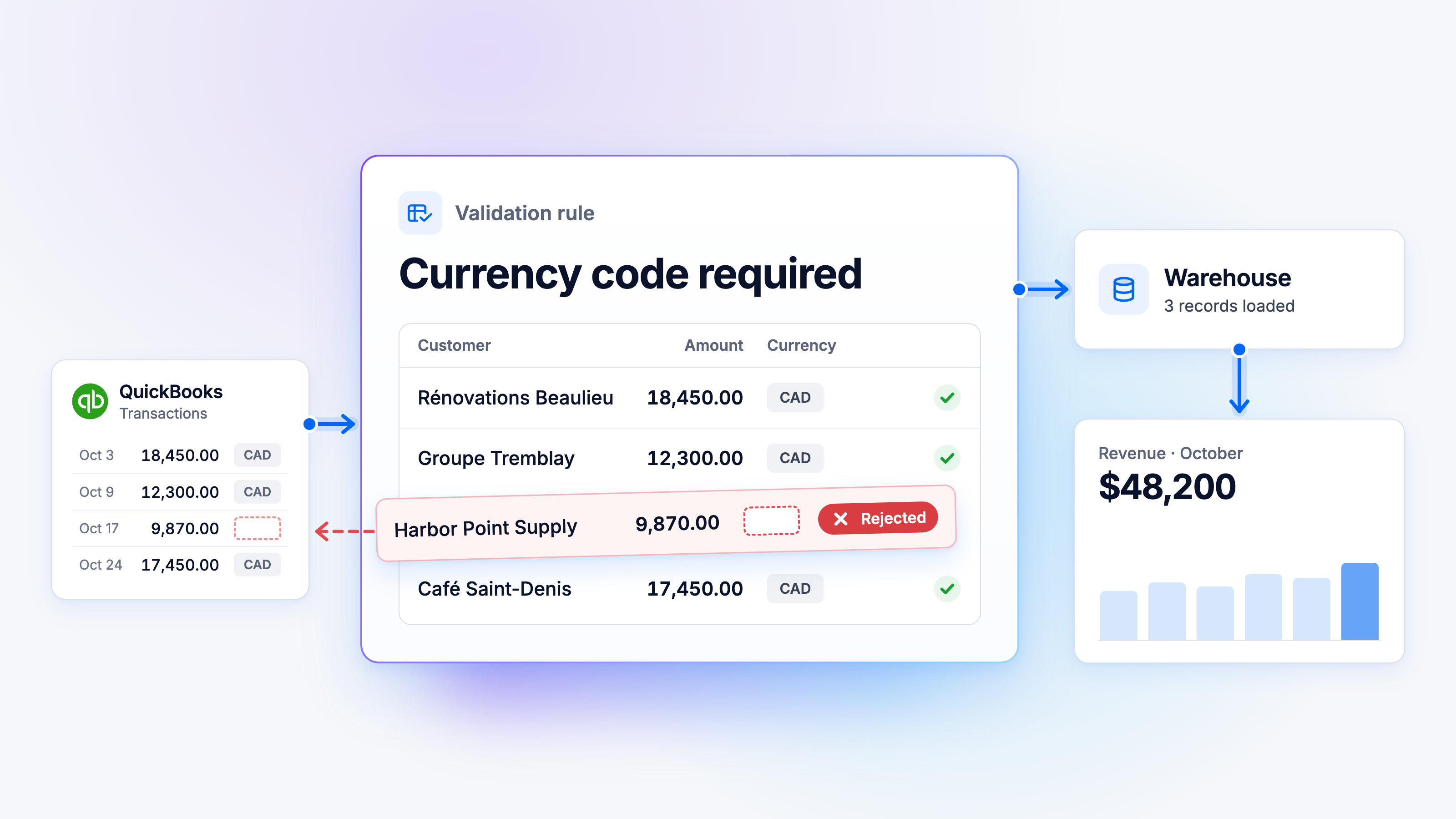
A finance team that sets validation rules before transaction data enters the warehouse, rejecting a record with a missing currency code instead of flagging it after month-end close, is practicing exactly that. A team that only checks numbers when a report looks wrong is practicing data quality cleanup, which is a different and more expensive job.
Setting data quality standards up front, and giving someone clear data quality control over enforcing them, is what separates the two approaches.
The Six Core Data Quality Dimensions You Need to Measure
Six dimensions show up again and again in data quality assurance practice. Treat this as a reference card, not a lecture: each one gets a one-line definition and a signal that tells you when it is failing.
Accuracy, Completeness, and Consistency
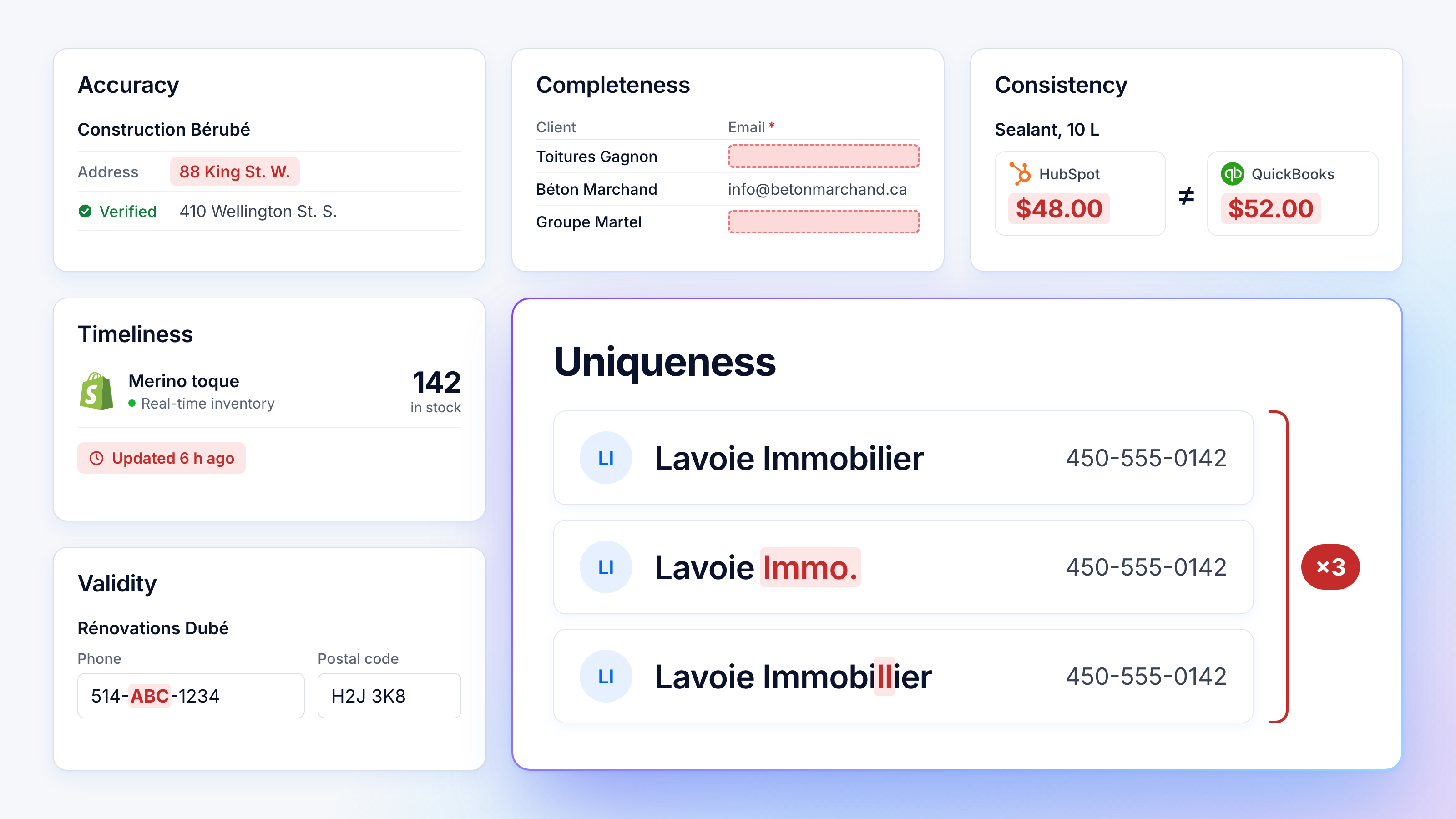
- Accuracy: the data reflects reality. Signal: a customer's listed address does not match what is on file elsewhere.
- Completeness: the data has no missing required fields. Signal: a required field is blank for a chunk of records with no clear reason why.
- Consistency: the same fact reads the same way across systems. Signal: a product's price differs between the CRM and the billing system.
Timeliness, Validity, and Uniqueness
- Timeliness: the data is current enough to act on. Signal: a "real-time" inventory count that is actually six hours old.
- Validity: the data follows the format and rules it is supposed to. Signal: a phone number field containing letters, or a future date for something that already happened.
- Uniqueness: each real-world entity appears once. Signal: the same customer exists as three separate records because of small spelling variations.
These six make up the backbone of most data quality checks, and most programs like it measure at least these before adding anything more specialized.
Building Your Data Quality Assessment Framework
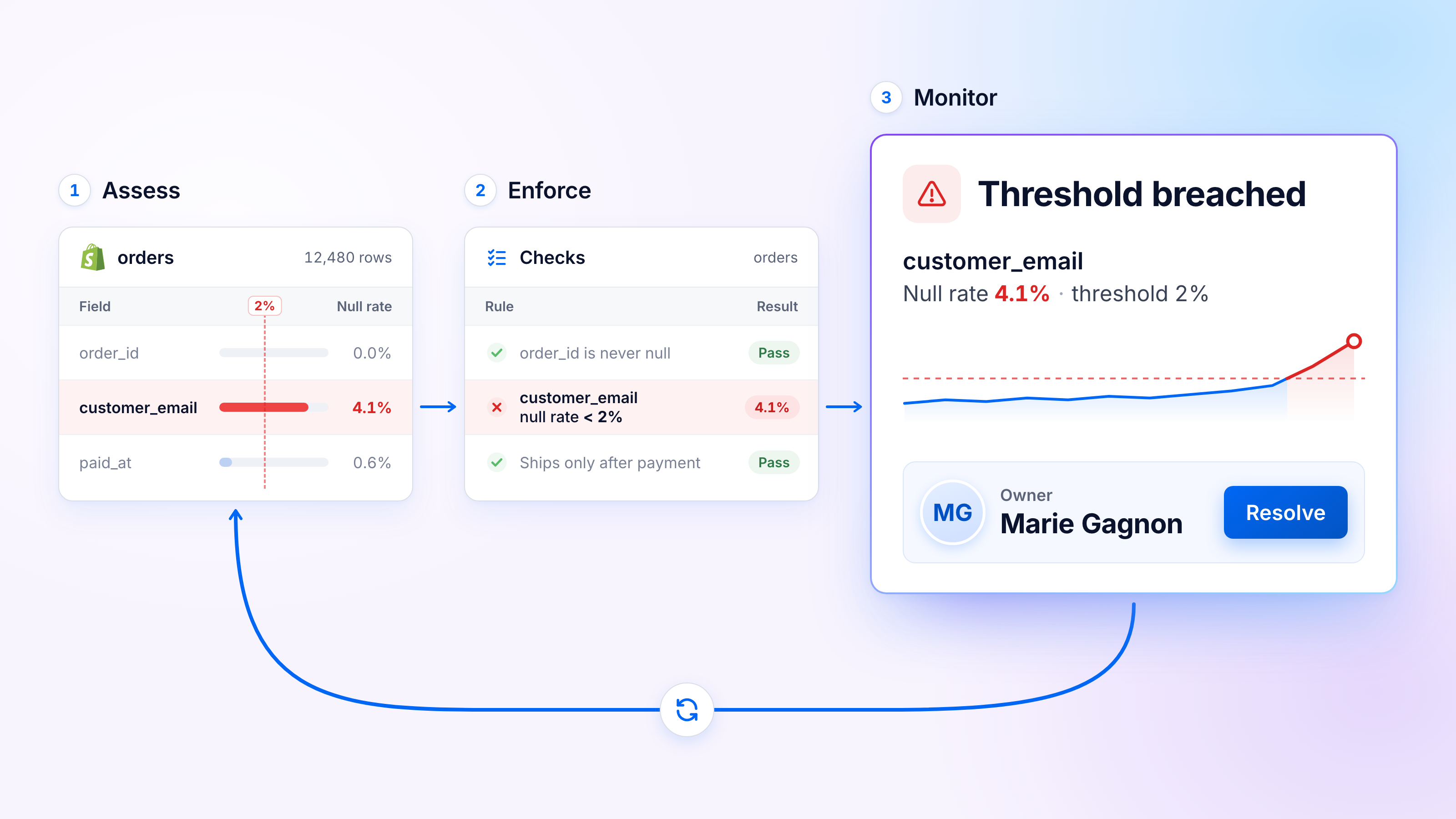
A data quality assessment framework turns the six dimensions above from a checklist into a repeating cycle: assess, enforce, monitor, repeat.
Step 1: Inventory and Profile Your Data Sources
Start by knowing what you actually have: which systems generate data, where it flows, and what its current state looks like. Data profiling, running basic statistics on each field (null rates, distinct values, format patterns), surfaces problems before you have written a single rule. This week's action: pick your three most business-critical tables, for a finance team that might be revenue postings, for an e-commerce team it might be inventory counts, and profile them.
Step 2: Define Rules, Checks, and Thresholds
Turn what you found into concrete data quality checks: business rules (an order cannot ship before it is paid), technical constraints (a field cannot be null), and acceptable thresholds (a null rate under 2% is fine, above that it is a problem). This is also where you set data quality standards the rest of the organization can be held to, rather than leaving quality as a matter of individual judgment. For a look at how this maps to an automated pipeline, see BEEM's data testing features.
Step 3: Monitor, Alert, and Remediate
Checks that only run during an annual audit catch problems long after they have caused damage. Build monitoring that runs continuously, alerts the right person when a threshold is breached, and has a defined remediation path, not just a message with no owner. This is the step that keeps data quality control an ongoing discipline instead of a one-time project.
This is a cycle, not a checklist you complete once: sources change, new fields get added, and thresholds that made sense last year may not this year.
Data Quality Assurance: From Data Doubt to Data Confidence
Data quality assurance is not a cleanup sprint you run once and move on from, it is an operational discipline: six dimensions to measure, a three-step framework to keep measuring them, and someone accountable for both. Teams that treat it this way stop re-litigating whether a number is trustworthy every time it shows up in a meeting.
The dashboard that shows the wrong number before a board meeting is usually not a one-off glitch, it is what happens when nobody owns that discipline upstream. Fix that, and the payoff shows up as faster decisions, dashboards people actually trust, and a team that stops second-guessing its own data.
