
Definition
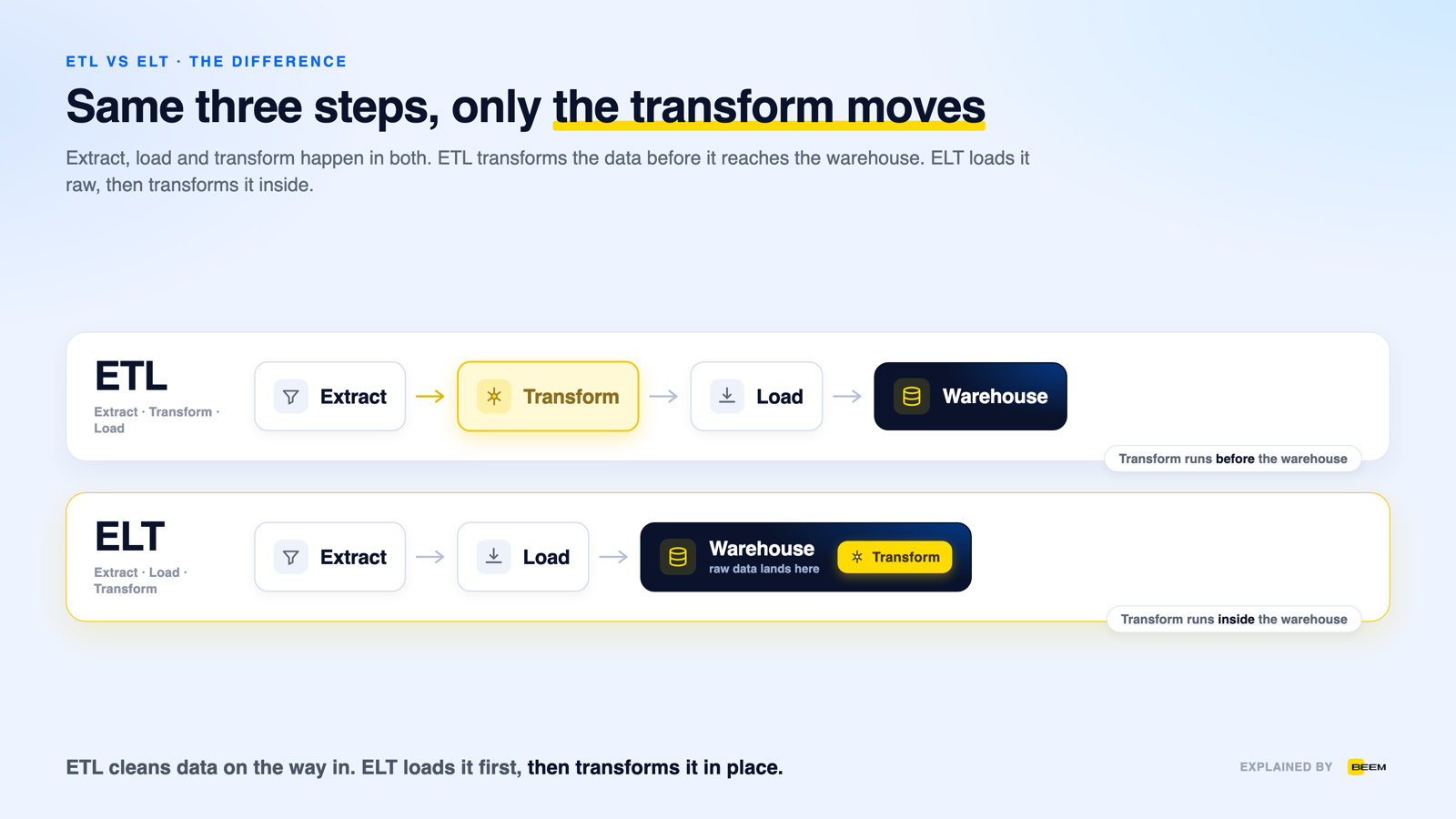
ETL vs ELT comes down to a single question: when do you transform the data? ETL (extract, transform, load) cleans and reshapes data before loading it into a warehouse. ELT (extract, load, transform) loads raw data into the warehouse first, then transforms it there.
Same three steps, different order.
How it works
What is ETL?
ETL stands for extract, transform, load. It pulls data out of source systems, transforms it on a separate processing engine, and loads the finished result into the warehouse. Only clean, structured data ever reaches the destination.
This was the original approach to data integration. Because the transform step runs before loading, teams control exactly what lands in the warehouse, which helps with sensitive fields and strict schemas. The trade-off is a separate transformation server to run and scale.
What is ELT?
ELT stands for extract, load, transform. It loads raw data straight into the warehouse, then transforms it there using the warehouse's own compute. Raw and modeled data both live in one place.
ELT fits modern cloud warehouses, which are fast and cheap enough to handle transformation at scale. You load everything first, so analysts can reshape data with SQL whenever a new question comes up, without rebuilding the whole pipeline. It works well for large volumes and for semi-structured data that would be hard to model up front.
How it compares
The core difference is the transform step: ETL transforms before loading, ELT transforms after. That one change ripples through where the work runs, how fast data loads, and the kind of data each handles best.
Use ETL when data must be cleaned and validated before it lands, for example with regulated fields or a fixed reporting schema. Use ELT when you run a cloud data warehouse and want to load everything, then transform as questions come up. Most modern teams default to ELT because the warehouse does the heavy lifting. In practice the line blurs, and a single data pipeline often mixes both, transforming some data on the way in and the rest once it is in the warehouse.
| ETL | ELT | |
|---|---|---|
| Transform order | Transform before load | Load before transform |
| Where transform runs | Separate processing engine | Inside the warehouse |
| Speed | Slower to load, clean on arrival | Faster to load, transform on demand |
| Cost | Extra engine to run and scale | Uses warehouse compute you already pay for |
| Best for | Small, structured data and strict schemas | Large or mixed data on cloud warehouses |
When your business needs one
- Choose ETL when you have a strict schema, need sensitive data filtered before load, or work with smaller structured sources.
- Choose ELT when you have a cloud warehouse, large or varied data, and analysts who want raw data on hand for new questions.
- Choose ETL when a regulated field must never reach the destination in its raw form.
- Choose ELT when new questions arrive faster than a pipeline can be rebuilt to answer them.
- Expect to mix both: most real pipelines transform some data on the way in and the rest in the warehouse.
Benefits and limits
- ETL — only clean, validated data reaches the warehouse, which suits regulated fields and strict schemas.
- ETL — the transform is controlled in one place before the load, so the destination schema stays predictable.
- ELT — loading is fast, because raw data goes straight into the warehouse.
- ELT — raw data stays on hand, so analysts can answer a new question in SQL without rebuilding the pipeline.
- ELT — transformation runs on warehouse compute you already pay for, with no separate engine to operate.
- ETL — a separate transformation engine has to be run, scaled and paid for.
- ETL — loads are slower, and anything not modeled up front is not in the warehouse to query later.
- ELT — raw and modeled data both sit in the warehouse, so storage grows and governance matters more.
- ELT — loading everything unfiltered is a poor fit when sensitive fields must never land.
- ELT — transformation cost lands on warehouse compute, which climbs quickly with careless SQL.
- The only real difference is where the transform step sits: before the load in ETL, after it in ELT.
- ELT is the default for cloud data stacks because loading is cheap and the warehouse handles transformation at scale; ETL still fits strict schemas and data that must be cleaned or masked before it lands.
- Neither replaces the other outright, and most working pipelines end up using both.
Frequently Asked Questions
What is the difference between ETL and ELT?
The difference is the order of the transform step. ETL (extract, transform, load) cleans and reshapes data on a separate engine before loading it into the warehouse. ELT (extract, load, transform) loads raw data into the warehouse first, then transforms it there. Same three steps, different order, which changes where the work runs and what it costs.
Which is better, ETL or ELT?
Neither is better for every case. ELT suits modern cloud warehouses because loading is cheap and the warehouse handles transformation at scale, so most new projects default to it. ETL still fits when data must be cleaned or filtered before it lands, such as regulated fields or a strict fixed schema.
Is ELT replacing ETL?
ELT has become the default for cloud data stacks, but it has not fully replaced ETL. Teams still use ETL when they need to transform or mask data before it reaches the warehouse. Many real pipelines mix both, transforming some data on the way in and the rest inside the warehouse.
When should you use ETL instead of ELT?
Use ETL when data has to be cleaned, validated or masked before it lands, for example with sensitive fields, a strict reporting schema, or smaller structured sources. Use ELT when you run a cloud warehouse and want to load everything first, then transform with SQL as new questions arise.
Which is faster, ETL or ELT?
ELT usually loads data faster because it sends raw data straight to the warehouse and transforms it in parallel using warehouse compute. ETL loads more slowly since it transforms first, but the data arrives clean. The trade-off is load speed versus how ready the data is on arrival.
Does BEEM use ETL or ELT?
BEEM follows an ELT-style approach. It ingests raw data from 750+ connectors into a built-in warehouse on Amazon Redshift, then you transform it with SQL inside the warehouse. Ingestion and transformation run in one managed platform, with dashboards and AI Insights on top. Plans start at $899 per month.
