
Definition
ETL stands for Extract, Transform, Load, the three-step process that moves data out of business systems, cleans and reshapes it, then loads it into a central store for analysis.
It pulls data from sources like a CRM, an ERP or ad platforms, standardizes it into one consistent format, and lands it in a data warehouse so every report reads from the same clean copy.
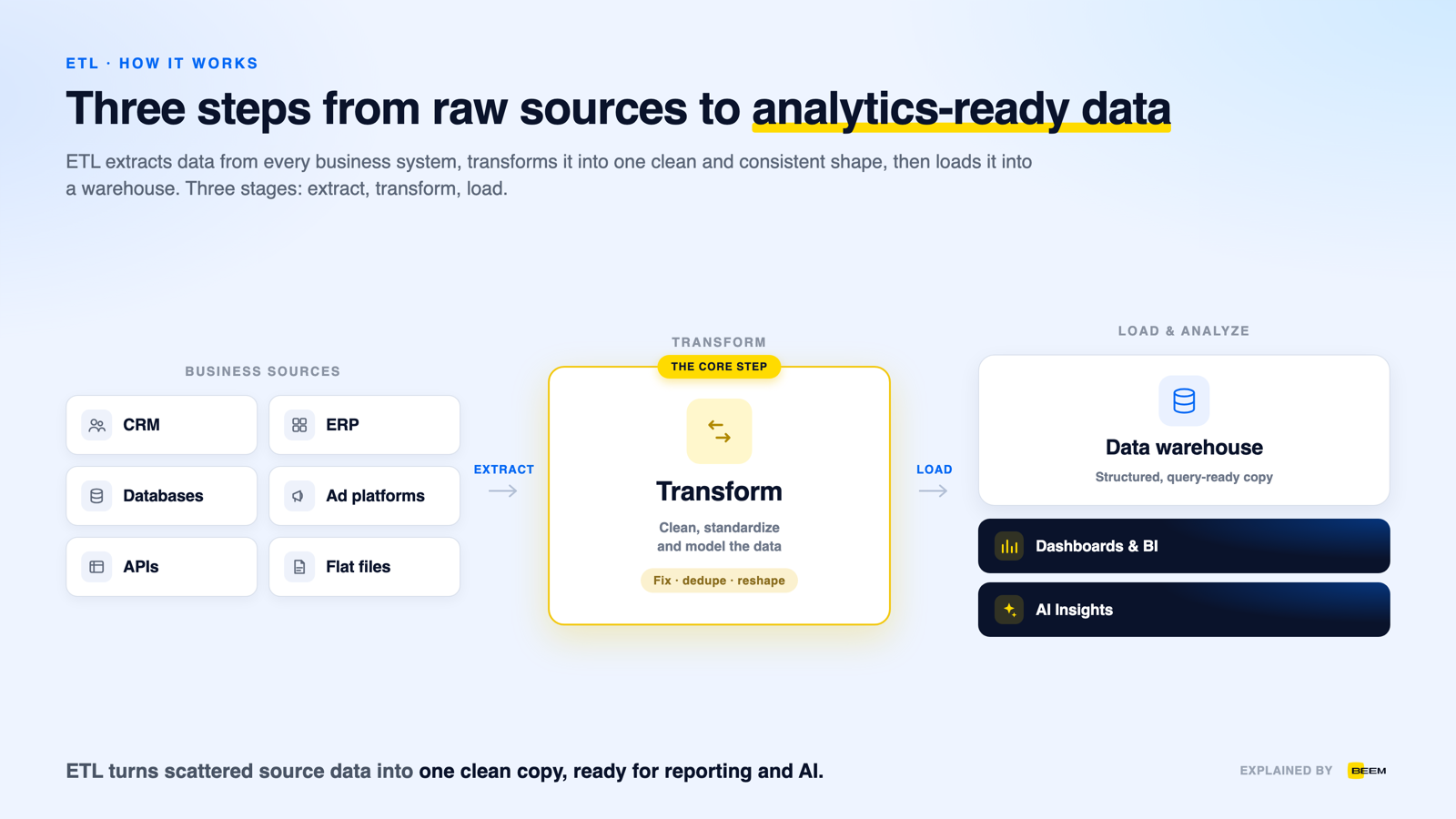
How it works
ETL works in three ordered steps: extract data from source systems, transform it into a clean and consistent shape, then load it into a target warehouse. Each step does one job.
How it compares
The difference between ETL and ELT is the order of the last two steps. ETL transforms data before loading it into the warehouse. ELT loads the raw data first, then transforms it inside the warehouse using its own compute. ELT became popular as cloud warehouses grew powerful enough to run heavy transformations at scale.
ETL suits cases where data must be cleaned or masked before it lands, common in compliance-heavy work. ELT suits large volumes and cloud-native setups where you want raw data available fast. Many teams use both.
| Approach | What it moves | Best for |
|---|---|---|
| ETL | Batches of data into a warehouse, transformed on the way | Reporting and analytics that run on a schedule |
| iPaaS | Records between applications as events occur | Keeping operational tools in sync close to real time |
| Hand-coded scripts | Whatever the script is written to move | Unusual sources with no connector, where someone owns the code |
When your business needs one
- Sales, finance and marketing data have to come together in a warehouse so dashboards read from one source instead of separate exports.
- Data is moving off a legacy system into a new database or cloud warehouse and needs cleaning and reformatting on the way.
- The same customer appears across a CRM, billing and support and has to be merged into one consistent profile.
- Sensitive fields must be masked or validated before the data is allowed to land.
- A wider data pipeline needs clean, structured tables to serve on to BI and AI.
Benefits and limits
- Only clean data lands — transformation happens before the load, so the warehouse holds analysis-ready tables.
- Sensitive fields can be masked or dropped in transit, which matters in compliance-heavy work.
- Modeling is done once, centrally, rather than repeated in every report.
- The steps are ordered and repeatable, which makes runs easy to schedule, monitor and re-run.
- It is a mature pattern with a deep tool ecosystem and well-understood practice.
- Transformation happens before the load, so raw data is not available in the warehouse if a question needs it later.
- Changing the model usually means reprocessing, since the shape was fixed on the way in.
- The transform step runs on separate compute, which is an extra system to size and pay for.
- At large volumes, transforming before loading is slower than letting a cloud warehouse do the work.
- Each source connection is a dependency that breaks when an upstream schema or API changes.
- ETL is extract, transform, load — the order is the whole point, and it is what separates ETL from ELT.
- Transforming before the load keeps the warehouse clean and lets sensitive data be masked in transit, at the cost of not keeping raw data on hand.
- Common tools include Fivetran, Airbyte and Stitch; they move data, but a warehouse, transformation logic and BI still have to be added around them.
Frequently Asked Questions
What does ETL stand for?
ETL stands for Extract, Transform, Load. It is a three-step process that extracts data from source systems, transforms it into a clean and consistent format, and loads it into a target system such as a data warehouse. The three steps run in that order, which is what the name describes.
What is ETL in simple terms?
ETL is the process of collecting data from a company's different systems, cleaning and organizing it, and moving it into one central place for analysis. Think of it as tidying data from many sources into a single, consistent set of tables that reports and dashboards can trust.
What is the difference between ETL and ELT?
The difference is the order of the last two steps. ETL transforms data before loading it into the warehouse, on a separate processing step. ELT loads the raw data into the warehouse first, then transforms it there using the warehouse's own compute. ELT became common with powerful cloud warehouses.
What are the three steps of ETL?
The three steps are Extract, Transform and Load. Extract pulls raw data from source systems like a CRM, ERP, databases and APIs. Transform cleans, standardizes and reshapes that data. Load writes the finished data into a destination, usually a cloud data warehouse or data lake.
What is ETL used for?
ETL is used to bring data from several systems into one place for reporting and analytics. Common uses include business reporting, migrating data from legacy systems to the cloud, building a single customer view across tools, and preparing clean tables that feed dashboards and AI.
What are examples of ETL tools?
Common ETL and data-integration tools include Fivetran, Airbyte and Stitch, which automate extracting and loading data with pre-built connectors. These tools move data, but you still add a warehouse, transformation and BI around them. BEEM combines connectors, transformation and a built-in warehouse in one managed platform.
