
The scenario is familiar in many SMBs: the controller closes the month, pulls the revenue report, and the number doesn't match what sales leadership presented the week before. Two systems, two answers, and no one to quickly settle which is right. The close drags on three extra days while someone traces the gap by hand.
Financial data quality management exists precisely to avoid this kind of episode. Not as a theoretical governance project, but as a set of concrete controls that make sure a number pulled from a report is the same as the one in the system that produced it.
What is financial data quality management?
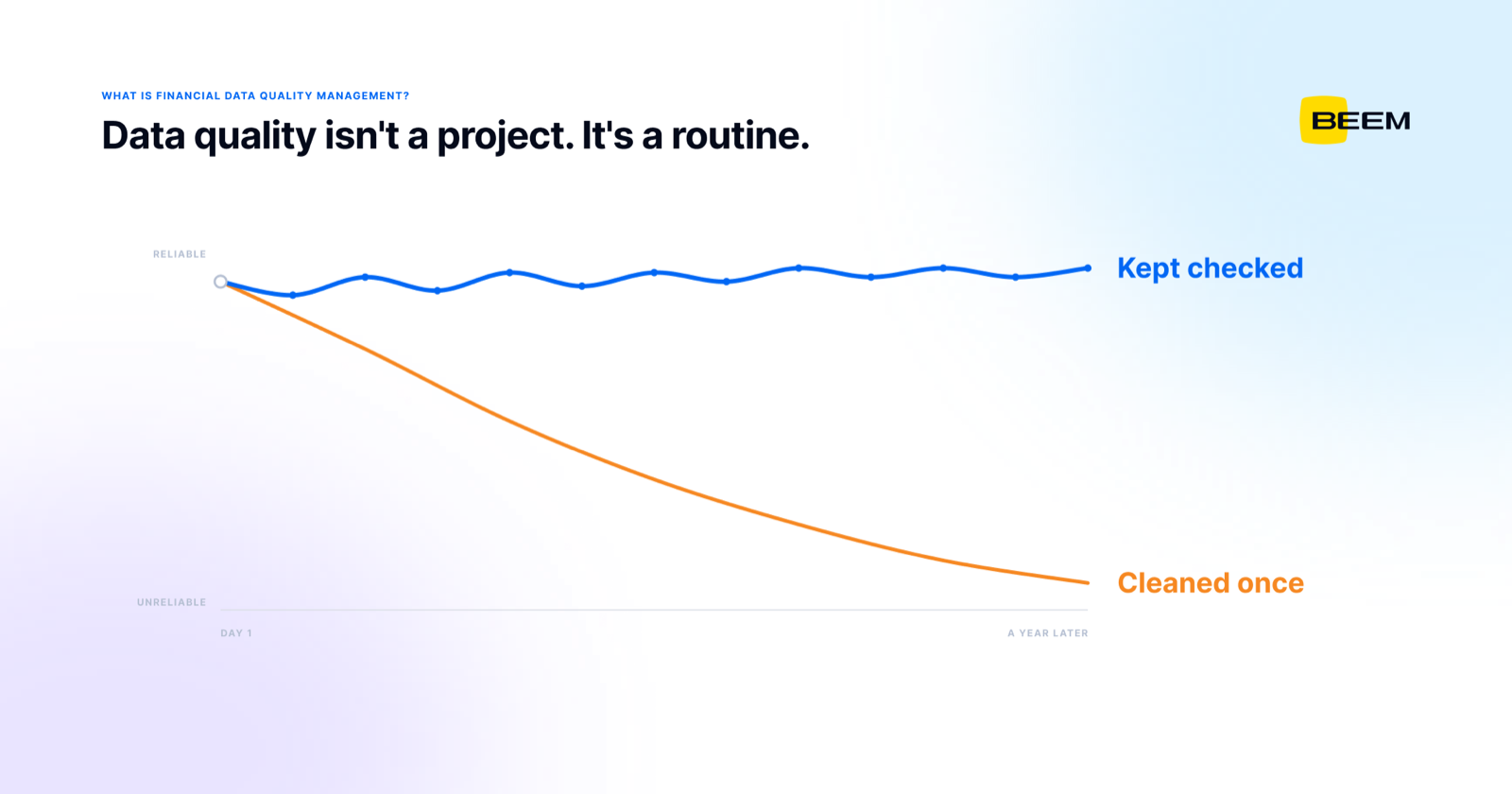
Two things are often confused. Financial data quality is a state: your numbers are accurate or they are not, at a given moment. Data quality management is the process that keeps that state over time, with rules, controls and named owners. A base cleaned once during an ERP project degrades within months. Without a process, there are only successive cleanups.
The generic dimension lists found everywhere cover a lot of ground. In finance, only six really make the difference. Accuracy first: the recorded amount matches the real transaction. Completeness: no entry is missing. Consistency across systems: the same customer, invoice and account carry the same value in the ERP, the CRM and the billing tool. Freshness: a cash report reflecting the state of six days ago helps no one decide. Uniqueness: an invoice booked twice throws off everything downstream. And validity: a due date earlier than the invoice date is an error, even if both fields are filled.
These six dimensions don't carry equal weight in every context. In a services firm, consistency between time tracking and billing matters most. In retail, freshness becomes decisive.
What unreliable financial data changes day to day
The consequences show up in operations well before they appear in an audit report.
The close stretches out. Every unexplained gap between two systems becomes a manual investigation that ties up the most experienced person on the team, the one whose time would be worth more elsewhere. Reports contradict each other across departments, and the leadership meeting turns into a debate about where the numbers came from rather than the decision to make.
Then comes the most damaging effect, because it is silent: loss of trust. Once a team has been burned twice by a wrong number, it rebuilds its own calculations in a local file. Financial reporting accuracy then degrades not just technically but politically, and the company ends up with five unofficial versions of the truth that nobody ever reconciles.
In the end, these are audit adjustments to justify, cash decisions made on stale balances, and reminders sent to customers who have already paid.
Where do financial data errors come from?
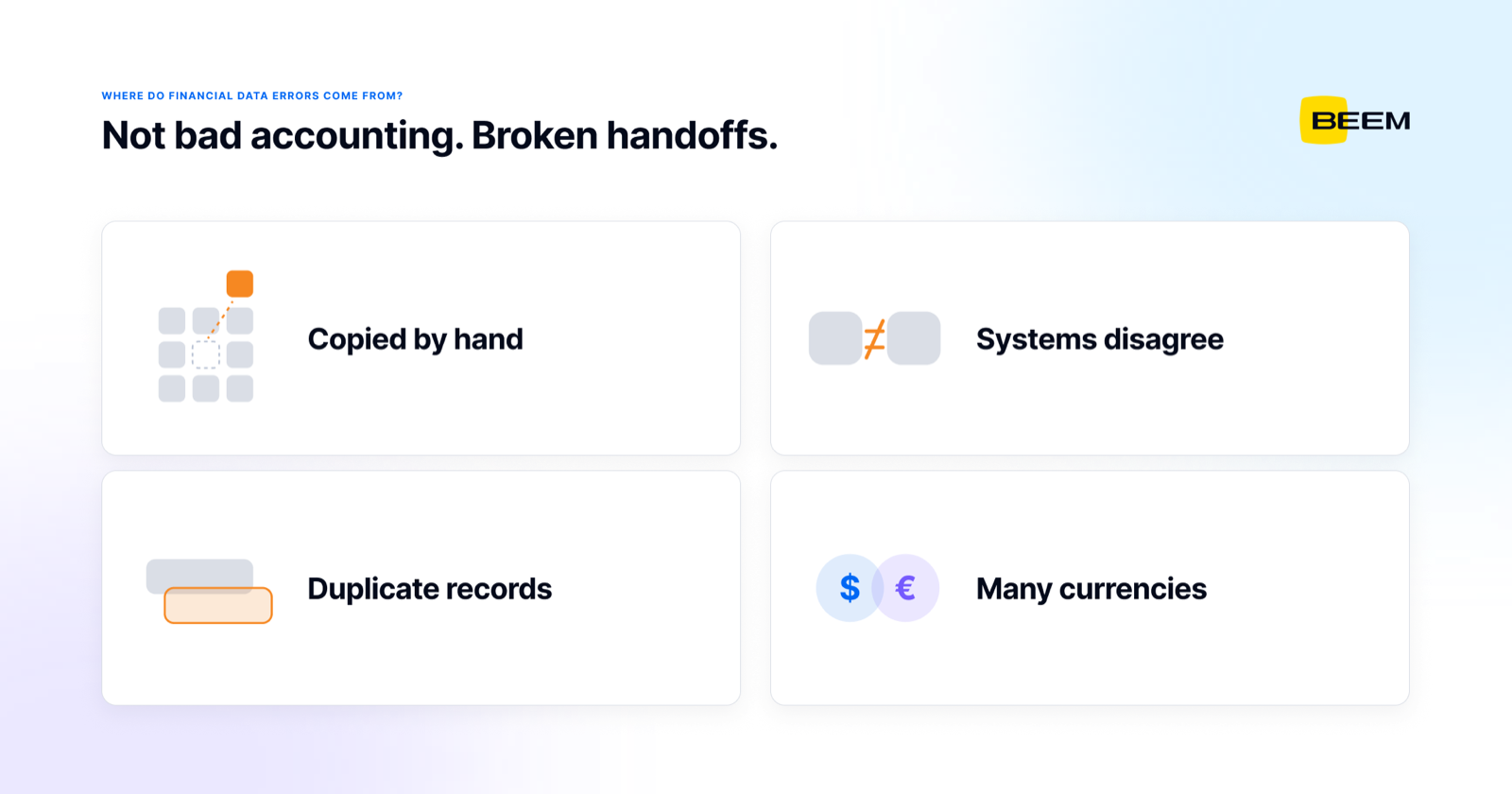
Almost never from a lack of accounting rigor. The causes are structural.
Manual entry and spreadsheets in circulation
An export, a tweak in Excel, a re-import elsewhere. Every manual step is a chance for error, and above all a break in the audit trail: no one knows which version of the file produced the final report. The workbook holding a formula edited by someone who left two years ago is a routine case.
Reconciliation gaps between the ERP, the CRM and billing
A closed opportunity in the CRM doesn't always match an issued invoice, nor the final amount after adjustment. Without an automatic reconciliation rule, these gaps pile up and become impossible to untangle after the fact. Automating them means connecting the ERP, the CRM and billing on a common base, rather than comparing them by hand at month-end.
An inconsistent chart of accounts and reference data
Two accounts serving the same purpose, a cost center created twice during a reorganization, a customer registered under two legal names: financial data management most often stumbles on this reference data, not on the transactions themselves.
Multi-entity and multi-currency consolidation
As soon as there are two legal entities, the question of which exchange rate, which application date and how to eliminate intercompany transactions turns a simple roll-up into a source of recurring gaps.
How to improve financial data quality
The order of operations matters as much as the operations themselves.
Map the flows before fixing anything
Which data comes in, from where, into which system, transformed by what, consumed by whom. This step looks slow, and it is the one most companies skip. Common result: you fix a report for months without ever noticing the error originates three systems upstream.
Validate at the source, then validate the transformations
A control at the entry point always costs less than a fix downstream: enforced date format, required field, plausible value range, consistency rule between two fields. But validating at the source is not enough. Clean data going in can come out wrong after a bad join, a mis-applied currency conversion or an aggregation rule that doubles rows. Transformations and reconciliations must therefore be tested too, with end-to-end controls: the sum of sales in the report must equal the sum of invoices in the source system, with no silent exception.
Automate the controls instead of repeating them by hand
A control that relies on one person's vigilance eventually slips the month they are on vacation. Automated tests that run on every load, with an alert on failure, catch the error before it reaches the leadership report rather than after.
Cleanse and deduplicate continuously
Data cleansing shouldn't be a one-off project with an end date. Vendor deduplication, normalizing legal names and standardizing identifiers are routines. A base cleaned in January turns dirty by June if nothing watches the new entries.
Track error rate, reconciliation gaps and freshness
Three indicators are enough to start: the percentage of records failing validation rules, the number and amount of unexplained reconciliation gaps, and the lag between the real transaction and its availability in the report. They can be measured, tracked over time, and used to demonstrate improvement beyond a mere impression.
Data governance in finance: who owns which number
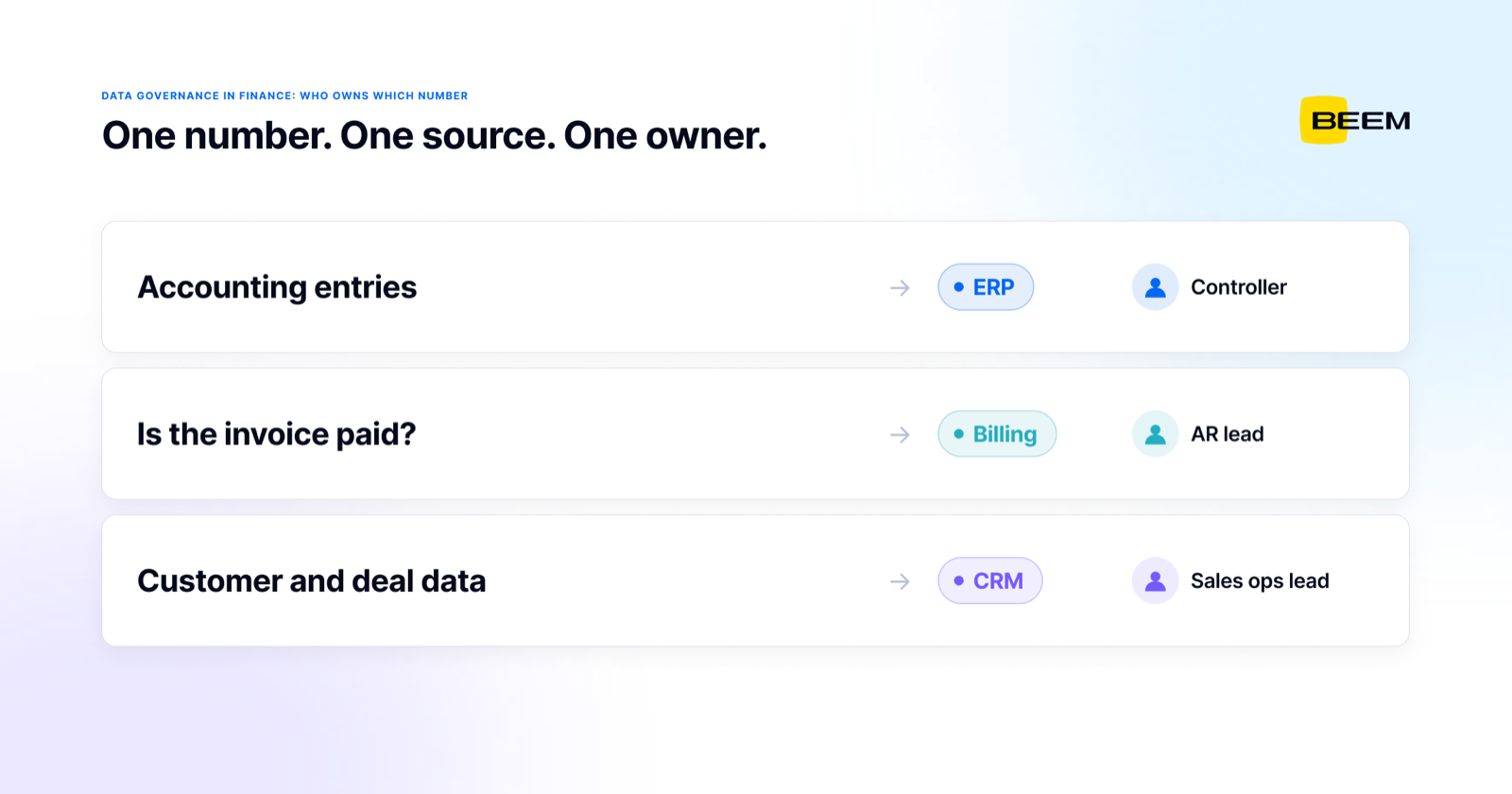
The technical part settles faster than the human part. Data governance in finance is above all about answering one precise question: when two systems show two different values, which one is authoritative and who decides?
That means defining a source of truth per data domain, not one single source for all of finance. The ERP is usually authoritative on accounting entries and the general ledger, the billing tool on the payment status of an invoice, the CRM on commercial data and account ownership. The exact split depends on the systems in place, but the exercise must be done explicitly, written down somewhere, and known to the teams. Until it is, every gap becomes a negotiation again.
Add to that named ownership for each domain (a person, not a department), traceability of changes, and access rules. In Quebec, Law 25 requires governing personal information, including data flowing through financial systems such as billing contact details. Documenting access and retention periods therefore serves two goals at once.
How to manage financial data quality: three approaches
Manual controls and spreadsheets
This is the starting point of almost every SMB, and it works for a while. The limit is not technical, it is human: the setup rests on the memory of two or three people and does not survive their departure.
In-house pipelines
Full control, fine adaptation to the company's specifics, but a maintenance cost SMBs systematically underestimate. A pipeline is not delivered once; it evolves with every change to a source system.
The specialized or managed platform
Tests, monitoring and alerts come with the tool, and day-to-day operation is handled. Quality tests and traceability then come with the platform rather than being rebuilt by hand at every audit. This is the right approach when a company wants reliable numbers without building a data team in-house, which matches the model BEEM runs for its clients in financial and accounting data analysis. Where in-house effort ends and a managed service begins is itself part of the decision.
The choice comes down to four criteria: total cost including internal maintenance time, the skills actually available on the team, the number of systems to reconcile, and the refresh frequency leadership needs. A company that closes monthly doesn't face the same constraints as one tracking cash day by day.
One last point, and it is the most common mistake seen even in rigorous finance teams: they invest in the tool but document neither the reconciliation rules, nor the arbitration between systems, nor the tolerated exceptions. The day the controller changes roles, all that's left is a report nobody dares challenge or correct.
Your financial reports don't match from one system to the next? See how BEEM can automate your controls and reconciliations without tying up your finance team on it every month.
