
Definition
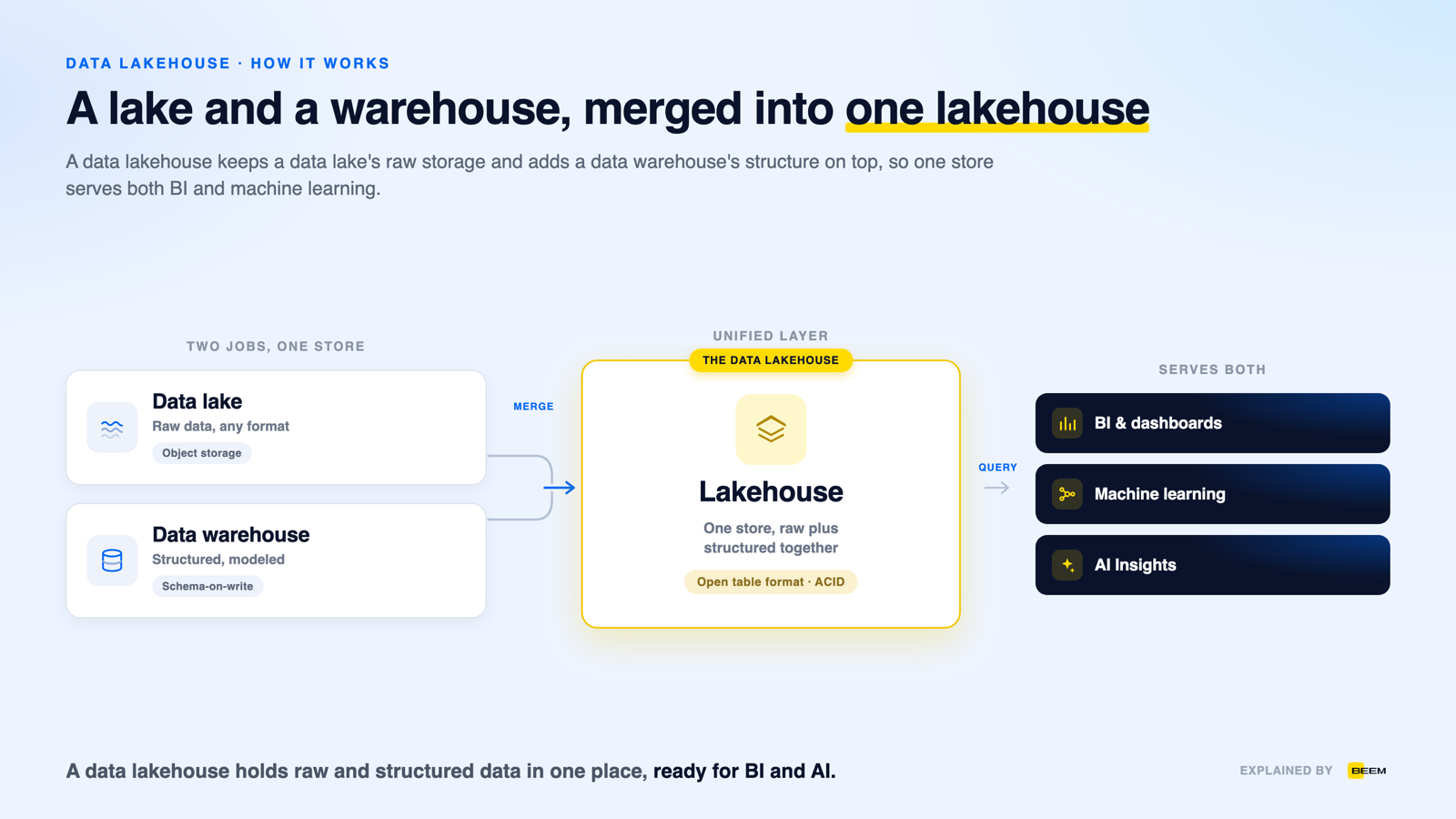
A data lakehouse is a single data platform that combines a data lake's raw storage with a data warehouse's structure and fast queries in one system. It keeps raw data of any type on cheap object storage, then adds a metadata and transaction layer on top so the same data can be queried like a warehouse.
One store serves both BI reporting and machine learning, without copying data between separate systems.
How it works
A data lakehouse works by storing raw files on low-cost object storage, then layering a table format and metadata over them so engines can read and write the data like a structured database. That metadata layer is what turns a plain data lake into a lakehouse.
How it compares
A data warehouse stores structured, modeled data for reporting. A data lake stores raw data of any type for exploration. A data lakehouse combines both, keeping raw data on cheap storage and adding warehouse-style structure and transactions on top.
Pick a warehouse when the goal is clean reporting from known data. Pick a lake when you need to keep raw, varied data for data science. A lakehouse suits teams that want both from one store and are ready to run the open table format that makes it work.
| Store | Data type | Best for |
|---|---|---|
| Data warehouse | Structured, modeled | Reporting, dashboards, BI |
| Data lake | Raw, any format | Exploration, data science |
| Data lakehouse | Raw plus structured | BI and machine learning together |
When your business needs one
- You are running a data lake and a warehouse side by side and copying data between them.
- Machine learning work needs raw and unstructured data that a warehouse cannot hold.
- BI and data science are drifting apart because each reads a different copy of the same data.
- Warehouse storage costs are climbing on data that is rarely queried.
- You want engine choice and open formats rather than data locked inside one vendor's database.
Benefits and limits
- One copy of the data — BI and machine learning read the same tables, so there are fewer pipelines and less drift between systems.
- Lower storage cost — raw data sits on cheap object storage instead of pricier warehouse storage.
- Handles any data type — structured, semi-structured and unstructured data live in one place, which suits AI and machine learning work.
- Warehouse-style reliability — ACID transactions and schema enforcement keep queries consistent on raw storage.
- Open formats — open table formats reduce lock-in, so different engines can read the same data.
- Lakehouse platforms expect a data team to run ingestion, modeling and governance around them, which fits large engineering organizations more than lean ones.
- The open table format is a real operating commitment: file layouts, compaction and table maintenance do not run themselves.
- For plain BI on known, structured data, a warehouse is simpler and usually faster to get right.
- Without governance, cheap raw storage invites a swamp of data nobody can find or trust.
- The ecosystem is still moving, so table formats and engine support change faster than warehouse tooling.
- A lakehouse is a data lake plus a metadata and transaction layer, which gives raw object storage warehouse-style structure and reliability.
- Its point is one copy of the data serving both BI and machine learning, instead of a lake and a warehouse kept in sync.
- The best-known platforms are Databricks and Snowflake, alongside the open table formats Delta Lake, Apache Iceberg and Apache Hudi that make the pattern possible.
Frequently Asked Questions
What is a data lakehouse in simple terms?
A data lakehouse is one system that does the job of both a data lake and a data warehouse. It keeps raw data of any type on cheap storage, then adds structure on top so the same data can be used for reports and for machine learning. It saves teams from running two separate systems and copying data between them.
What is the difference between a data lakehouse and a data warehouse?
A data warehouse stores structured, modeled data and is tuned for clean reporting. A data lakehouse also handles raw and unstructured data on cheap object storage, then adds warehouse-style structure and transactions on top. A warehouse suits BI first, while a lakehouse aims to serve BI and machine learning from one store.
What is the difference between a data lake and a data lakehouse?
A data lake stores raw data of any type but has no built-in structure, so it can turn into a hard-to-query swamp. A data lakehouse adds a metadata and table layer on top of that raw storage, bringing schema, versioning and ACID transactions. In short, a lakehouse is a data lake with warehouse-style reliability added.
How does a data lakehouse work?
A data lakehouse stores raw files in open formats like Parquet on object storage such as Amazon S3. An open table format like Delta Lake, Apache Iceberg or Apache Hudi tracks those files as tables and adds schema and ACID transactions. SQL and machine learning engines then query the same tables directly.
Is Databricks a data lakehouse?
Yes. Databricks popularized the lakehouse and builds on Delta Lake and Apache Spark to combine data lake storage with warehouse-style querying. Snowflake and open engines built on Apache Iceberg support similar lakehouse patterns. Each stores data on object storage and adds a transactional table layer for analytics and machine learning.
Does BEEM offer a data lakehouse?
No. BEEM is warehouse-based, with a built-in data warehouse on Amazon Redshift rather than a raw open-format lakehouse. BEEM is the managed all-in-one option when you want a warehouse, dashboards and AI in one service, with 750+ connectors and plans from $899 per month. For large-scale machine learning on raw data, a lakehouse platform fits better.
