
Definition
The modern data stack is a cloud-native architecture assembled from specialized, interchangeable services rather than a single monolithic platform. Its usual layers are ingestion, a cloud data warehouse, a transformation layer, and business intelligence or analytics on top, with the warehouse acting as the shared center. It is a pattern rather than a product, and two organizations can both run a modern data stack with no vendor in common.
How it works
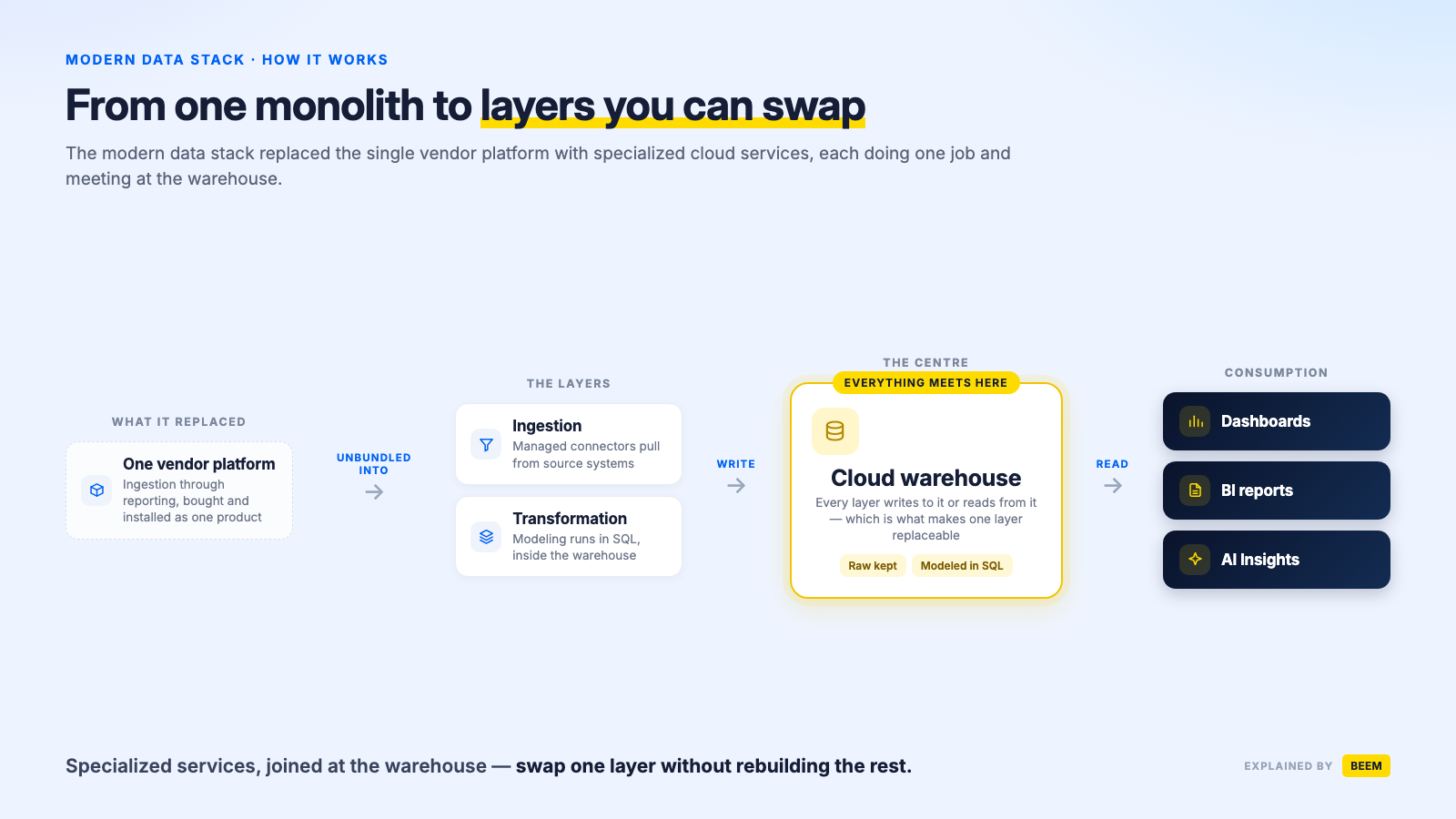
What holds the stack together is the warehouse. Ingestion tools write into it, transformation runs inside it, and every consumption tool reads from it, which is why one layer can be swapped without rebuilding everything around it. The layers are normally described as ingestion, storage, transformation and consumption, with governance, orchestration and quality monitoring cutting across all of them rather than sitting at one point in the chain.
How it compares
The modern data stack is usually defined against what it replaced: a single vendor's platform covering the whole chain, running on hardware you owned.
| Legacy monolithic platform | Modern data stack | |
|---|---|---|
| Shape | One vendor covering ingestion through reporting | Specialized services per layer, connected through the warehouse |
| Where it runs | On-premise hardware, capacity bought up front | Cloud services, capacity billed as it is used |
| Changing a component | A replatforming project | Swap one layer, leave the rest in place |
| Time to first value | Months, including procurement and installation | Days to weeks, starting from one source |
| Main cost | Licences and hardware, paid ahead of use | Consumption, plus the integration work between tools |
When your business needs one
- Your reporting depends on exports from several systems being reconciled by hand.
- The current platform cannot be changed in one place without a project.
- You need to add a source and the honest estimate is months.
- Capacity has to be bought up front for demand you cannot predict.
- Business teams have outgrown spreadsheets but there is no shared, governed source to move them to.
Benefits and limits
- Each layer can be chosen and replaced on its own merits, so one bad decision is not permanent.
- Costs scale with use rather than with capacity bought in advance.
- Managed connectors and cloud warehouses remove most of the infrastructure work, so a small team can run it.
- A single warehouse at the center gives every tool the same numbers to read from.
- More vendors means more contracts, more security reviews and more places a failure can originate.
- The integration between the layers becomes your responsibility, because nobody sells you the seams.
- Consumption pricing is flexible but can be unpredictable, particularly when transformations run frequently over large tables.
- The pattern assumes cloud, so where data cannot leave a jurisdiction or a building, parts of it are hard to apply.
- Modern data stack is a marketing term as much as an architecture, and the label says nothing about whether a given assembly is well designed.
- The modern data stack is a pattern: specialized cloud services for ingestion, warehousing, transformation and BI, joined at the warehouse.
- Its advantage is modularity, since layers can be replaced individually instead of replatforming.
- Its cost is integration work and vendor sprawl, which is why platforms covering several layers at once have become common.
Frequently Asked Questions
What are the layers of the modern data stack?
Usually four: ingestion, which gets data out of source systems; a cloud data warehouse for storage and compute; transformation, which models raw data into usable tables, normally in SQL; and consumption, meaning BI, dashboards and analytics. Governance, orchestration and quality monitoring run across all four.
Is the modern data stack still modern?
The term dates from the mid-2010s and the architecture is now mainstream rather than novel. What has changed most recently is consolidation, with several layers arriving from a single vendor, and the addition of AI-assisted querying on top of the same warehouse.
Does a small company need a modern data stack?
Not a large one. The pattern scales down well, and one warehouse, a handful of connectors and a BI tool already is a modern data stack. The point is the architecture, not the number of vendors.
Is the modern data stack the same as ELT?
No, but they arrived together. ELT is the sequence, meaning load raw data first and transform it inside the warehouse. The modern data stack is the wider architecture that the sequence made practical.
What is the main criticism of the modern data stack?
Fragmentation. Assembling five or six tools produces integration work, overlapping bills and unclear ownership when something breaks, which is why many teams now prefer a platform that covers several layers at once.
Where does BEEM fit in the modern data stack?
BEEM covers several layers in one platform: ingestion through 750+ connectors, a managed Amazon Redshift warehouse, SQL transformation with versioning and tests, dashboards and plain-language questions through AI Insights, and reverse ETL flows that push modeled results back into operational tools. It also connects to existing BI tools such as Power BI, Tableau and Looker rather than replacing them.
