
Definition
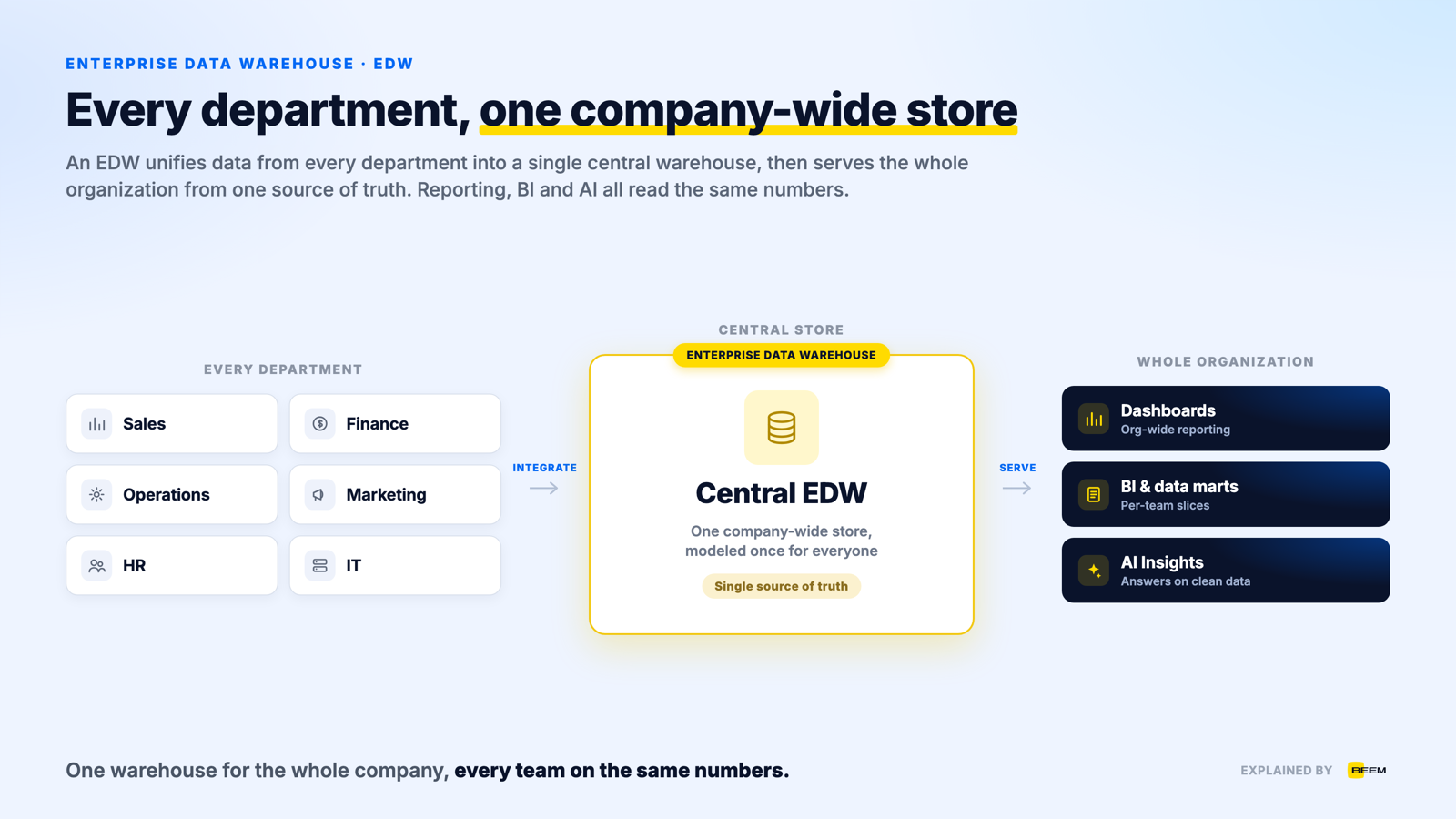
An enterprise data warehouse (EDW) is a company-wide central warehouse that unifies data from every department, such as sales, finance, operations, marketing and HR, into one store for organization-level reporting and analytics.
It gives the whole business a single, consistent source of truth instead of numbers scattered across separate systems.
How it works
An enterprise data warehouse works by collecting data from every department's systems, integrating it into one consistent model, and serving it to the whole organization for reporting. Most EDWs are built in three layers: staging, integration and presentation.
How it compares
An enterprise data warehouse is a data warehouse built at organization-wide scale, while a data mart is a smaller subset focused on one department. All three store structured data for analysis, but they differ in scope and audience.
The line between a data warehouse and an EDW is mostly one of scale. A regular warehouse might serve a few teams, while an EDW is the organization-wide version that every function reads from. A data mart is often a slice of the EDW, filtered down for one team so its reports run fast.
| Store | Scope | Best for |
|---|---|---|
| Enterprise data warehouse | Whole organization | Company-wide reporting and BI |
| Data warehouse | One or more departments | Team and cross-team analytics |
| Data mart | Single department or subject | Focused, fast departmental reports |
When your business needs one
- Departments report different figures for the same metric, and reconciling them has become a monthly ritual.
- Separate team warehouses or data marts have grown up independently and no longer agree with each other.
- Leadership needs to connect activity across functions, such as marketing spend to product usage to revenue.
- Terms like revenue, customer and churn are defined differently in each system.
- Company-wide history is needed for planning, audit or regulatory reporting.
Benefits and limits
- One source of truth across departments — finance, sales and operations all read the same modeled data instead of separate exports.
- Company-wide history in one place — an EDW keeps years of data across every function, so you can track trends and compare periods.
- Consistent definitions — shared models mean a metric like revenue or churn means the same thing everywhere.
- Heavier analytics, safely — large queries run in the warehouse without slowing the apps that serve customers.
- Ready for governed AI — clean, structured, company-wide data is what BI tools and AI assistants need to give reliable answers.
- Building one is a long programme, because every department's systems and definitions have to be agreed on and modeled.
- The hard part is organizational rather than technical: functions have to give up their own version of the numbers.
- A company-wide schema is slow to change, so new sources and new metrics take longer to land than in a single-team warehouse.
- Cost scales with breadth, covering storage, compute and the people who maintain the model.
- Departments often still need data marts on top, which adds a layer to keep in sync.
- An EDW is the organization-wide form of a data warehouse: every department feeds it, and every department reports from it.
- It is usually built in three layers — staging for raw arrivals, integration for the company-wide model, presentation for dashboards, BI and department data marts.
- Common platforms include Snowflake, Google BigQuery and Amazon Redshift; each handles storage and query at organization scale and leaves ingestion, modeling and BI to be added around it.
Frequently Asked Questions
What is an enterprise data warehouse in simple terms?
An enterprise data warehouse (EDW) is one central store that collects data from every department in a company, cleans it, and keeps it organized so the whole organization reports from the same numbers. It is the largest form of data warehouse, built to serve the entire business rather than a single team.
What is the difference between a data warehouse and an enterprise data warehouse?
The difference is mostly scale. A data warehouse may serve one or a few departments, while an enterprise data warehouse is the organization-wide version that every function reads from. An EDW holds company-wide history and enforces shared definitions so all departments report consistently.
What is the difference between an EDW and a data mart?
An enterprise data warehouse serves the whole organization, while a data mart is a smaller subset focused on one department or subject. A data mart is often a filtered slice of the EDW, which lets a single team run fast, targeted reports without querying the entire warehouse.
What are the main layers of an enterprise data warehouse?
Most enterprise data warehouses have three layers. The staging layer receives raw data from source systems, the integration layer cleans and models it into one company-wide schema, and the presentation layer serves that data to dashboards, BI and AI, often through department data marts.
What are common enterprise data warehouse platforms?
Common enterprise data warehouse platforms include Snowflake, Google BigQuery and Amazon Redshift. Each stores and queries structured data at organization scale and leaves ingestion, transformation and BI for you to add around it. BEEM runs its built-in warehouse on Amazon Redshift.
Can a mid-market company use an enterprise data warehouse?
Yes. A managed platform gives mid-market teams an EDW-style central store without the enterprise setup cost. BEEM includes a built-in data warehouse on Amazon Redshift with 750+ connectors, dashboards and AI Insights. Plans start at $899 per month and first dashboards land in as little as 2 weeks.
