
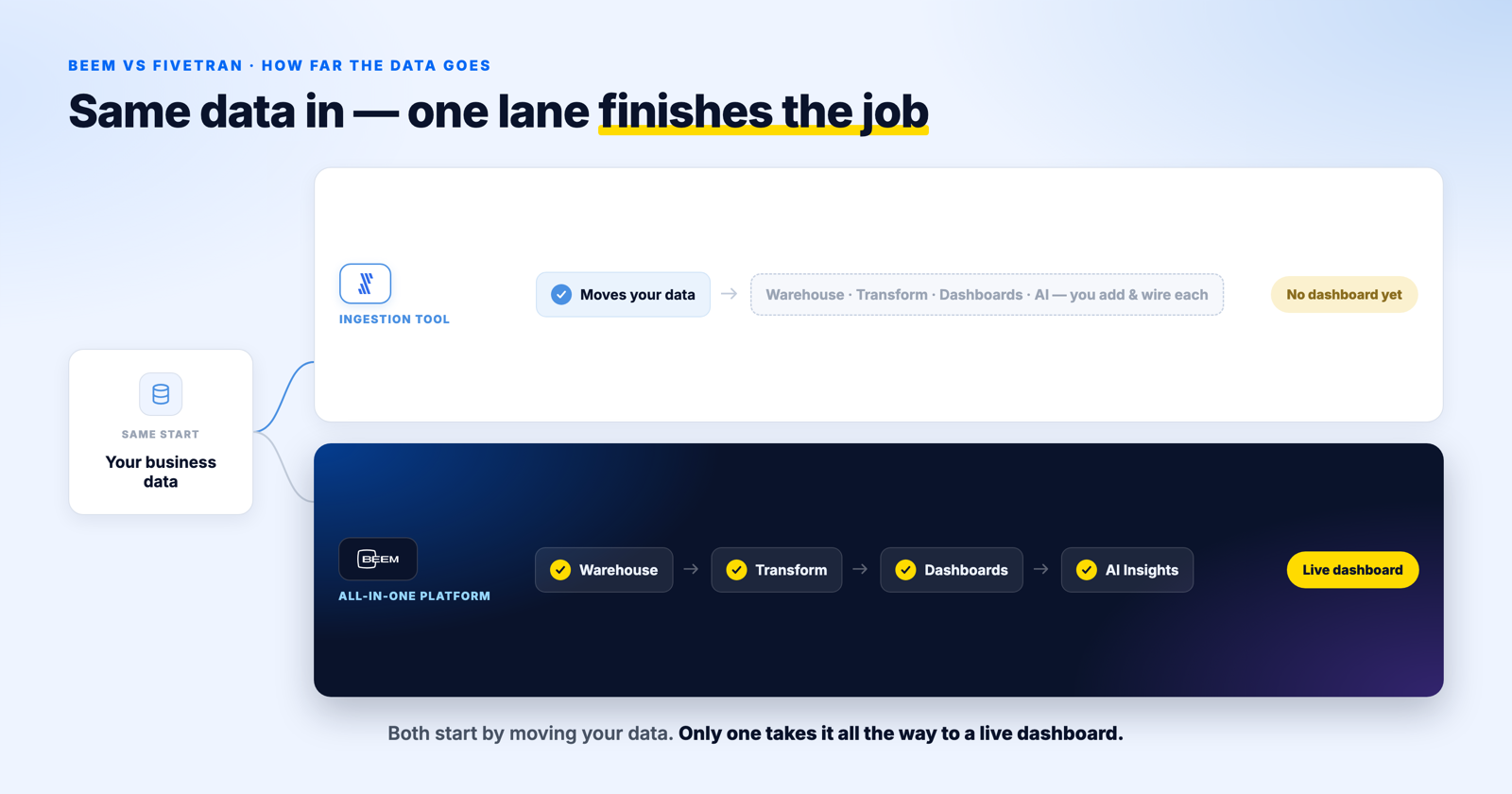
Choosing between BEEM vs Fivetran comes down to one question. Do you want a tool that moves your data, or a platform that turns it into dashboards? Fivetran is a focused ingestion service. BEEM is an all-in-one data platform that includes ingestion and everything after it.
They are often compared because both start at the same place, getting data out of your business systems. From there they go in different directions. This guide breaks down what each one does, where they differ, and which fits your team.
What each one is
BEEM is a managed data platform. It connects to 750+ sources, stores your data in a built-in warehouse on Amazon Redshift, transforms it with SQL, and builds dashboards with AI Insights. A managed team is available when you need help, so you are not running the pipeline alone.
Fivetran is a managed data-ingestion tool. It moves data from your sources into a warehouse you provide, on a schedule, and maintains the connectors. It is trusted for reliable extraction and loading. It does not store your data long term or build dashboards on top of it.
BEEM vs Fivetran at a glance
| Capability | BEEM | Fivetran |
|---|---|---|
| Data ingestion | 750+ managed connectors | Managed connectors (core product) |
| Built-in warehouse | Yes, on Amazon Redshift | No, bring your own |
| Transformation | Yes, SQL layer | Limited, post-load |
| Dashboards | Yes, built in | No |
| AI insights | Yes, on AWS | No |
| Managed expert team | Available when you need it | No, self-serve tool |
| Pricing model | From $899/mo + usage ($0.60/DPU, $0.10/GB) | Usage-based, active rows |
| Compliance | SOC2, PIPEDA, GDPR | SOC2, GDPR, and others |
| Data residency | AWS Canada (ca-central-1) | Multi-region |
Where they differ
Scope: one platform vs one step
This is the core difference. Fivetran does ingestion, and it does it well. BEEM does ingestion and then everything after it, storage, transformation, dashboards, and AI, in one platform. With Fivetran you assemble the rest of the stack yourself. With BEEM it is already connected.
The warehouse
Fivetran needs a warehouse to load into, like Snowflake, BigQuery, or Redshift. You buy and manage it separately. BEEM includes a built-in warehouse on Amazon Redshift. So storage is part of the platform, not another vendor and another bill.
Who runs it
Fivetran is a self-serve tool. It maintains the connectors, but your team owns the pipeline and the tools around it. BEEM is a platform with a managed team available when you need help. That suits teams without data engineers on staff.
Pricing
Fivetran bills on monthly active rows, so costs move with your data volume. BEEM plans start at $899/mo, plus usage-based data processing from $0.60 per DPU and storage at $0.10/GB. You pay one vendor for the whole stack — connectors, warehouse, transformation, dashboards, and AI — instead of separate bills for each. Our Fivetran pricing guide breaks the model down in detail.
AI and dashboards
Fivetran stops at loading data, so dashboards and AI live in other tools. BEEM includes dashboards and AI Insights, which answer plain-language questions on AWS. You get from source to insight without leaving the platform.
When to choose Fivetran
Fivetran is the better choice when you already have the rest of the stack. If you run a warehouse, a BI tool, and a data team, and you want reliable, proven ingestion at scale, Fivetran is focused and does that one job well. It also fits when you have unusual sources and want a specialist tool for that job.
When to choose BEEM
BEEM is the better choice when you want the whole outcome, not just the data movement. If you are a mid-market team without a data-engineering staff, and you want dashboards without assembling a stack, BEEM covers the full path. It uses fully managed connectors under the hood, so ingestion is reliable, and it adds the warehouse, transformation, dashboards, and AI around it. First dashboards can be live in as little as 2 weeks, often at 40-60% less than building an in-house solution. For a related comparison, see BEEM vs Peliqan. If you are weighing ingestion tools directly, our Fivetran vs Airbyte comparison breaks them down.
See your own data in a dashboard, not a demo dataset. BEEM connects a source and shows you a live dashboard built on it, so you can judge with your own numbers. Compare the full platform and pricing, or book a demo.
