BEEM vs Peliqan

BEEM vs Peliqan compared: connectors, warehouse, AI, write-back, pricing, and residency. See where they overlap and which platform fits your team.
Navigate Quickly

BEEM vs Peliqan is a choice between two all-in-one data platforms, not a platform against a point tool. Both pull your business data into one place, store it in a built-in warehouse, let you transform it with SQL, and show it on dashboards. So the real decision is about what you want to do once the data is centralized.

BEEM leans toward managed reporting, natural-language AI, and Canadian data residency. Peliqan leans toward low-code data apps and pushing data back into your business tools. This comparison lays out what each one is, where they overlap, and where they genuinely differ, so you can match the platform to your team.

What each one is

Both platforms centralize data and serve analytics, but they were built with different centers of gravity. Here is a plain definition of each.

BEEM

BEEM is a fully managed cloud data platform for mid-market companies that want reporting without running infrastructure. It combines 750+ pre-built connectors, a built-in warehouse on Amazon Redshift, SQL transformation, dashboards, and AI Insights in one platform. A team of data experts is available when you need them. Plans start at $899 per month, data stays in Canada on AWS ca-central-1, and the platform is SOC2, PIPEDA, and GDPR compliant. You can read how it replaces an assembled stack in our BEEM vs Fivetran comparison.

Peliqan

Peliqan is an all-in-one data platform popular with agencies and SaaS teams. It offers 300+ connectors, a built-in warehouse, SQL and low-code Python, and one-click integration with BI tools like Power BI and Tableau. Its signature features are low-code data apps built on Streamlit and write-back, so teams can build interactive apps and push data back into business systems. Peliqan is SOC2 and ISO 27001 certified, GDPR compliant, and its hosting is EU-focused. It prices per connected data source, so cost scales with how many sources you sync.

BEEM vs Peliqan at a glance

Both platforms cover the same core: connectors, a warehouse, SQL, and dashboards. The table below shows where they match and where each one pulls ahead.

CapabilityRecommendedBEEMPeliqan
Connectors750+ pre-built connectors300+ pre-built connectors
Built-in warehouseYes, on Amazon RedshiftYes, built-in
TransformationSQLSQL and low-code Python
DashboardsBuilt-in, core of the productBuilt-in, plus BI tool integration
AIAI Insights in plain language, on AWS BedrockText-to-SQL and an MCP server
Write-back and activationNot offeredYes, reverse-ETL and write-back
Low-code data appsNot offeredYes, Streamlit-based
Managed serviceExpert team availableSelf-serve, with a partner network
Pricing modelFlat plans from $899/moPer connected data source
ComplianceSOC2, PIPEDA, GDPRSOC2, ISO 27001, GDPR
Data residencyCanada, AWS ca-central-1EU-focused hosting
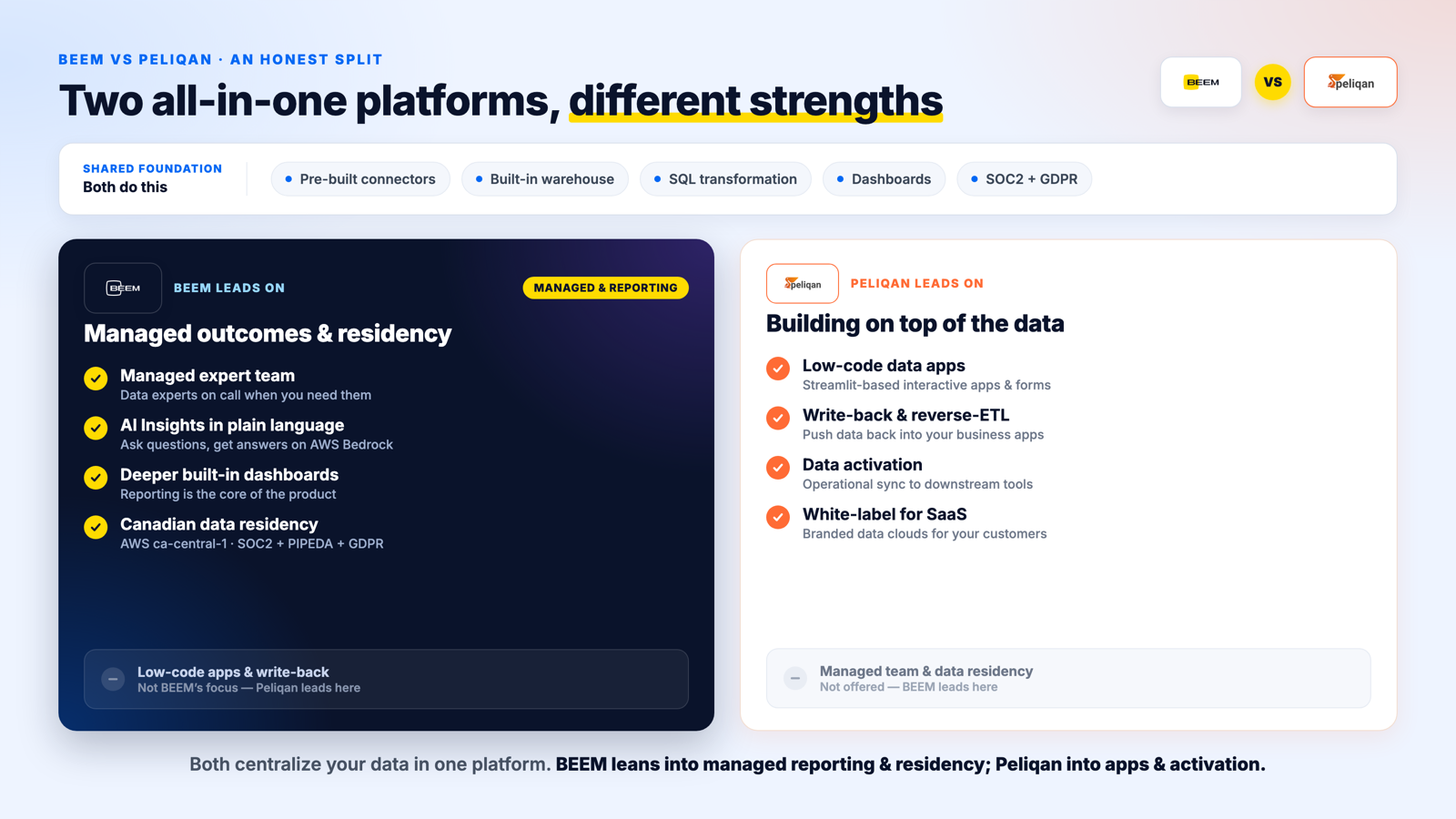
Side-by-side capability map of BEEM and Peliqan showing a shared foundation of connectors, warehouse, SQL, and dashboards, with BEEM distinct on managed team, AI Insights, and Canadian residency, and Peliqan distinct on low-code apps, write-back, and data activation
BEEM and Peliqan share a data foundation and diverge on their strengths.

Where they differ

The overlap is real, so the choice comes down to five dimensions where the two platforms make different bets.

Managed team vs self-serve

BEEM comes with a team of data experts you can call on to build and maintain your reporting. That suits companies without data engineers on staff. Peliqan is a self-serve tool with a partner network of agencies and consultants. If you have technical people or an implementation partner, Peliqan gives them room to work. If you don't, BEEM does the job for you.

AI and dashboards

Both platforms include AI and dashboards, but they aim them differently. BEEM builds reporting as the core product, with dashboards and AI Insights that answer questions in plain language on AWS Bedrock. Peliqan offers text-to-SQL and an MCP server aimed at developers and AI agents. Choose BEEM if business users need answers without SQL. Choose Peliqan if your team writes queries.

Data activation and low-code apps

This is Peliqan's clearest edge. It supports write-back, reverse-ETL, and data activation, so you can push clean data back into Salesforce, HubSpot, or another business app. It also builds low-code data apps on Streamlit. BEEM does neither. BEEM centralizes data and reports on it, but it does not send data back out or build custom apps.

Compliance and data residency

Both platforms are SOC2 certified and GDPR compliant, so the split is geography. BEEM keeps data in Canada on AWS ca-central-1 and adds PIPEDA compliance, which matters for Canadian and regulated companies. Peliqan is ISO 27001 certified with EU-focused hosting. For Canadian data residency, BEEM is the direct fit. For EU hosting, Peliqan is at home.

Pricing model

The models are structured differently. BEEM charges flat monthly plans that start at $899 and include the warehouse, connectors, dashboards, and AI. Peliqan prices per connected data source, so the bill grows with the number of sources. Flat plans are easier to forecast. Per-source pricing can be cheaper when you sync only a few sources. Model your own source count before you compare.

When to choose Peliqan

Peliqan is the better fit when building on top of your data matters as much as reporting on it.

  • You want to push data back into business apps with write-back or reverse-ETL.
  • You want to build low-code data apps and internal tools on Streamlit.
  • You have developers or an implementation partner who like Python and SQL.
  • You are a SaaS company offering white-label data clouds to your own customers.
  • EU hosting fits your requirements.

When to choose BEEM

BEEM is the better fit when you want managed reporting and Canadian residency without running the stack yourself.

  • You want dashboards and reports without hiring data engineers. A single data engineer costs $120K+ per year.
  • You want business users to ask questions in plain language and get answers.
  • You need data to stay in Canada on AWS ca-central-1, with SOC2, PIPEDA, and GDPR.
  • You prefer a flat, predictable plan from $899 per month over usage-based billing.
  • You want an expert team available when you need help, not just software.

To be clear about fit, neither platform is a strict upgrade on the other. If your priority is activation, apps, and developer flexibility, Peliqan earns the look. If your priority is managed reporting, plain-language AI, and Canadian residency, BEEM is built for that. For a wider view of the category, see our Snowflake competitors guide and our roundup of Fivetran alternatives.

See your own data in a dashboard. BEEM connects your systems and delivers your first dashboards in as little as 2 weeks, so you can judge with your own numbers. Book a demo or explore the platform and integrations.

About the author
Alexandre Lataille, Co-Founder and CEO of BEEM
Alexandre Lataille
Co-Founder & CEO
Alexandre Lataille is the co-founder and CEO of BEEM. He leads the team behind a fully managed data platform for mid-market companies that want dashboards, automated reports, and AI insights without running data infrastructure.
August 4, 2026

FAQs

What is the best alternative to Databricks?

There is no single best alternative. The right one depends on why you are leaving. If cost is the issue, a lean warehouse like Google BigQuery or Amazon Redshift lets you pay for the compute you use. If complexity is the issue, a managed all-in-one platform like BEEM covers connectors, warehouse, dashboards and AI Insights without a data team. If you need petabyte machine learning or streaming, staying on Databricks is the honest answer.

Is there a cheaper alternative to Databricks?

Yes. Serverless warehouses such as BigQuery and Redshift bill for the compute you actually use, which can cut costs for steady workloads. For predictable spend, BEEM uses flat plans that start at $899 per month and include the warehouse, dashboards and AI Insights, so you avoid consumption-based bill spikes.

Can I replace Databricks with a data warehouse?

If you mainly use Databricks as a warehouse with dashboards on top, yes. A warehouse like Snowflake, BigQuery or Redshift can take over the SQL analytics. You will still add ingestion, transformation and BI around it, or choose a platform like BEEM that includes those layers.

What is the difference between Databricks and Snowflake?

Databricks is a lakehouse built for Spark, machine learning and data engineering, and it assumes an engineering team. Snowflake is a cloud data warehouse focused on SQL analytics, billed by per-second credits. Both are strong at scale, and both still need ingestion, transformation and BI tools around them.

How hard is it to migrate off Databricks?

It depends on the workload. Moving SQL analytics and dashboards to a warehouse is fairly straightforward. Heavy Spark pipelines and custom machine learning are harder to move and may be worth keeping on Databricks. A managed platform like BEEM handles ingestion and modeling for you, which reduces the migration effort for mid-market analytics.

Does BEEM replace Databricks?

For mid-market analytics, yes. BEEM covers connectors, a warehouse on Amazon Redshift, transformation, dashboards and AI Insights as one managed service. It does not replace Databricks for petabyte machine learning, real-time streaming or self-hosting. The difference is ownership, not raw capability.

Is BEEM or Peliqan better?

Neither is better across the board. BEEM is stronger for managed reporting, plain-language AI, and Canadian data residency. Peliqan is stronger for write-back, data activation, and low-code data apps. The right pick depends on whether you want to report on your data or also build on top of it.

Do BEEM and Peliqan both include a data warehouse?

Yes. Both are all-in-one platforms with a built-in warehouse, connectors, SQL, and dashboards. BEEM runs its warehouse on Amazon Redshift. Peliqan includes its own built-in warehouse. You do not need to buy a separate warehouse for either one.

Does BEEM support write-back or reverse-ETL like Peliqan?

No. Write-back, reverse-ETL, and data activation are Peliqan strengths, not BEEM features. BEEM centralizes data and reports on it with dashboards and AI Insights, but it does not push data back into business apps. If activation is a hard requirement, Peliqan fits better.

How is pricing different between BEEM and Peliqan?

BEEM charges flat monthly plans that start at $899 and include the warehouse, connectors, dashboards, and AI. Peliqan prices per connected data source, so cost scales with the number of sources. Flat plans are easier to forecast, while per-source pricing can be cheaper for a small number of sources.

Which platform is better for Canadian data residency?

BEEM. It keeps data in Canada on AWS ca-central-1 and is SOC2, PIPEDA, and GDPR compliant. Peliqan is SOC2 and ISO 27001 certified and GDPR compliant, with EU-focused hosting. For Canadian residency requirements, BEEM is the direct fit.

Can BEEM feed a BI tool like Power BI or Tableau?

Yes. BEEM has built-in dashboards and can also feed external BI tools such as Power BI, Tableau, and Looker from its warehouse. Peliqan offers similar one-click BI tool integration. Both let you keep an existing BI tool while they handle the data layer underneath.

What is the best alternative to Tableau?

The best alternative depends on your stack. Power BI is the closest rival for Microsoft teams, Looker suits governed metrics, and Metabase and Google Looker Studio are strong low-cost options. BEEM is the best fit for mid-market teams that want dashboards plus the connectors, warehouse, and transformation behind them in one managed platform.

Is Power BI better than Tableau?

Neither is simply better. Power BI is cheaper per user and integrates tightly with Microsoft tools, while Tableau offers deeper, more flexible visualization. Both are visualization layers that need a data pipeline behind them, so the right pick depends on your existing stack and budget.

Is there a free alternative to Tableau?

Yes. Metabase is open source and free to self-host, and Google Looker Studio is free to use, especially with Google data sources. Both are lighter than Tableau on advanced visualization and governance, and both still need a database or warehouse to query.

Can BEEM replace Tableau?

BEEM is not a like-for-like replacement for Tableau's visualization depth. It is an all-in-one alternative that includes the data layer Tableau lacks, with built-in dashboards and AI Dashboards for teams that want one platform. If you prefer Tableau, BEEM feeds it clean, modeled data instead of replacing it.

How much does Tableau cost compared to alternatives?

Tableau uses per-user Creator, Explorer, and Viewer licensing, which typically costs more per user than Power BI. Metabase and Google Looker Studio have free tiers, and Looker uses higher platform pricing. BEEM plans start at $899 per month and include connectors, a warehouse, transformation, and dashboards together.

Do I need a data warehouse to use Tableau?

For anything beyond small extracts, yes. Tableau performs best on modeled data in a warehouse rather than raw source files. BEEM includes a built-in warehouse on Amazon Redshift, so the storage and modeling are handled and can feed Tableau directly.

How does Fivetran pricing work?

Fivetran uses consumption pricing based on Monthly Active Rows (MAR). You pay for the unique rows each connector syncs in a month, and the per-row rate falls as volume rises. Plans range from Free to Business Critical, and each active connection adds a small base charge.

What is a Monthly Active Row (MAR)?

A Monthly Active Row is any unique row a connector inserts, updates, or deletes during a billing month. Fivetran counts each row once, even if it syncs many times. Initial historical loads no longer count toward MAR.

Why is Fivetran so expensive?

Costs climb when MAR climbs. Source schema changes, historical re-syncs, and new high-volume connectors all raise the row count. Because pricing is usage-based, a busy month can cost far more than a quiet one.

How can I reduce my Fivetran bill?

Audit which connectors drive the most MAR, pause sources no one uses, and slow sync frequency on low-value tables. For a bigger saving, count the full stack cost of ingestion plus warehouse, transformation, and BI, then compare an all-in-one platform.

Is there a cheaper alternative to Fivetran?

For a mid-market team, an all-in-one platform is often cheaper once you add a warehouse, transformation, and BI. BEEM charges one flat fee from $899/mo that includes connectors, a built-in warehouse, dashboards, and AI Insights.

Does Fivetran have a free plan?

Yes. Fivetran offers a Free tier with a monthly MAR cap, aimed at small projects and trials. Paid plans, Standard, Enterprise, and Business Critical, add higher volumes, faster syncs, and stronger security controls.

Is BEEM a replacement for Fivetran?

For teams that want more than ingestion, yes. BEEM uses fully managed connectors and adds a warehouse, transformation, dashboards, and AI in one platform. If you only need data moved into a warehouse you already run, Fivetran on its own may be enough.

Does BEEM use Fivetran connectors?

BEEM uses fully managed connector technology under the hood, alongside native and custom connectors, to reach 750+ sources. So ingestion is as reliable as a dedicated tool, and the warehouse, transformation, and dashboards come with it.

Is BEEM cheaper than Fivetran?

It depends on your data volume and how many other tools you would otherwise buy. Fivetran charges by active rows, which can be unpredictable. BEEM is a subscription from $899/mo that also includes the warehouse, dashboards, and AI, so it can replace several bills.

Does Fivetran include a data warehouse?

No. Fivetran loads data into a warehouse you provide and pay for separately. BEEM includes a built-in warehouse on Amazon Redshift, so ingestion and storage come together in one platform.

Can Fivetran build dashboards?

No. Fivetran moves and loads data, then hands off to a BI tool for dashboards. BEEM builds dashboards inside the platform and adds AI Insights for plain-language questions.

Which is better for a team without data engineers?

BEEM. It is a managed platform with an expert team available when you need help, so you do not have to staff and assemble a pipeline. Fivetran is a self-serve tool that assumes you already have the warehouse, BI, and people around it.

What is the best Fivetran alternative?

It depends on what you need. For open-source control, Airbyte is the closest match. For a simple, low-cost tool, Stitch works well. If you want more than ingestion, an all-in-one platform like BEEM adds the warehouse, transformation, and dashboards in one place.

Is there a cheaper alternative to Fivetran?

Yes. Stitch and open-source tools like Airbyte or Meltano can cost less for ingestion alone. But the full pipeline also needs a warehouse and BI. An all-in-one platform can lower the total by replacing several tools. BEEM starts at $899/mo.

What is the difference between Fivetran and Airbyte?

Fivetran is fully managed with a curated connector catalog. Airbyte is open source, with more connectors and more control, but more maintenance. Fivetran suits teams that want it handled. Airbyte suits teams that want to customize.

Does BEEM replace Fivetran?

BEEM can, for teams that want more than ingestion. It uses fully managed connectors and adds a warehouse, transformation, and dashboards in one platform. If you only need ingestion into a warehouse you already run, Fivetran on its own may be enough.

Is Fivetran just for ingestion?

Mostly, yes. Fivetran moves data from sources into a warehouse and maintains the connectors. It added some transformation features, but it does not store data long term or build dashboards. You add those with other tools.

Do I need a warehouse to use Fivetran?

Yes. Fivetran loads data into a warehouse you provide, like Snowflake, BigQuery, or Redshift. It does not include storage. BEEM includes a built-in warehouse on Amazon Redshift, so ingestion and storage come together.

What is the best Databricks alternative?

It depends on your goal. For a SQL-first warehouse, Snowflake or BigQuery are the closest matches. For teams that want analytics without engineering, an all-in-one platform like BEEM covers ingestion, warehouse, and dashboards in one place.

What is the difference between Databricks and Snowflake?

Databricks is a lakehouse built around processing and machine learning in code. Snowflake is a SQL-first data warehouse. Databricks suits engineering teams, and Snowflake is friendlier for analytics. Both still need tools around them for ingestion and dashboards.

Is there a cheaper alternative to Databricks?

Yes, depending on your workload. Warehouses like BigQuery or Redshift can cost less for standard analytics. For the full stack, an all-in-one platform can lower the total by replacing several tools and reducing engineering time. BEEM starts at $899/mo.

Do I need Databricks for machine learning?

Not always. Databricks is strong for large-scale, custom machine learning. For forecasting and analytics on business data, a managed platform can cover most needs. BEEM includes AI Insights and forecasting built on AWS, without a separate machine-learning setup.

Is BEEM a Databricks competitor?

BEEM competes with Databricks for mid-market teams that want analytics outcomes, not for petabyte-scale engineering workloads. BEEM delivers connectors, a warehouse on Amazon Redshift, transformation, and dashboards in one managed platform, so you do not need a data-engineering team to get value.

Can BEEM replace a data warehouse?

For most mid-market teams, yes. BEEM includes a built-in warehouse on Amazon Redshift, so you do not have to buy, set up, and tune one separately. For petabyte-scale or highly custom workloads, a dedicated warehouse or lakehouse may still fit better.

What is the best Power BI alternative?

It depends on what you need. For deeper visualization, Tableau is the closest match. For a simple, low-cost tool, Metabase or Google Looker Studio work well. If your real problem is the data behind the dashboard, an all-in-one platform like BEEM covers the connectors, warehouse, and transformation Power BI leaves to you.

Is there a free alternative to Power BI?

Yes. Google Looker Studio is free and Metabase has a free open-source version. Both are good for straightforward dashboards. They still need a clean data source, which you have to build and maintain yourself.

Tableau vs Power BI, which is better?

Tableau usually wins on depth and flexibility of visualization. Power BI wins on price and on fit if you already use Microsoft tools. Both sit at the top of the stack, so both still need a warehouse and clean data underneath.

Is there a cheaper alternative to Power BI?

Metabase and Google Looker Studio cost less per seat. But the real cost of a BI setup includes the warehouse, connectors, and people who run them. An all-in-one platform can lower that total by replacing several tools with one. BEEM starts at $899/mo.

Do I need a data warehouse to use Power BI?

For anything beyond small, static reports, yes. Power BI works best on modeled data in a warehouse. Without one, refreshes get slow and fragile. BEEM includes a warehouse on Amazon Redshift, so you do not have to buy and manage one separately.

Is BEEM a Power BI alternative?

BEEM is an all-in-one alternative to the whole Power BI stack, rather than the chart tool alone. It handles connectors, storage, transformation, and dashboards in one platform. If you want to keep Power BI, BEEM can feed it clean data instead of replacing it.