
The main Snowflake competitors in 2026 are Databricks, Google BigQuery, Amazon Redshift, Microsoft Fabric, and ClickHouse. Each one is a different bet on architecture and pricing: lakehouse versus warehouse, serverless versus provisioned clusters, consumption credits versus capacity units. The right pick depends on your cloud, your workload, and how much data engineering your team wants to own.
This comparison covers the five Snowflake alternatives teams evaluate most often, what each platform does best, and where each one stings. It also makes the case for BEEM, a managed platform that reaches the same goal for the same mid-market buyers and does more than a warehouse alone. It ends with the question most roundups skip: whether a standalone data warehouse is what your company actually needs.
Why teams look beyond Snowflake
Snowflake is a cloud data warehouse that separates storage from compute and bills usage in per-second credits. It runs on AWS, Azure, and Google Cloud, and it remains the reference point every alternative gets measured against.
Three complaints drive most searches for Snowflake competitors:
- Unpredictable cost. Compute credits dominate the bill, and one oversized virtual warehouse or one badly written query can multiply spend overnight. Third-party comparisons like Flexera's consistently rank cost surprises as the top reason teams shop around.
- The warehouse is only one piece. Snowflake stores and queries data. You still need an ingestion tool, a transformation layer, and a BI tool on top. Four vendors, four bills, and someone to wire them together.
- Workload mismatch. Machine learning teams drift toward lakehouses. Sub-second event analytics runs cheaper on a columnar engine. A general-purpose warehouse is not the best home for every job.
The top Snowflake competitors at a glance
| Platform | Type | Pricing model | Implementation complexity | Best for |
|---|---|---|---|---|
Recommended | All-in-one managed data platform | From $899/mo + usage ($0.60/DPU, $0.10/GB) | Low | Mid-market teams without data engineers |
| Snowflake | Cloud data warehouse | Per-second compute credits | Medium | SQL analytics and BI at scale |
| Databricks | Lakehouse platform | DBU consumption | High | Machine learning and data engineering teams |
| Google BigQuery | Serverless warehouse | Pay-per-query or reserved slots | Medium | Spiky workloads, Google Cloud stack |
| Amazon Redshift | Warehouse (provisioned or serverless) | Node-hours or RPU-hours | High | AWS-centric teams |
| Microsoft Fabric | Unified data platform | Capacity units | Medium | Power BI-centric enterprises |
| ClickHouse | Columnar OLAP engine | Open source or cloud usage | High | High-volume event analytics |
Snowflake competitors compared
Databricks
Databricks is the closest thing Snowflake has to a head-on rival. It is a lakehouse platform built on Apache Spark that runs data engineering, machine learning, and analytics on a single copy of the data. Teams with heavy ML pipelines or unstructured data usually prefer it, and Unity Catalog gives large organizations a serious governance layer. The tradeoff is skill: Databricks assumes real data engineers, and DBU pricing takes effort to forecast. Its Delta Lake open format suits teams that want to avoid lock-in, though pure SQL and BI reporting can run pricier here than on a warehouse built for it. If your team lives in notebooks, shortlist it. Our Databricks alternatives guide compares the closest options.
Google BigQuery
Google BigQuery is a serverless data warehouse: no clusters to size, no infrastructure to manage, and a choice between pay-per-query pricing and reserved slots. It fits spiky, unpredictable workloads and anything already living in the Google stack, from Analytics to Ads. Watch on-demand pricing on large scans, because one careless query across a wide table costs real money. BigQuery ML lets analysts train models in SQL, and it feeds Looker and the wider Google Cloud toolset with no extra plumbing. For teams on Google Cloud, it is usually the default answer.
Amazon Redshift
Amazon Redshift is AWS's data warehouse, available as provisioned clusters or a serverless option billed in RPU-hours. Its strength is proximity: if your data already sits in S3 and your applications run on AWS, Redshift keeps everything inside one cloud and one bill. Provisioned clusters still need tuning and capacity planning, which is the part small teams underestimate. Redshift Spectrum queries data straight in S3 without loading it, and RA3 nodes separate storage from compute the way Snowflake does, with tight AWS IAM and VPC control for security-conscious teams. It is also the engine under BEEM's built-in warehouse, which says something about how far it scales.
Microsoft Fabric
Microsoft Fabric bundles a warehouse, a data lake (OneLake), pipelines, and Power BI into one platform billed in capacity units. For enterprises standardized on Microsoft 365 and Power BI, it removes a lot of integration work, and Direct Lake mode feeds dashboards without a separate refresh step. OneLake shortcuts let teams reuse data without copying it, and Copilot brings natural-language queries into the suite. It is the youngest platform on this list, and capacity sizing is its own learning curve, so getting the reserved tier wrong is the common early mistake. Power BI-centric companies should look here first.
ClickHouse
ClickHouse is an open-source columnar database built for sub-second analytics on billions of rows. For high-volume event analytics, telemetry, or customer-facing dashboards, it can cost a fraction of a general-purpose warehouse. It is not trying to be one: complex joins, broad BI workloads, and warehouse ergonomics are not its game. ClickHouse Cloud offers a managed option if you would rather not self-host, and materialized views keep dashboards fast, but it is built for appends and reads rather than frequent updates or transactions. Pick it for a speed-critical analytics workload, not as your only data platform.
BEEM
BEEM is the all-in-one alternative to a Snowflake stack. Its built-in warehouse runs on Amazon Redshift, so it does everything a dedicated cloud warehouse does, then adds the pieces Snowflake leaves to other vendors: 750+ connectors for ingestion, a SQL transformation layer, reverse ETL back to your tools, data quality testing, dashboards, and AI-powered insights. You get the same warehouse power as the platforms above, plus the rest of the stack, in one managed platform with data experts on call. Teams that would rather own outcomes than assemble and run infrastructure should shortlist it next to the warehouses above.
BEEM plans start at $899/mo, plus usage-based data processing from $0.60 per DPU and storage at $0.10/GB. You pay one vendor for the whole stack instead of separate bills for connectors, a warehouse, transformation, and a BI tool.
How to choose between Snowflake competitors
Choose a Snowflake alternative by matching the platform to your workload and your team, not by comparing feature lists.
- Start from the workload. Machine learning points to Databricks. Event analytics points to ClickHouse. Standard BI reporting works on any of the big three warehouses.
- Model the full cost. The warehouse is a fraction of total spend once you add ingestion, transformation, BI licenses, and people. A single data engineer costs $120K+ annually.
- Count the tools. Every extra vendor is another contract, another integration, and another failure point.
- Match your team. Serverless platforms suit small teams. Provisioned clusters and lakehouses assume engineers on staff.
- Check residency and compliance. Regulated industries and Canadian companies should confirm where the data physically lives before anything else.
The all-in-one alternative to a Snowflake stack
For many mid-market companies, the best answer to "which Snowflake competitor should we pick" is the platform that removes the question. Every warehouse on this list still needs an ingestion tool, a transformation layer, a BI tool, and a data engineer to connect them. BEEM includes all of it.
BEEM is a fully managed cloud data platform built for exactly that situation. It combines a built-in data warehouse, 750+ pre-built connectors, dashboards, and AI-powered insights in one platform, backed by a team of data experts you can call on when you need them. One platform instead of five tools means one login, one bill, and no stack to babysit. Companies typically get their first dashboards in as little as 2 weeks, at 40-60% less than building an in-house solution, with plans starting at $899/mo. Data stays in Canada (AWS ca-central-1) and the platform is SOC2, PIPEDA, and GDPR compliant.
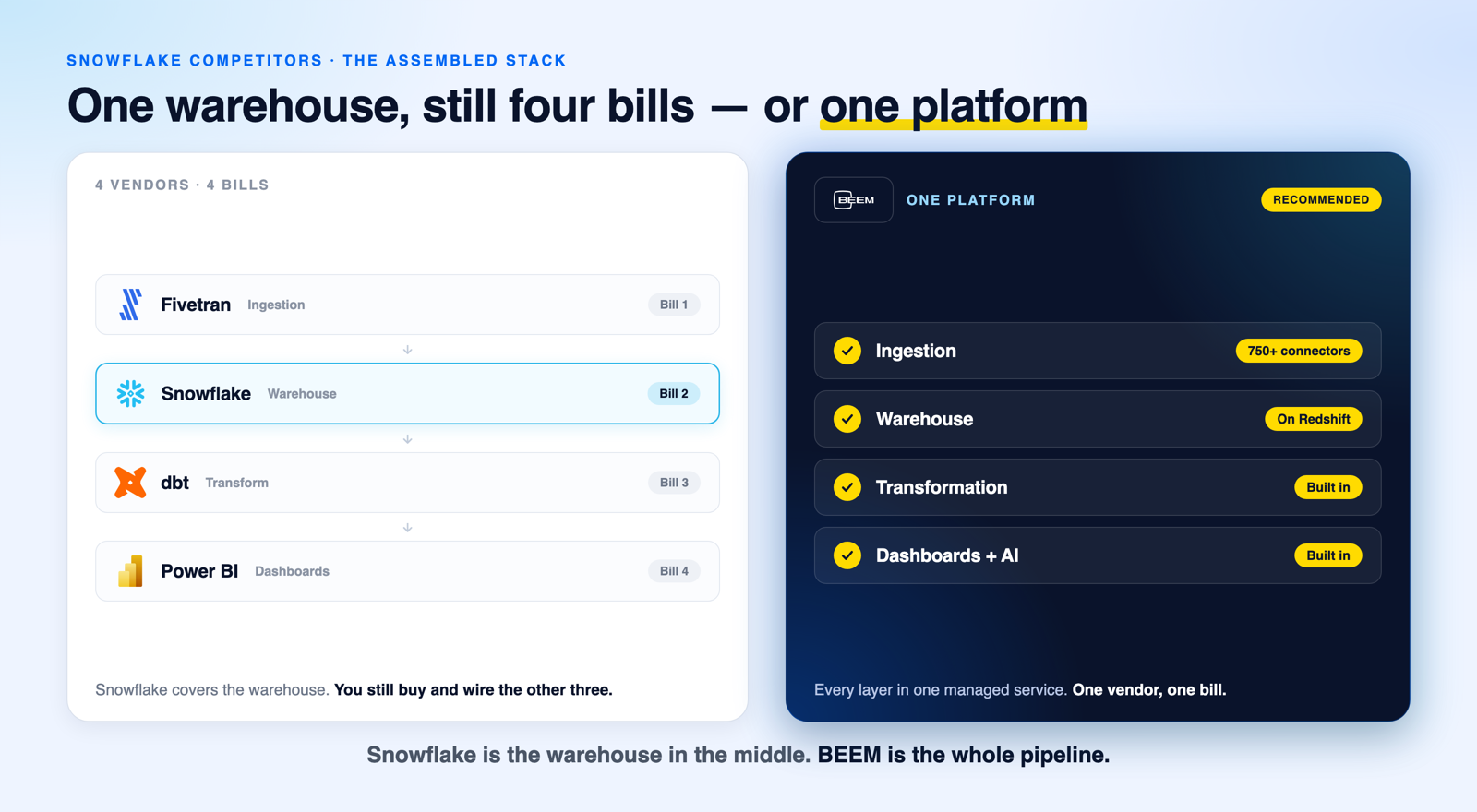
To be clear about fit: BEEM runs on Amazon Redshift, so under the hood it is a dedicated cloud warehouse that scales the way the platforms above do. The difference is not capability, it is ownership. A team that wants to assemble and operate its own stack can pick any warehouse on this list. A construction firm, accounting practice, retailer, or property manager that wants answers instead of infrastructure gets the same warehouse power with the connectors, dashboards, and AI already attached, and a team to run it.
See your own data in a dashboard. BEEM's proof of concept connects your systems and delivers your first dashboards in 2 weeks, so you can judge with your own numbers. Book a demo.
