
Definition
A data warehouse is a central store that holds structured data from across a business so it can be analyzed in one place. It pulls data out of the tools a company runs on, cleans and organizes it, and keeps it ready for reporting, dashboards and analytics.
Unlike the databases that run daily operations, a warehouse is built to answer questions across large volumes of current and historical data.
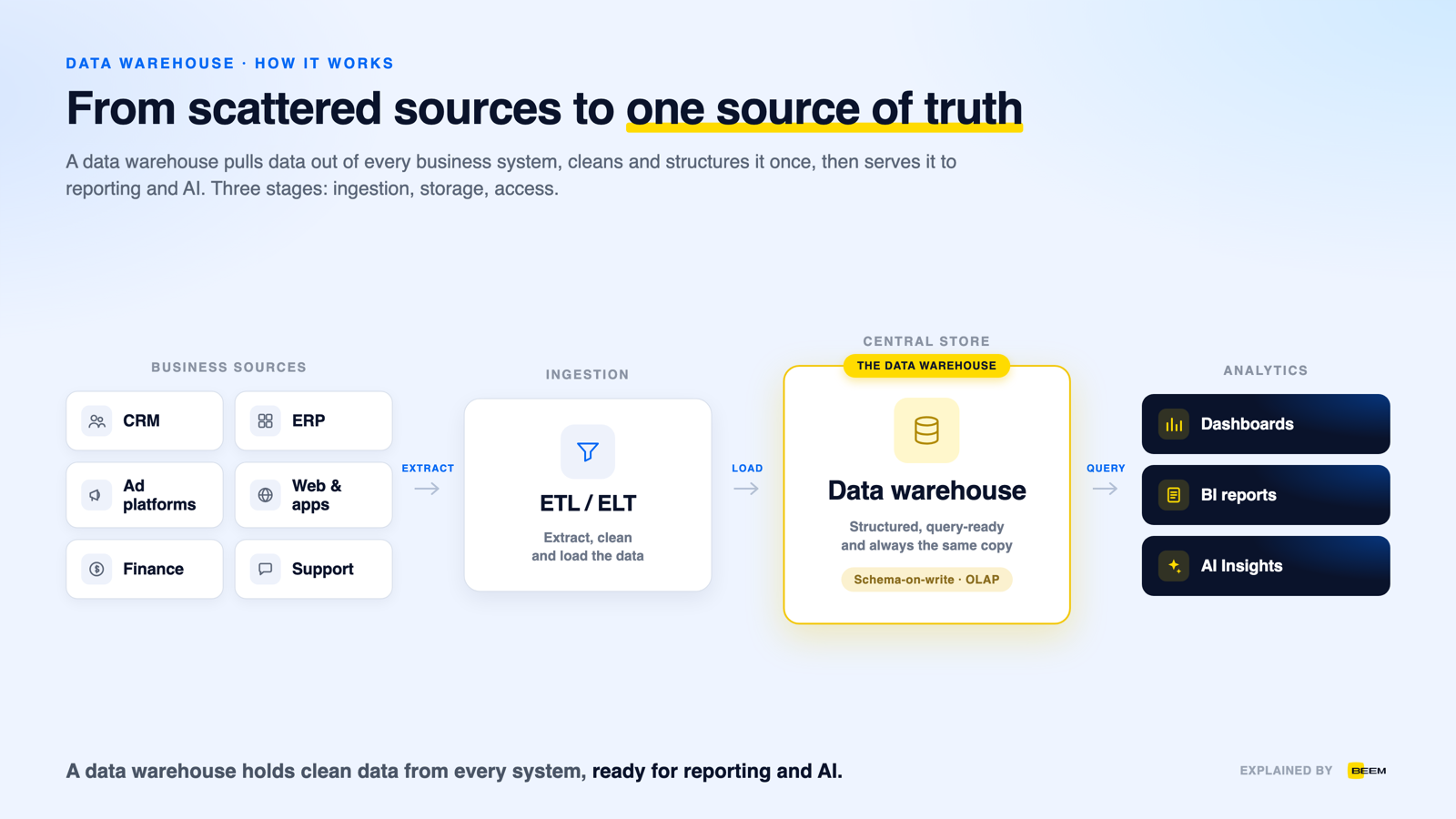
How it works
A data warehouse works by collecting data from many source systems, transforming it into a consistent structure, and storing it for analysis. The flow runs through three stages: ingestion, storage and access.
Underneath those stages sit four core components: the source systems that feed the warehouse, an ingestion layer, the central database where data is stored, and the access tools that query it. Metadata ties them together by describing what each table holds.
How it compares
A data warehouse stores structured, processed data for reporting, while a data lake stores raw data of any type for exploration. A lakehouse blends the two, keeping raw data and adding warehouse-style structure on top.
Pick a warehouse when the goal is clean reporting from known data, and a lake when you need to keep raw, varied data for exploration. A warehouse also differs from a plain database: a database runs daily operations under an OLTP model, while a warehouse is built for analytics across history. The large, company-wide version is called an enterprise data warehouse.
| Store | Data type | Best for |
|---|---|---|
| Data warehouse | Structured, modeled | Reporting, dashboards, BI |
| Data lake | Raw, any format | Exploration, data science |
| Lakehouse | Raw plus structured | Mixed analytics and ML |
When your business needs one
- Reports coming out of different tools disagree, and nobody can say which number is right.
- Analysts spend more time exporting and reconciling spreadsheets than analyzing them.
- Reporting queries are slowing down the applications that serve customers.
- You need to compare periods or track trends, but the source systems only keep recent data.
- BI tools or an AI assistant need one clean, consistent dataset to read from.
Benefits and limits
- One source of truth — every team reads the same modeled data instead of separate exports.
- Heavier analytics, safely — large queries run in the warehouse without slowing the apps that serve customers.
- History in one place — a warehouse keeps data over time, so you can track trends and compare periods.
- Consistent reporting — shared definitions mean revenue or churn means the same thing everywhere.
- Ready for AI — clean, structured data is what BI tools and AI assistants need to give useful answers.
- Structured data only — raw files, documents and unmodeled event streams belong in a lake or a lakehouse.
- Data is only as fresh as the last load, so a warehouse is rarely the right place for real-time operational lookups.
- Modeling takes effort up front, and every schema change in a source system creates maintenance downstream.
- Storage and compute costs grow with data volume and query load.
- A warehouse only enforces the definitions teams agree on; without governance, inconsistent modeling recreates the problem it was meant to solve.
- A data warehouse is the central, structured store that reporting, dashboards and AI all read from.
- Data reaches it through ingestion, is held in a query-ready schema, and is served out to access tools.
- The common cloud warehouses are Snowflake, Google BigQuery, Amazon Redshift and Databricks; each stores and queries data at scale and leaves ingestion, transformation and BI to be added around it.
Frequently Asked Questions
What is a data warehouse in simple terms?
A data warehouse is a single place that collects data from all of a company's systems, cleans it, and keeps it organized for analysis. Think of it as one tidy library for business data, separate from the apps that run day to day, so reports and dashboards all read from the same source.
What is the difference between a data warehouse and a database?
A database is built to run daily operations, like recording orders or updating inventory, using an OLTP model tuned for quick writes. A data warehouse is built for analysis, using an OLAP model tuned for large reads across history. A warehouse usually pulls its data from one or more databases.
What is the difference between a data warehouse and a data lake?
A data warehouse stores structured, processed data that is ready for reporting. A data lake stores raw data in any format, structured or not, for later exploration. Warehouses answer known business questions, while lakes keep everything open for data science. A lakehouse combines both approaches.
What are the main components of a data warehouse?
A data warehouse has four core components: the source systems that feed it, an ingestion or ETL layer that moves and cleans the data, the central database that stores it in a structured form, and the access tools that query it. Metadata describes what each table holds.
Is Snowflake a data warehouse?
Yes. Snowflake is a cloud data warehouse that separates storage from compute and runs SQL analytics at scale. Like other warehouses, it stores and queries data but leaves ingestion, transformation and BI for you to add. Amazon Redshift and Google BigQuery are similar cloud warehouses.
Does BEEM include a data warehouse?
Yes. BEEM includes a built-in data warehouse on Amazon Redshift, alongside 750+ connectors, transformation, dashboards and AI Insights in one managed platform. You get the warehouse without setting it up, and plans start at $899 per month.
