Databricks alternatives

Leaving Databricks for cost or complexity? Compare 6 Databricks alternatives, matched to why you are moving, and the managed all-in-one option.
Navigate Quickly

Databricks alternatives are the platforms teams move to when a lakehouse turns out to be too complex or too costly for the job at hand. Databricks is powerful. It was built for large data-engineering and machine-learning teams who want to run Spark, tune clusters and own every layer. Plenty of companies adopt it, then find they pay for scale and control they never use.

If you already run Databricks and the bills or the upkeep feel heavy, you have real options. Some are leaner warehouses. One, BEEM, is a managed all-in-one data platform that covers connectors, a warehouse on Amazon Redshift, dashboards and AI Insights without a team to run it. For a full look at the competitive field, see our Databricks competitors guide. This article takes the other angle. You have Databricks, and you want to leave.

The real question is not which tool is best. It is what is actually pushing you off Databricks.

Why teams replace Databricks

Teams rarely replace Databricks because it lacks power. They replace it because the power comes with a cost they can no longer justify. Three reasons come up again and again.

  1. Bills grow faster than the value. DBU consumption pricing scales with every job and cluster. As usage climbs, the monthly cost can outrun the insight you get back.
  2. The platform needs people to run it. Spark tuning, cluster sizing and pipeline upkeep assume in-house engineers. A data engineer costs $120K or more per year, and a full team runs $200K to $400K per year.
  3. It is over-powered for the need. Many teams use Databricks as a warehouse with dashboards on top. They pay for a lakehouse and heavy machine learning they never touch.

The top Databricks alternatives at a glance

The right replacement depends on why you are leaving. The table below sorts the main options by type, pricing model and how much setup each one needs. BEEM sits first as the managed all-in-one pick, with Databricks as the baseline you are comparing against.

PlatformTypePricing modelImplementation complexityBest for
RecommendedBEEMAll-in-one managed data platformPlans start at $899/moLowMid-market teams without data engineers
DatabricksLakehouse platformDBU consumptionHighMachine learning and data engineering teams
SnowflakeCloud data warehousePer-second creditsMediumElastic SQL analytics at scale
Google BigQueryServerless warehousePay-per-query or reserved slotsMediumSpiky workloads, Google Cloud stack
Microsoft FabricUnified data platformCapacity unitsMediumPower BI-centric enterprises
Amazon RedshiftWarehouse (provisioned or serverless)Node-hours or RPU-hoursHighAWS-centric teams
ClickHouseColumnar OLAP engineOpen source or cloud usageHighHigh-volume event analytics

Databricks alternatives compared

Here is how each alternative holds up, with the honest tradeoff for each one.

Snowflake

Snowflake is a cloud data warehouse that separates storage from compute. You scale query power up and down per workload and pay per second of use. It handles SQL analytics at scale cleanly and runs on AWS, Azure and Google Cloud.

The tradeoff is that Snowflake is a warehouse, not a full stack. You still wire up ingestion, transformation and BI around it. Credit-based pricing can also creep as more teams run more queries. For a wider view, see our Snowflake competitors guide.

Google BigQuery

BigQuery is Google Cloud's serverless warehouse. There are no clusters to manage, and you pay per query by data scanned or reserve capacity in slots. It suits spiky, unpredictable workloads and teams already inside Google Cloud.

The catch is cost control. Pay-per-query stays cheap until a few heavy scans surprise you. You also inherit the Google Cloud ecosystem, which is a plus or a lock-in depending on your stack.

Microsoft Fabric

Fabric is Microsoft's unified data platform. It folds warehousing, pipelines and Power BI into one product billed by capacity units. For shops that already live in Power BI and Azure, it keeps everything under one roof.

The tradeoff is maturity and lock-in. Fabric is newer, and capacity-unit pricing can be hard to size. It also pulls you deeper into the Microsoft ecosystem, which not every team wants.

Amazon Redshift

Redshift is AWS's data warehouse, available provisioned or serverless. It integrates tightly with the rest of AWS and bills by node-hours or RPU-hours. For AWS-centric teams, it is a familiar, proven choice.

The tradeoff is that Redshift is still a warehouse you operate. You tune it, model the data and add ingestion and BI yourself. BEEM actually runs its built-in warehouse on Amazon Redshift, so you get that engine without the setup.

ClickHouse

ClickHouse is a columnar OLAP engine built for speed on huge event and time-series data. It is open source, and ClickHouse Cloud offers a managed version billed by compute and storage. Query performance on high-volume analytics is hard to beat.

The tradeoff is scope and effort. ClickHouse is a fast engine, not an end-to-end platform. Self-hosting demands real expertise, and you still add ingestion, modeling and dashboards on top.

BEEM

BEEM is a managed all-in-one data platform aimed at mid-market teams that want outcomes, not infrastructure. It brings together 750+ connectors, a built-in warehouse on Amazon Redshift, SQL transformation, dashboards and AI Insights for plain-language questions. Plans start at $899 per month, and first dashboards land in as little as 2 weeks.

Unlike a warehouse you assemble, BEEM covers the whole path from source to dashboard. An expert team is available when you need help, so you are not staffing Spark specialists. To be clear about fit, petabyte pipelines, streaming and heavy machine learning still belong on Databricks. The difference is ownership, not raw capability. BEEM runs the stack for you so a lean team gets answers fast.

How to choose a Databricks alternative

Match the replacement to your real constraint, not to a feature list. Five questions make the choice clear.

  1. Name the reason you are leaving. Cost, upkeep and over-scope each point to a different tool.
  2. Count your engineers. No data team favors a managed platform over a raw warehouse you operate.
  3. Map the whole stack. A warehouse alone still needs ingestion, transformation and BI around it.
  4. Check where the data lives. Residency and compliance matter. BEEM runs on AWS ca-central-1 with SOC2, PIPEDA and GDPR.
  5. Watch the pricing model. Consumption pricing rewards steady use and punishes spikes. Flat plans stay predictable.

The all-in-one alternative to Databricks

If you are leaving Databricks because of complexity, not scale, the answer is not another tool to wire up. It is a platform that already includes the parts. BEEM gives you connectors, a warehouse on Amazon Redshift, transformation, dashboards and AI Insights as one managed service.

That means no Spark cluster to tune and no five-tool stack to assemble. You connect your sources, and BEEM models the data and serves dashboards. Ask a question in plain language and AI Insights answers from your own data. See the full picture on the product page and the connector library.
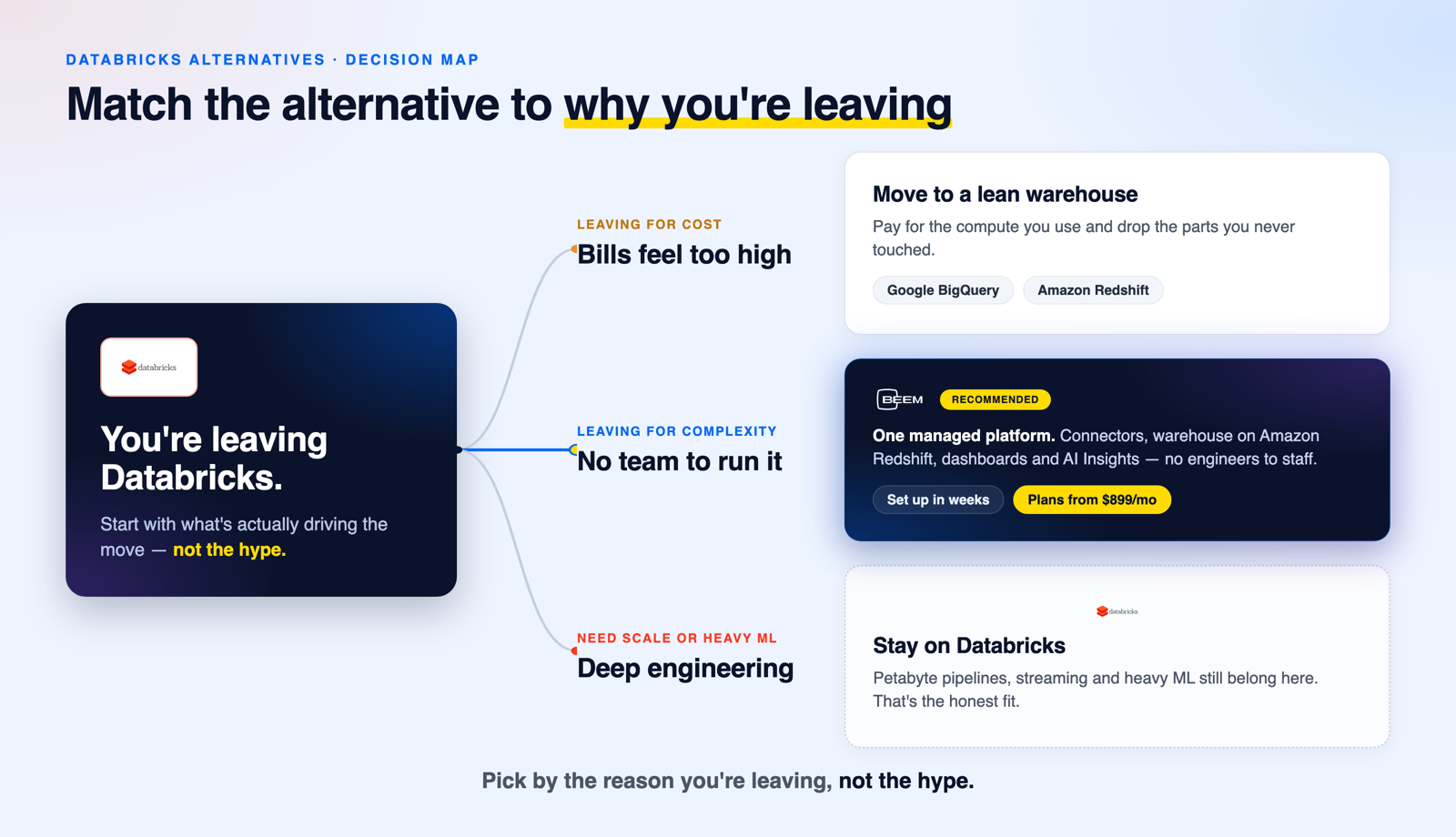
Decision map matching Databricks alternatives to the reason you are leaving
Match the alternative to why you are leaving Databricks.

To be clear about fit, BEEM is not a Databricks clone. It does not do real-time streaming, and it refreshes on a schedule. It is not built for petabyte machine learning or self-hosting. If that is your workload, stay on Databricks. If you want analytics outcomes without running the machine, BEEM is the swap. Compare the numbers on the pricing page.

Ready to see your own data in a live dashboard? Book a demo and watch BEEM turn your sources into answers.

About the author
Alexandre Lataille, Co-Founder and CEO of BEEM
Alexandre Lataille
Co-Founder & CEO
Alexandre Lataille is the co-founder and CEO of BEEM. He leads the team behind a fully managed data platform for mid-market companies that want dashboards, automated reports, and AI insights without running data infrastructure.
August 4, 2026

FAQs

What is the best alternative to Databricks?

There is no single best alternative. The right one depends on why you are leaving. If cost is the issue, a lean warehouse like Google BigQuery or Amazon Redshift lets you pay for the compute you use. If complexity is the issue, a managed all-in-one platform like BEEM covers connectors, warehouse, dashboards and AI Insights without a data team. If you need petabyte machine learning or streaming, staying on Databricks is the honest answer.

Is there a cheaper alternative to Databricks?

Yes. Serverless warehouses such as BigQuery and Redshift bill for the compute you actually use, which can cut costs for steady workloads. For predictable spend, BEEM uses flat plans that start at $899 per month and include the warehouse, dashboards and AI Insights, so you avoid consumption-based bill spikes.

Can I replace Databricks with a data warehouse?

If you mainly use Databricks as a warehouse with dashboards on top, yes. A warehouse like Snowflake, BigQuery or Redshift can take over the SQL analytics. You will still add ingestion, transformation and BI around it, or choose a platform like BEEM that includes those layers.

What is the difference between Databricks and Snowflake?

Databricks is a lakehouse built for Spark, machine learning and data engineering, and it assumes an engineering team. Snowflake is a cloud data warehouse focused on SQL analytics, billed by per-second credits. Both are strong at scale, and both still need ingestion, transformation and BI tools around them.

How hard is it to migrate off Databricks?

It depends on the workload. Moving SQL analytics and dashboards to a warehouse is fairly straightforward. Heavy Spark pipelines and custom machine learning are harder to move and may be worth keeping on Databricks. A managed platform like BEEM handles ingestion and modeling for you, which reduces the migration effort for mid-market analytics.

Does BEEM replace Databricks?

For mid-market analytics, yes. BEEM covers connectors, a warehouse on Amazon Redshift, transformation, dashboards and AI Insights as one managed service. It does not replace Databricks for petabyte machine learning, real-time streaming or self-hosting. The difference is ownership, not raw capability.

Is BEEM or Peliqan better?

Neither is better across the board. BEEM is stronger for managed reporting, plain-language AI, and Canadian data residency. Peliqan is stronger for write-back, data activation, and low-code data apps. The right pick depends on whether you want to report on your data or also build on top of it.

Do BEEM and Peliqan both include a data warehouse?

Yes. Both are all-in-one platforms with a built-in warehouse, connectors, SQL, and dashboards. BEEM runs its warehouse on Amazon Redshift. Peliqan includes its own built-in warehouse. You do not need to buy a separate warehouse for either one.

Does BEEM support write-back or reverse-ETL like Peliqan?

No. Write-back, reverse-ETL, and data activation are Peliqan strengths, not BEEM features. BEEM centralizes data and reports on it with dashboards and AI Insights, but it does not push data back into business apps. If activation is a hard requirement, Peliqan fits better.

How is pricing different between BEEM and Peliqan?

BEEM charges flat monthly plans that start at $899 and include the warehouse, connectors, dashboards, and AI. Peliqan prices per connected data source, so cost scales with the number of sources. Flat plans are easier to forecast, while per-source pricing can be cheaper for a small number of sources.

Which platform is better for Canadian data residency?

BEEM. It keeps data in Canada on AWS ca-central-1 and is SOC2, PIPEDA, and GDPR compliant. Peliqan is SOC2 and ISO 27001 certified and GDPR compliant, with EU-focused hosting. For Canadian residency requirements, BEEM is the direct fit.

Can BEEM feed a BI tool like Power BI or Tableau?

Yes. BEEM has built-in dashboards and can also feed external BI tools such as Power BI, Tableau, and Looker from its warehouse. Peliqan offers similar one-click BI tool integration. Both let you keep an existing BI tool while they handle the data layer underneath.

What is the best alternative to Tableau?

The best alternative depends on your stack. Power BI is the closest rival for Microsoft teams, Looker suits governed metrics, and Metabase and Google Looker Studio are strong low-cost options. BEEM is the best fit for mid-market teams that want dashboards plus the connectors, warehouse, and transformation behind them in one managed platform.

Is Power BI better than Tableau?

Neither is simply better. Power BI is cheaper per user and integrates tightly with Microsoft tools, while Tableau offers deeper, more flexible visualization. Both are visualization layers that need a data pipeline behind them, so the right pick depends on your existing stack and budget.

Is there a free alternative to Tableau?

Yes. Metabase is open source and free to self-host, and Google Looker Studio is free to use, especially with Google data sources. Both are lighter than Tableau on advanced visualization and governance, and both still need a database or warehouse to query.

Can BEEM replace Tableau?

BEEM is not a like-for-like replacement for Tableau's visualization depth. It is an all-in-one alternative that includes the data layer Tableau lacks, with built-in dashboards and AI Dashboards for teams that want one platform. If you prefer Tableau, BEEM feeds it clean, modeled data instead of replacing it.

How much does Tableau cost compared to alternatives?

Tableau uses per-user Creator, Explorer, and Viewer licensing, which typically costs more per user than Power BI. Metabase and Google Looker Studio have free tiers, and Looker uses higher platform pricing. BEEM plans start at $899 per month and include connectors, a warehouse, transformation, and dashboards together.

Do I need a data warehouse to use Tableau?

For anything beyond small extracts, yes. Tableau performs best on modeled data in a warehouse rather than raw source files. BEEM includes a built-in warehouse on Amazon Redshift, so the storage and modeling are handled and can feed Tableau directly.

How does Fivetran pricing work?

Fivetran uses consumption pricing based on Monthly Active Rows (MAR). You pay for the unique rows each connector syncs in a month, and the per-row rate falls as volume rises. Plans range from Free to Business Critical, and each active connection adds a small base charge.

What is a Monthly Active Row (MAR)?

A Monthly Active Row is any unique row a connector inserts, updates, or deletes during a billing month. Fivetran counts each row once, even if it syncs many times. Initial historical loads no longer count toward MAR.

Why is Fivetran so expensive?

Costs climb when MAR climbs. Source schema changes, historical re-syncs, and new high-volume connectors all raise the row count. Because pricing is usage-based, a busy month can cost far more than a quiet one.

How can I reduce my Fivetran bill?

Audit which connectors drive the most MAR, pause sources no one uses, and slow sync frequency on low-value tables. For a bigger saving, count the full stack cost of ingestion plus warehouse, transformation, and BI, then compare an all-in-one platform.

Is there a cheaper alternative to Fivetran?

For a mid-market team, an all-in-one platform is often cheaper once you add a warehouse, transformation, and BI. BEEM charges one flat fee from $899/mo that includes connectors, a built-in warehouse, dashboards, and AI Insights.

Does Fivetran have a free plan?

Yes. Fivetran offers a Free tier with a monthly MAR cap, aimed at small projects and trials. Paid plans, Standard, Enterprise, and Business Critical, add higher volumes, faster syncs, and stronger security controls.

Is BEEM a replacement for Fivetran?

For teams that want more than ingestion, yes. BEEM uses fully managed connectors and adds a warehouse, transformation, dashboards, and AI in one platform. If you only need data moved into a warehouse you already run, Fivetran on its own may be enough.

Does BEEM use Fivetran connectors?

BEEM uses fully managed connector technology under the hood, alongside native and custom connectors, to reach 750+ sources. So ingestion is as reliable as a dedicated tool, and the warehouse, transformation, and dashboards come with it.

Is BEEM cheaper than Fivetran?

It depends on your data volume and how many other tools you would otherwise buy. Fivetran charges by active rows, which can be unpredictable. BEEM is a subscription from $899/mo that also includes the warehouse, dashboards, and AI, so it can replace several bills.

Does Fivetran include a data warehouse?

No. Fivetran loads data into a warehouse you provide and pay for separately. BEEM includes a built-in warehouse on Amazon Redshift, so ingestion and storage come together in one platform.

Can Fivetran build dashboards?

No. Fivetran moves and loads data, then hands off to a BI tool for dashboards. BEEM builds dashboards inside the platform and adds AI Insights for plain-language questions.

Which is better for a team without data engineers?

BEEM. It is a managed platform with an expert team available when you need help, so you do not have to staff and assemble a pipeline. Fivetran is a self-serve tool that assumes you already have the warehouse, BI, and people around it.

What is the best Fivetran alternative?

It depends on what you need. For open-source control, Airbyte is the closest match. For a simple, low-cost tool, Stitch works well. If you want more than ingestion, an all-in-one platform like BEEM adds the warehouse, transformation, and dashboards in one place.

Is there a cheaper alternative to Fivetran?

Yes. Stitch and open-source tools like Airbyte or Meltano can cost less for ingestion alone. But the full pipeline also needs a warehouse and BI. An all-in-one platform can lower the total by replacing several tools. BEEM starts at $899/mo.

What is the difference between Fivetran and Airbyte?

Fivetran is fully managed with a curated connector catalog. Airbyte is open source, with more connectors and more control, but more maintenance. Fivetran suits teams that want it handled. Airbyte suits teams that want to customize.

Does BEEM replace Fivetran?

BEEM can, for teams that want more than ingestion. It uses fully managed connectors and adds a warehouse, transformation, and dashboards in one platform. If you only need ingestion into a warehouse you already run, Fivetran on its own may be enough.

Is Fivetran just for ingestion?

Mostly, yes. Fivetran moves data from sources into a warehouse and maintains the connectors. It added some transformation features, but it does not store data long term or build dashboards. You add those with other tools.

Do I need a warehouse to use Fivetran?

Yes. Fivetran loads data into a warehouse you provide, like Snowflake, BigQuery, or Redshift. It does not include storage. BEEM includes a built-in warehouse on Amazon Redshift, so ingestion and storage come together.

What is the best Databricks alternative?

It depends on your goal. For a SQL-first warehouse, Snowflake or BigQuery are the closest matches. For teams that want analytics without engineering, an all-in-one platform like BEEM covers ingestion, warehouse, and dashboards in one place.

What is the difference between Databricks and Snowflake?

Databricks is a lakehouse built around processing and machine learning in code. Snowflake is a SQL-first data warehouse. Databricks suits engineering teams, and Snowflake is friendlier for analytics. Both still need tools around them for ingestion and dashboards.

Is there a cheaper alternative to Databricks?

Yes, depending on your workload. Warehouses like BigQuery or Redshift can cost less for standard analytics. For the full stack, an all-in-one platform can lower the total by replacing several tools and reducing engineering time. BEEM starts at $899/mo.

Do I need Databricks for machine learning?

Not always. Databricks is strong for large-scale, custom machine learning. For forecasting and analytics on business data, a managed platform can cover most needs. BEEM includes AI Insights and forecasting built on AWS, without a separate machine-learning setup.

Is BEEM a Databricks competitor?

BEEM competes with Databricks for mid-market teams that want analytics outcomes, not for petabyte-scale engineering workloads. BEEM delivers connectors, a warehouse on Amazon Redshift, transformation, and dashboards in one managed platform, so you do not need a data-engineering team to get value.

Can BEEM replace a data warehouse?

For most mid-market teams, yes. BEEM includes a built-in warehouse on Amazon Redshift, so you do not have to buy, set up, and tune one separately. For petabyte-scale or highly custom workloads, a dedicated warehouse or lakehouse may still fit better.

What is the best Power BI alternative?

It depends on what you need. For deeper visualization, Tableau is the closest match. For a simple, low-cost tool, Metabase or Google Looker Studio work well. If your real problem is the data behind the dashboard, an all-in-one platform like BEEM covers the connectors, warehouse, and transformation Power BI leaves to you.

Is there a free alternative to Power BI?

Yes. Google Looker Studio is free and Metabase has a free open-source version. Both are good for straightforward dashboards. They still need a clean data source, which you have to build and maintain yourself.

Tableau vs Power BI, which is better?

Tableau usually wins on depth and flexibility of visualization. Power BI wins on price and on fit if you already use Microsoft tools. Both sit at the top of the stack, so both still need a warehouse and clean data underneath.

Is there a cheaper alternative to Power BI?

Metabase and Google Looker Studio cost less per seat. But the real cost of a BI setup includes the warehouse, connectors, and people who run them. An all-in-one platform can lower that total by replacing several tools with one. BEEM starts at $899/mo.

Do I need a data warehouse to use Power BI?

For anything beyond small, static reports, yes. Power BI works best on modeled data in a warehouse. Without one, refreshes get slow and fragile. BEEM includes a warehouse on Amazon Redshift, so you do not have to buy and manage one separately.

Is BEEM a Power BI alternative?

BEEM is an all-in-one alternative to the whole Power BI stack, rather than the chart tool alone. It handles connectors, storage, transformation, and dashboards in one platform. If you want to keep Power BI, BEEM can feed it clean data instead of replacing it.