
The main Databricks competitors in 2026 include cloud data warehouses like Snowflake and BigQuery, and all-in-one platforms that deliver analytics without a data-engineering team. Databricks is a powerful lakehouse. It is also built for engineers, and it expects you to bring the people who run it.
BEEM belongs on this list from the other end of the market. It is a managed data platform with a built-in warehouse on Amazon Redshift, connectors, transformation, and dashboards in one place. Databricks is built to operate at massive scale. BEEM is built to deliver outcomes for mid-market teams. So the question is less about raw power, and more about how much you want to build and staff yourself. If you are set on replacing it, our Databricks alternatives guide covers the closest options.
Why teams look for Databricks alternatives
Databricks is a lakehouse platform. It combines data storage, large-scale processing, and machine learning in one engine, mostly through notebooks and code. Teams look for alternatives for three reasons.
- It expects a data-engineering team. Databricks rewards people who write Spark, manage clusters, and tune jobs. Without that skill in-house, most of its power sits idle.
- Cost scales with compute. Clusters bill by the hour, and costs can climb fast when jobs are not tuned. Budgets are hard to predict.
- It is more platform than product. Databricks gives you the building blocks. You still assemble ingestion, modeling, dashboards, and governance on top.
The top Databricks competitors at a glance
| Platform | Type | Pricing model | Implementation complexity | Best for |
|---|---|---|---|---|
Recommended | All-in-one data platform | From $899/mo + usage ($0.60/DPU, $0.10/GB) | Low | Mid-market teams that want analytics without engineers |
| Databricks | Lakehouse and processing | Compute-based (per DBU) | High | Engineering teams doing large-scale processing and ML |
| Snowflake | Cloud data warehouse | Compute and storage usage | Medium | Teams that want a scalable SQL warehouse |
| Google BigQuery | Serverless warehouse | Per-query or per-slot | Medium | Google Cloud teams that want serverless scale |
| Microsoft Fabric | Unified analytics suite | Capacity-based | Medium | Microsoft shops consolidating on one vendor |
| Amazon Redshift | Cloud data warehouse | Provisioned or serverless | Medium | AWS teams that want a managed warehouse |
| Cloudera | Hybrid data platform | Enterprise license | High | Large enterprises with on-prem and hybrid needs |
Databricks competitors compared
Snowflake
Snowflake is a cloud data warehouse known for separating storage from compute. That design makes it easy to scale each independently, and its SQL-first approach is friendlier than Databricks for analytics teams. It has become a default choice for warehousing.
The tradeoff is that Snowflake is still just the warehouse. You bring your own ingestion, transformation, and BI tools around it. Costs are usage-based, so heavy or unoptimized queries can get expensive. We cover it in depth in our Snowflake competitors guide.
Google BigQuery
BigQuery is Google Cloud's serverless warehouse. There are no clusters to manage, and it scales automatically, which removes a lot of operational work. For teams already on Google Cloud, it fits naturally.
Pricing is based on data scanned or reserved slots, which can surprise teams that run large queries often. Like the others, BigQuery handles storage and compute, not the full pipeline. You still need connectors, modeling, and dashboards on top.
Microsoft Fabric
Microsoft Fabric bundles data engineering, warehousing, and Power BI into one capacity-based suite. For organizations standardizing on Microsoft, it brings several tools under one bill and one login.
It is newer, and the pieces are still maturing together. Fabric also assumes you are comfortable in the Microsoft ecosystem and have people to run it. Capacity pricing can be hard to size for smaller teams.
Amazon Redshift
Amazon Redshift is AWS's managed data warehouse, now available in both provisioned and serverless forms. It integrates tightly with the rest of AWS, and its serverless option lowers the operational burden.
Redshift is a warehouse, so the rest of the stack is still yours to build. Worth noting, BEEM runs its built-in warehouse on Amazon Redshift. So you can get Redshift's engine as part of a managed platform, without setting it up and tuning it yourself.
Cloudera
Cloudera is a hybrid data platform built for large enterprises that run across on-prem and cloud. It handles big, regulated workloads and gives central teams a lot of control. For that audience, it remains relevant.
It is heavy. Cloudera needs specialists to deploy and maintain, and its licensing suits enterprise budgets. For a mid-market team that wants results without a platform team, it is far more than needed.
BEEM
BEEM is a managed data platform that delivers the whole analytics outcome, not just the storage layer. It connects to 750+ sources, stores data in a built-in warehouse on Amazon Redshift, transforms it with SQL, and builds dashboards with AI Insights for plain-language questions. A managed team is available when you need help.
BEEM does not compete with Databricks on raw scale or machine learning. If you have petabytes and a team writing Spark, Databricks is the right tool. BEEM is for teams that want the result, from raw source to live dashboard, in weeks rather than quarters. First dashboards can be live in as little as 2 weeks, often at 40-60% less than building an in-house solution. The difference is ownership, not capability. You run less of it yourself.
How to choose between Databricks alternatives
Match the platform to your team and your scale.
- Do you have data engineers? Databricks and Cloudera assume you do. If you do not, a managed platform will get you further.
- Warehouse or full platform? Snowflake, BigQuery, and Redshift are warehouses. You still assemble the rest around them.
- How predictable is your budget? Compute-based pricing scales with usage. A predictable base plan plus usage-based processing you can see is easier to plan around.
- What is your real workload? Heavy ML and petabyte processing suit Databricks. Standard analytics and reporting do not need it.
- Do you want tools or outcomes? Build the stack yourself, or run one platform that delivers the result.
The all-in-one alternative to a Databricks stack
A Databricks setup is rarely just Databricks. Around it sit ingestion tools, a BI layer, orchestration, and the engineers who keep it running. Each piece adds cost and complexity.
BEEM replaces that with one managed platform. Connectors, a built-in warehouse on Amazon Redshift, SQL transformation, and dashboards with AI Insights in one place. Pricing starts at $899/mo, plus usage-based data processing from $0.60 per DPU and storage at $0.10/GB. You pay one vendor for the whole stack instead of separate bills for connectors, a warehouse, transformation, and a BI tool. A managed team is available when you need it.
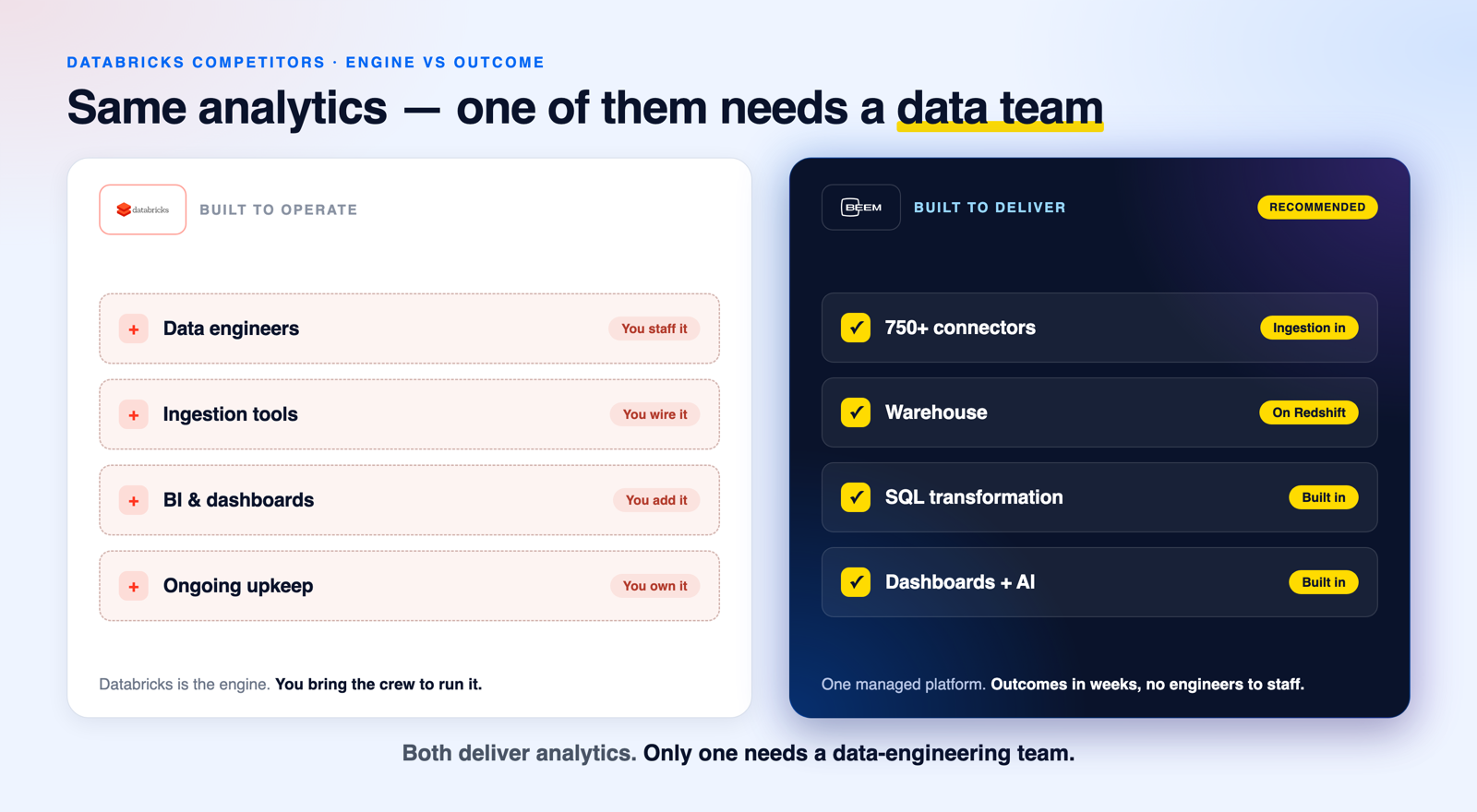
To be clear about fit. If your work is heavy machine learning or petabyte-scale processing, Databricks or a dedicated warehouse is the better home for it. BEEM is for mid-market teams that want analytics outcomes without hiring a data-engineering team to get there.
See your own data in a dashboard, not a demo dataset. BEEM connects a source and shows you a live dashboard built on it, so you can judge with your own numbers. Book a demo.
