
Snowflake alternatives are the platforms teams move to when a cloud warehouse costs more, or does less, than the job needs. Snowflake is a strong warehouse. It separates storage from compute, scales SQL analytics cleanly and runs across the big clouds. The catch is that a warehouse is only one layer. You still pay for the rest of the stack around it, and the credits keep counting.
If you run Snowflake and the bills or the missing pieces bother you, you have real options. Some are leaner warehouses. One, BEEM, is a managed all-in-one data platform that covers connectors, a warehouse on Amazon Redshift, dashboards and AI Insights without a team to run it. For the full competitive field, see our Snowflake competitors guide. This article takes the replace angle. You have Snowflake, and you want to simplify or cut the cost.
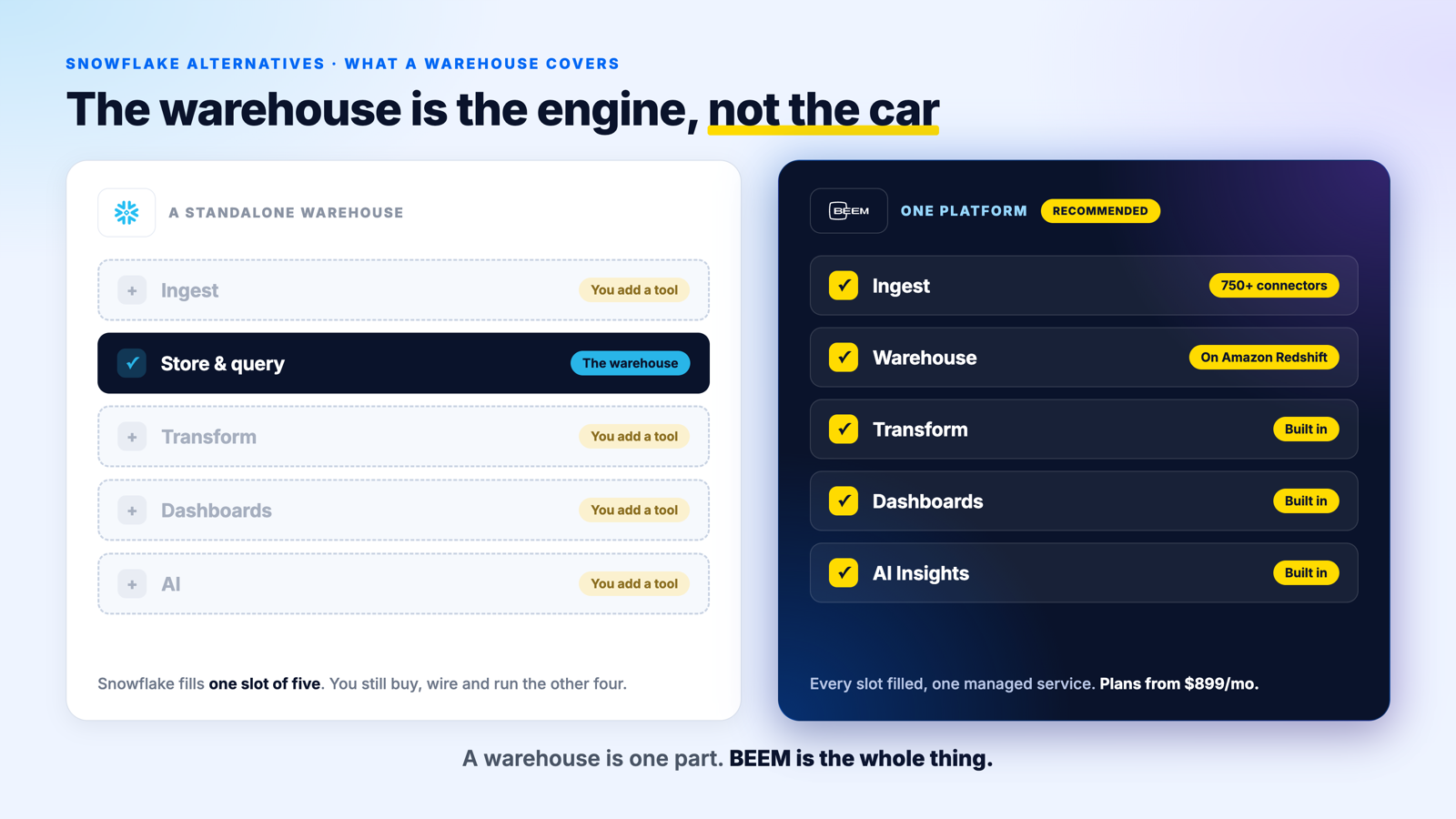
The real question is not which warehouse wins. It is whether you still need a standalone warehouse at all.
Why teams replace Snowflake
Teams rarely replace Snowflake because it fails. They replace it because the model gets expensive, or because a warehouse alone leaves too much unfinished. Three reasons come up again and again.
The top Snowflake alternatives at a glance
The right replacement depends on why you are leaving. The table below sorts the main options by type, pricing model and how much setup each one needs. BEEM sits first as the managed all-in-one pick, with Snowflake as the baseline you are comparing against.
| Platform | Type | Pricing model | Implementation complexity | Best for |
|---|---|---|---|---|
Recommended | All-in-one managed data platform | From $899/mo + usage ($0.60/DPU, $0.10/GB) | Low | Mid-market teams without data engineers |
| Snowflake | Cloud data warehouse | Per-second credits | Medium | Elastic SQL analytics at scale |
| Google BigQuery | Serverless warehouse | Pay-per-query or reserved slots | Medium | Spiky workloads, Google Cloud stack |
| Amazon Redshift | Warehouse (provisioned or serverless) | Node-hours or RPU-hours | Medium | AWS-centric teams |
| Databricks | Lakehouse platform | DBU consumption | High | Machine learning and data engineering teams |
| Microsoft Fabric | Unified data platform | Capacity units | Medium | Power BI-centric enterprises |
| ClickHouse | Columnar OLAP engine | Open source or cloud usage | High | High-volume event analytics |
Snowflake alternatives compared
Here is how each alternative holds up, with the honest tradeoff for each one.
Google BigQuery
BigQuery is Google Cloud's serverless warehouse. There are no clusters to manage, and you pay per query by data scanned or reserve capacity in slots. It suits spiky, unpredictable workloads and teams already inside Google Cloud.
The catch is cost control. Pay-per-query stays cheap until a few heavy scans surprise you. Like Snowflake, BigQuery is still a warehouse. You add ingestion, transformation and BI around it to get a full picture.
Amazon Redshift
Redshift is AWS's data warehouse, offered provisioned or serverless. It integrates tightly with the rest of AWS and bills by node-hours or RPU-hours. For AWS-centric teams, it is a familiar, proven choice with predictable node pricing.
The tradeoff is that Redshift is still a warehouse you operate. You tune it, model the data and add ingestion and BI yourself. BEEM actually runs its built-in warehouse on Amazon Redshift, so you get that engine without the setup.
Databricks
Databricks is a lakehouse built for Spark, machine learning and data engineering. It handles huge pipelines and custom models that a SQL warehouse cannot. For teams doing heavy engineering, it is a genuine step up from Snowflake.
The tradeoff is complexity and cost. DBU consumption pricing climbs with every cluster, and the platform assumes in-house engineers to run it. If you left Snowflake to simplify, Databricks moves the other way. For a wider view, see our Databricks competitors guide.
Microsoft Fabric
Fabric is Microsoft's unified data platform. It folds warehousing, pipelines and Power BI into one product billed by capacity units. For shops that already live in Power BI and Azure, it keeps everything under one roof.
The tradeoff is maturity and lock-in. Fabric is newer, and capacity-unit pricing can be hard to size. It also pulls you deeper into the Microsoft ecosystem, which not every team wants.
ClickHouse
ClickHouse is a columnar OLAP engine built for speed on huge event and time-series data. It is open source, and ClickHouse Cloud offers a managed version billed by compute and storage. Query performance on high-volume analytics is hard to beat.
The tradeoff is scope and effort. ClickHouse is a fast engine, not an end-to-end platform. Self-hosting demands real expertise, and you still add ingestion, modeling and dashboards on top.
BEEM
BEEM is a managed all-in-one data platform aimed at mid-market teams that want outcomes, not infrastructure. It brings together 750+ connectors, a built-in warehouse on Amazon Redshift, SQL transformation, dashboards and AI Insights for plain-language questions. Plans start at $899 per month, and first dashboards land in as little as 2 weeks. Beyond the base plan you pay usage-based data processing from $0.60 per DPU and storage at $0.10/GB, billed as one vendor for the whole stack instead of separate tools.
Unlike a warehouse you assemble around, BEEM covers the whole path from source to dashboard. An expert team is available when you need help, so you are not staffing warehouse specialists. To be clear about fit, petabyte pipelines, streaming and heavy machine learning still belong on a dedicated warehouse. The difference is ownership, not raw capability. BEEM runs the stack for you so a lean team gets answers fast.
How to choose a Snowflake alternative
Match the replacement to your real constraint, not to a feature list. Five questions make the choice clear.
The all-in-one alternative to Snowflake
If you are leaving Snowflake to cut cost or stop assembling tools, the answer is not another warehouse to wire up. It is a platform that already includes the parts. BEEM gives you connectors, a warehouse on Amazon Redshift, transformation, dashboards and AI Insights as one managed service. BEEM plans start at $899/mo, plus usage-based data processing from $0.60 per DPU and storage at $0.10/GB. You pay one vendor for the whole stack instead of separate bills for connectors, a warehouse, transformation, and a BI tool.
That means one platform instead of a five-tool stack to assemble. You connect your sources, and BEEM models the data and serves dashboards. Ask a question in plain language and AI Insights answers from your own data. See the full picture on the product page and the connector library.
To be clear about fit, BEEM is not a warehouse clone. It does not do real-time streaming, and it refreshes on a schedule. It is not built for petabyte machine learning or self-hosting. If that is your workload, a dedicated warehouse still fits. If you want analytics outcomes without assembling the stack, BEEM is the swap. Compare the numbers on the pricing page.
Ready to see your own data in a live dashboard? Book a demo and watch BEEM turn your sources into answers.
