
The main Fivetran alternatives in 2026 range from other data-ingestion tools like Airbyte and Stitch to all-in-one platforms that do more than move data. Fivetran is a reliable, fully managed connector service. It is also just the ingestion step, which means the warehouse, transformation, and dashboards are still yours to add.
BEEM belongs on this list as the all-in-one option. It handles ingestion, a built-in warehouse on Amazon Redshift, transformation, and dashboards in one platform, with a managed team when you need it. BEEM uses fully managed connectors too, so ingestion quality is not the difference. The difference is how much of the rest lives in one place. So the real question is whether you need a standalone ingestion tool, or the whole pipeline around it.
Why teams look for Fivetran alternatives
Fivetran is a managed data-ingestion tool. It moves data from your sources into a warehouse on a schedule, and it maintains the connectors so you do not have to. Teams look for alternatives for three reasons.
- Pricing scales with data volume. Fivetran bills on monthly active rows, so costs can rise quickly and unpredictably as you grow. Our Fivetran pricing guide breaks down how those costs add up.
- It is only ingestion. Fivetran lands your data in a warehouse. You still buy and run the warehouse, the transformation layer, and the BI tools around it.
- It assumes you have the rest of the stack. Fivetran works best when you already have engineers and a warehouse. On its own, it does not produce a dashboard.
The top Fivetran alternatives at a glance
| Platform | Type | Pricing model | Implementation complexity | Best for |
|---|---|---|---|---|
Recommended | All-in-one data platform | From $899/mo + usage ($0.60/DPU, $0.10/GB) | Low | Mid-market teams that want the whole pipeline, not just ingestion |
| Fivetran | Managed ingestion / ELT | Usage-based (active rows) | Low | Teams with a warehouse and engineers that want reliable connectors |
| Airbyte | Open-source ingestion | Open source and cloud | Medium | Teams that want control and custom connectors |
| Stitch | Managed ingestion | Volume-based tiers | Low | Small teams that want simple, low-cost ETL |
| Matillion | Ingestion and transformation | Credit-based | Medium | Teams that want ETL and modeling in one tool |
| Hevo | Managed pipeline | Event-based tiers | Low | Teams that want near real-time pipelines |
| Meltano | Open-source ELT | Open source (self-run) | High | Engineering teams that want code-first pipelines |
Fivetran alternatives compared
Airbyte
Airbyte is the leading open-source ingestion tool. It has a large catalog of community connectors, and you can build your own, which appeals to teams that want control. A paid cloud version removes some of the hosting work.
The tradeoff is effort. Open-source connectors vary in quality and need maintenance. Self-hosting Airbyte takes engineering time. Like Fivetran, it moves data and stops there. The warehouse and everything after it are still your job. For a direct comparison, see our Fivetran vs Airbyte guide.
Stitch
Stitch is a simple, managed ingestion tool, now part of Talend. It is quick to set up and priced by volume, which makes it friendly for smaller teams and budgets. For straightforward pipelines, it does the job well.
Its connector catalog is smaller than Fivetran's, and advanced features are limited. Stitch also focuses only on moving data. You still need a warehouse, transformation, and BI tools to turn that data into reporting. If Stitch is on your shortlist, our Stitch alternatives guide compares the closest options.
Matillion
Matillion combines ingestion with transformation, so you can load and model data in one tool. It runs inside your cloud warehouse and suits teams that want more than raw extraction. That extra scope sets it apart from pure ingestion tools.
It is priced on credits and expects a warehouse to run against. Matillion still leaves storage and dashboards to other tools. And its transformation features reward people who are comfortable building data pipelines.
Hevo
Hevo is a managed pipeline tool built for speed, with near real-time loading and a no-code setup. Teams that need fresh data without heavy engineering tend to like it. Its pricing is based on event volume.
Hevo is still an ingestion layer. It moves and lightly transforms data, then hands off to your warehouse and BI stack. As volume grows, event-based pricing needs watching. The rest of the pipeline remains separate.
Meltano
Meltano is an open-source, code-first ELT platform. It treats pipelines as version-controlled code, which engineering teams value for reproducibility and CI. It is flexible and free to run yourself.
That flexibility comes with real setup and maintenance. Meltano expects engineers who are comfortable on the command line. It handles extraction and loading, so the warehouse, modeling, and dashboards are still yours to build and connect.
BEEM
BEEM is a managed data platform that covers the whole pipeline, not just ingestion. It connects to 750+ sources, stores data in a built-in warehouse on Amazon Redshift, transforms it with SQL, and builds dashboards with AI Insights. A managed team is available when you need help.
BEEM uses fully managed connectors, so ingestion is as reliable as a dedicated tool. Where it differs is scope. With Fivetran you buy ingestion, then assemble the warehouse, transformation, and BI around it. With BEEM those pieces are already connected, so your data goes from source to dashboard in one platform. First dashboards can be live in as little as 2 weeks, often at 40-60% less than building an in-house solution. For a direct look, see our BEEM vs Fivetran comparison.
How to choose between Fivetran alternatives
Match the tool to how much of the stack you want to own.
- Do you already have a warehouse and BI? If yes, a focused ingestion tool may be all you need. If no, an all-in-one platform saves you assembling them.
- How technical is your team? Airbyte and Meltano reward engineers. Stitch, Hevo, and BEEM suit leaner teams.
- How predictable is your pricing? Every option here carries usage costs. Pure volume-based ingestion pricing can spike as data grows, while a base plan plus usage gives you a fixed floor with transparent usage on top.
- Do you need transformation and dashboards too? Ingestion alone does not produce reporting. Count the tools you still have to add.
- Do you want tools or outcomes? Wire the pieces together yourself, or run one platform that delivers the dashboard.
The all-in-one alternative to a Fivetran stack
Fivetran is one piece of a larger setup. To get from raw data to a dashboard, you also need a warehouse, a transformation layer, and a BI tool. Each is a separate product, a separate bill, and a separate thing to maintain.
BEEM brings those together. Connectors, a built-in warehouse on Amazon Redshift, SQL transformation, and dashboards with AI Insights in one place. BEEM plans start at $899/mo, plus usage-based data processing from $0.60 per DPU and storage at $0.10/GB. You pay one vendor for the whole stack instead of separate bills for connectors, a warehouse, transformation, and a BI tool. A managed team is available when you need it.
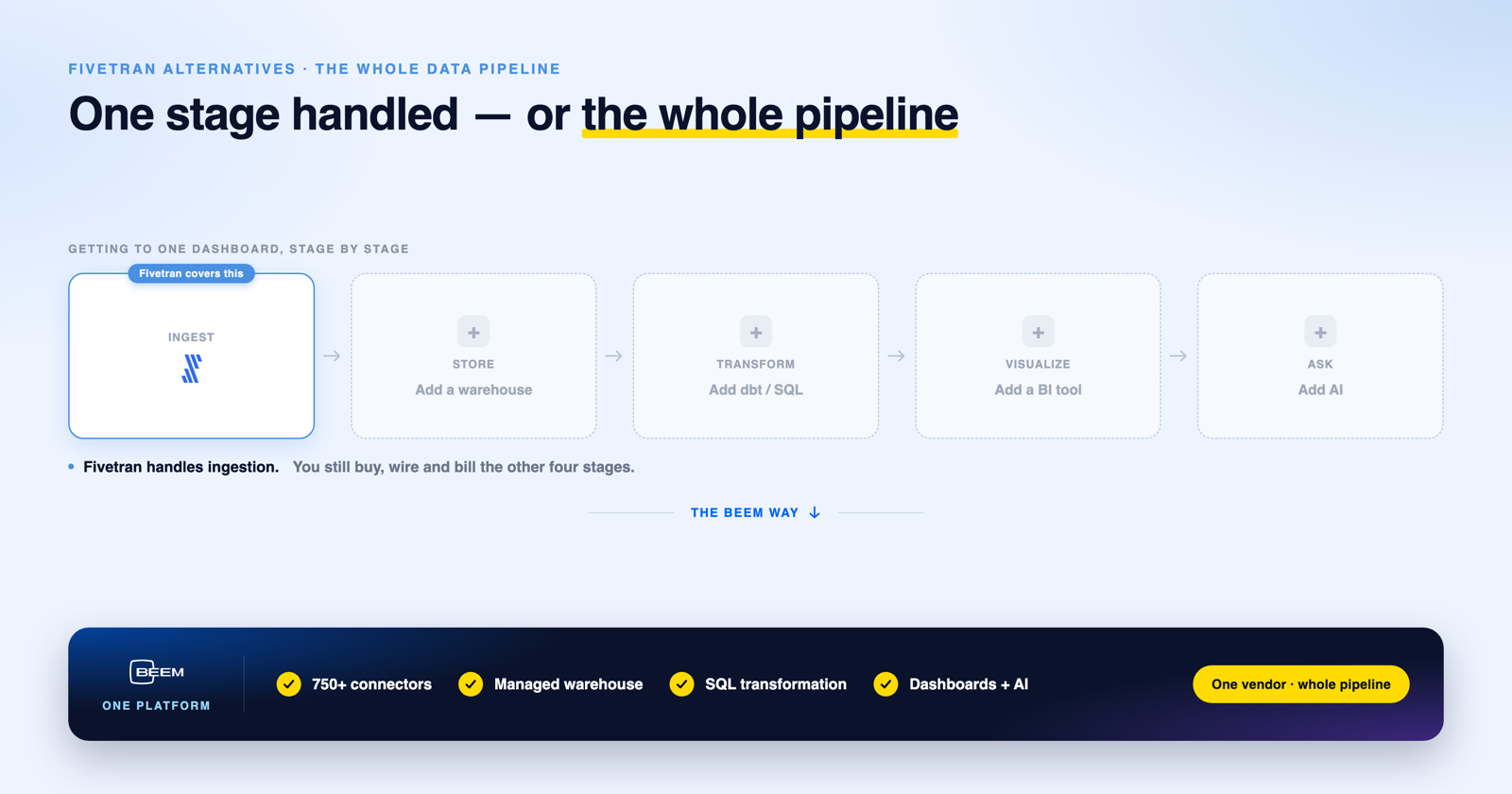
To be clear about fit. If you already run a warehouse, a BI tool, and a data team, and you only need reliable ingestion at scale, Fivetran is a strong, focused choice. BEEM is for teams that want the whole pipeline in one place, without buying and connecting four tools.
See your own data in a dashboard, not a demo dataset. BEEM connects a source and shows you a live dashboard built on it, so you can judge with your own numbers. Book a demo.
