
Fivetran pricing runs on a consumption model built around Monthly Active Rows, or MAR. You pay for the unique rows each connector syncs to your destination in a billing month. Sync the same row ten times and Fivetran still counts it once. The published plans are Free, Standard, Enterprise, and Business Critical, and the per-MAR rate falls as volume rises.
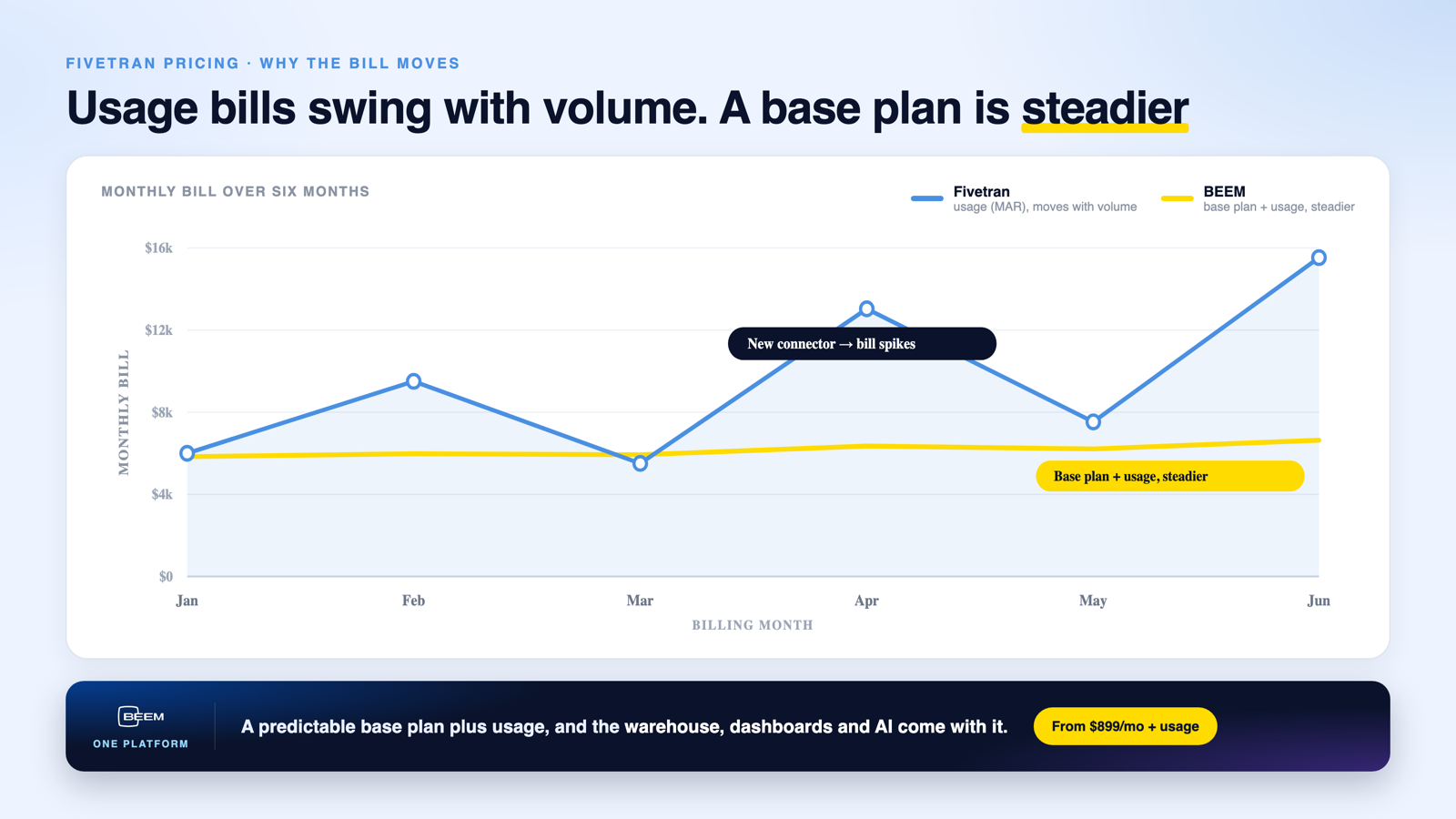
Usage pricing rewards you when volumes are steady. It works against you when they spike. This guide breaks down how the MAR model works, why bills move month to month, and how to keep them down. It also covers BEEM, the all-in-one alternative that brings your whole stack under one vendor. The real question is bigger than ingestion. It is what you pay for the rest of the stack too.
How Fivetran pricing works
Fivetran uses consumption pricing. Your bill tracks the volume of data each connector moves, measured in MAR. A Monthly Active Row is any unique row a connector inserts, updates, or deletes during the month. Fivetran counts each row once, no matter how often it syncs. Initial historical loads no longer count toward MAR, so backfills are cheaper than they used to be.
Fivetran publishes four plans, from a free tier to a top security tier:
- Free. A no-cost tier with a monthly MAR cap, for small projects and trials.
- Standard. Usage-based pricing with core connectors and daily to sub-hourly syncs.
- Enterprise. Faster syncs, more governance, and advanced access controls.
- Business Critical. The top tier, adding controls like customer-managed keys and private networking.
Two more factors shape the bill. Each active connection carries a small monthly base charge. And teams with steady, high volume can move to annual capacity pricing, which commits to a MAR volume up front for a lower effective rate. The per-MAR rate itself declines as usage climbs, so larger accounts pay less per row. Fivetran publishes the current rates on its pricing page.
Why Fivetran bills are hard to predict
Fivetran bills are hard to predict because MAR reacts to changes you don't fully control. Three drivers cause most of the surprises.
- Source changes spike MAR. When a source system adds columns or changes how it flags updates, more rows look active. Your MAR climbs without any change on your side.
- Historical re-syncs reload rows. A schema change or a connector re-sync can reprocess large tables. That reloads rows and inflates the month's count.
- New connectors add volume. Every source you add brings its own row activity. A single busy connector can move the whole bill.
Fivetran pricing vs the alternatives
Most Fivetran alternatives still price ingestion by usage, so the same unpredictability follows you. The bigger difference is what each tool includes. Ingestion is one stage of the pipeline. You still need a warehouse, a transformation layer, and dashboards on top. The table below compares pricing model, cost predictability, and scope.
| Platform | Pricing model | Cost predictability | What's included | Best for |
|---|---|---|---|---|
Recommended | From $899/mo + usage ($0.60/DPU, $0.10/GB) | Base + usage | Connectors, warehouse, transformation, dashboards, AI | Mid-market teams that want the whole outcome |
| Fivetran | Usage-based (MAR) | Low | Managed ingestion only | Best-in-class ingestion at scale |
| Airbyte | Usage-based or open source | Medium | Ingestion (cloud or self-hosted) | Engineers who want connector control |
| Stitch | Row-volume tiers | High | Ingestion (Singer-based) | Simple, budget-conscious pipelines |
| Hevo | Event-based tiers | Medium | Ingestion plus light transforms | Near-real-time pipelines, no engineers |
| Matillion | Credit consumption | Low | Ingestion plus transformation | In-warehouse transformation-heavy teams |
For a wider view of the options, see our guide to Fivetran alternatives or the head-to-head on BEEM vs Fivetran. For a pure ingestion matchup, see our Fivetran vs Airbyte guide. If you are also weighing the warehouse layer, our Snowflake competitors guide covers that ground.
How to reduce Fivetran costs
You can lower a Fivetran bill without leaving the platform. Start with the connectors that move the most rows.
- Audit your MAR. Open the usage dashboard and find the connectors driving the bill. A few sources usually dominate.
- Prune unused connectors. Pause or delete sources no one reports on. Every active connection adds rows and a base charge.
- Tune sync frequency. Not every table needs a sync every few minutes. Slower schedules on low-value sources cut activity.
- Consolidate the stack. Add up ingestion plus a warehouse, transformation, and BI. A single platform can cost less than four tools.
One platform for the whole stack
BEEM is a fully managed data platform that brings your whole stack under one vendor. Plans start at $899/mo, plus usage-based data processing. One subscription covers 750+ connectors, a built-in warehouse on Amazon Redshift, a transformation layer, dashboards, and AI Insights in plain language. A team of data experts is available when you need them.
BEEM runs on Fivetran-managed connectors under the hood, so you get the same ingestion reliability. The difference is the scope and the vendor count. Fivetran prices ingestion on MAR; with BEEM the warehouse, dashboards, and AI come in the same platform, so you settle one bill instead of four. BEEM plans start at $899/mo, plus usage-based data processing from $0.60 per DPU and storage at $0.10/GB. You pay one vendor for the whole stack instead of separate bills for connectors, a warehouse, transformation, and a BI tool. Companies typically see their first dashboards in as little as 2 weeks, at 40 to 60% less than an in-house build. Data stays in Canada on AWS ca-central-1, and the platform is SOC2, PIPEDA, and GDPR compliant.
To be clear about fit. If you only need best-in-class ingestion at very large scale, and you already run a warehouse, transformation, and BI, Fivetran is the specialist. BEEM is for mid-market teams that want the whole outcome managed under one vendor, with a predictable base plan and usage you can see. Compare the numbers on our pricing page or across the full product.
See your own data in a live dashboard. BEEM connects your systems and delivers your first dashboards in about 2 weeks, so you can judge the value with your own numbers. Book a demo.
