
Fivetran vs Airbyte is a choice between two ways to move data into your warehouse. Both are ELT tools that pull data from your business systems and load it somewhere central. The split is philosophy. Fivetran is a fully managed, closed service that runs its connectors for you. Airbyte is open source, so you can self-host it or run it in the cloud, with a large catalog you can extend.
Neither one is a strict winner. The right pick depends on your team, your budget, and how much of the pipeline you want to run yourself. This comparison lays out what each tool is, where they differ, and when to choose one over the other. It also covers a third option, since both tools stop at ingestion and leave the rest of the stack to you.
What each one is
Both tools do ELT, which means they extract data from sources and load it into a destination for transformation later. They take opposite approaches to who runs the pipeline.
Fivetran
Fivetran is a fully managed data movement service. You connect a source, pick a destination like Snowflake or BigQuery, and Fivetran handles the sync, schema changes, and connector upkeep in its own cloud. When a source API changes, Fivetran updates the connector for you, so pipelines keep running without your team stepping in. It offers hundreds of pre-built connectors that its own engineers build and maintain. The tradeoff is control and cost. Fivetran is cloud-only with no self-host option, and it prices on consumption, based on monthly active rows. That model is hands-off and reliable, but the bill can climb as data volume grows.
Airbyte
Airbyte is an open-source data integration platform. You can run the free self-hosted version on your own infrastructure or use Airbyte Cloud as a managed service. Its catalog is large and open, with many connectors built and maintained by the community, and you can build your own with a connector kit. That openness gives you flexibility, cost control, and the ability to inspect or change how a pipeline works. The tradeoff is upkeep. Self-hosting means you run the infrastructure and monitor jobs, and community connectors vary in reliability. Airbyte suits engineering teams that want extensibility and are ready to maintain the setup.
Fivetran vs Airbyte at a glance
The two tools cover the same job with different models. The table below shows where they part ways across the dimensions that usually decide the choice.
| Dimension | Fivetran | Airbyte |
|---|---|---|
| Model | Closed, fully managed | Open source |
| Hosting | Cloud-only, vendor-run | Self-host or Airbyte Cloud |
| Connectors | Hundreds, vendor-built and maintained | Large open catalog, many community-built |
| Reliability and maintenance | Vendor handles upkeep and API changes | You monitor jobs, quality varies by connector |
| Pricing model | Consumption, based on monthly active rows | Free self-host, or volume-based cloud plans |
| Transformation | Loads raw, transform in your warehouse | Loads raw, transform in your warehouse |
| Support | Vendor support and SLAs | Community for OSS, paid support on Cloud |
| Best for | Teams that want hands-off, reliable pipelines | Teams that want control and extensibility |
Where they differ
The tools overlap on the core job, so the decision comes down to a few dimensions where they make different bets.
Open source vs fully managed
This is the core split. Airbyte is open source, so you can read the code, change a connector, and avoid lock-in. Fivetran is a closed, managed service that trades that openness for a hands-off experience. If you value transparency and the freedom to modify pipelines, Airbyte fits. If you want a vendor to own the plumbing so your team does not have to, Fivetran fits.
Hosting and control
Airbyte can run on your own infrastructure, which keeps data inside your environment and gives you full control. Fivetran runs only in its cloud, so your data passes through its managed environment. Teams with strict governance or a preference to keep everything in-house lean toward self-hosted Airbyte. Teams that would rather not run servers lean toward Fivetran.
Connectors and maintenance
Fivetran builds and maintains its connectors with its own engineers, and it updates them when a source API changes. Airbyte has a large open catalog, with many connectors maintained by the community, plus a kit to build your own. The tradeoff is upkeep. Fivetran connectors are consistent because one vendor owns them. Airbyte connectors range wider but can vary in quality, so you may monitor or fix some yourself.
Reliability and upkeep
Fivetran is built to run without attention. Pipelines recover from schema changes on their own, which is why teams pick it for reliability. Airbyte, especially self-hosted, asks more of you. You run the infrastructure, watch the jobs, and handle connectors that need care. That work buys you control, but it is real work that a managed service removes.
Pricing model
The models are structured differently. Fivetran charges on consumption, based on monthly active rows, so cost scales with how much data changes. Airbyte is free to self-host, where you pay only for infrastructure, or you can use volume-based cloud plans. Self-hosting can be cheaper at scale if you have the engineers to run it. Fivetran is simpler to adopt but its bill can grow with volume. Model your own data before you compare.
Transformation and the rest of the stack
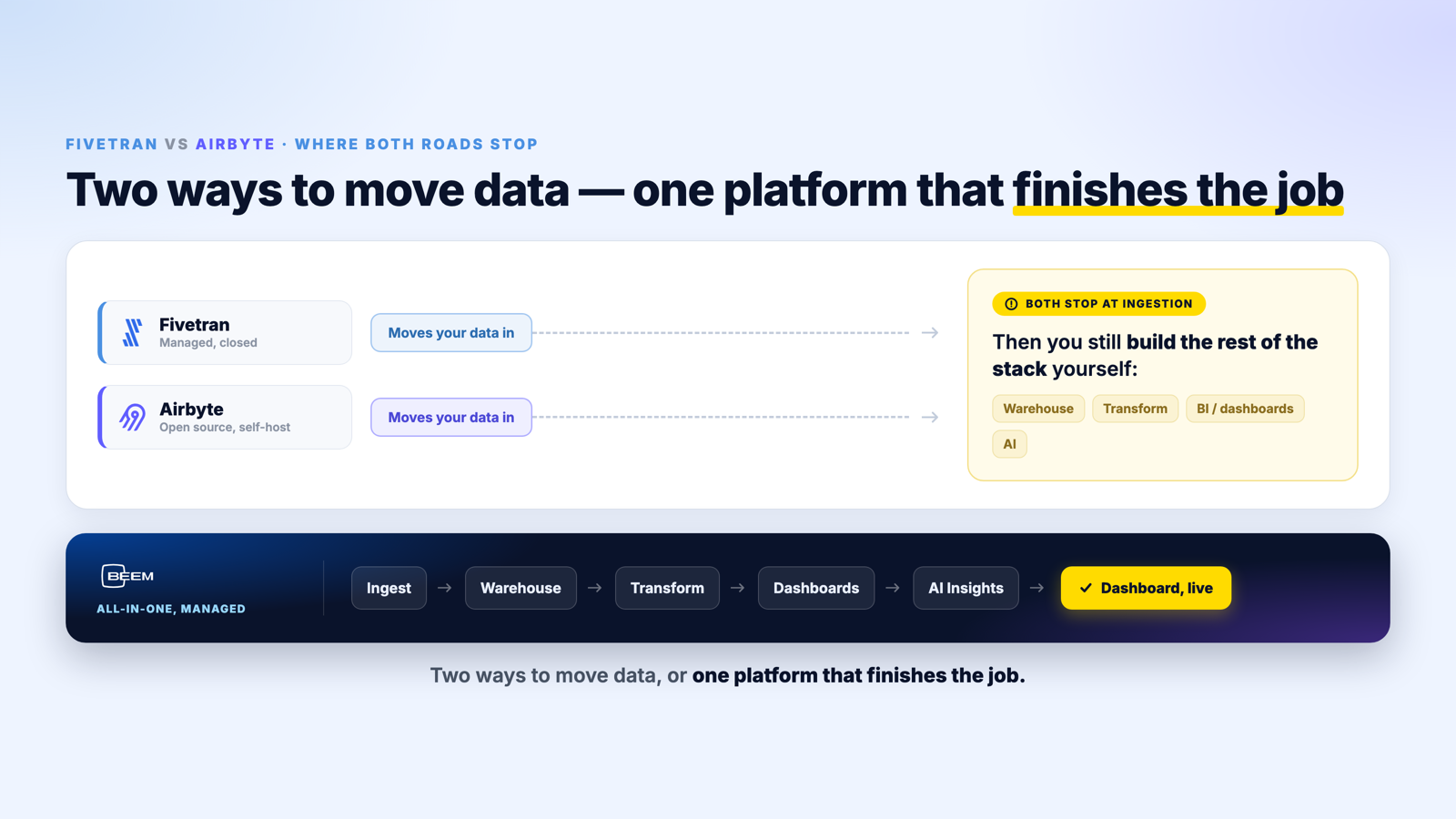
Here the two tools are the same. Both load raw data and expect you to transform it in your warehouse, often with SQL or a tool like dbt. And both stop at ingestion. Once your data lands, you still need a warehouse, a transformation layer, a BI tool, and an AI layer to actually get reporting. That gap is the same whichever ELT tool you choose.
When to choose Fivetran
Fivetran is the better fit when reliability and low effort matter more than control or cost.
- You want pipelines that run without your team maintaining them.
- You do not have engineers to run self-hosted infrastructure.
- You need connectors that a vendor keeps current as source APIs change.
- You already run a warehouse, a BI tool, and a data team, and want best-in-class managed ingestion. For more options, see our guide to Fivetran alternatives and Fivetran pricing.
When to choose Airbyte
Airbyte is the better fit when control, openness, and cost at scale matter more than a hands-off setup.
- You want open source, with the freedom to inspect and change pipelines.
- You want to self-host so data stays inside your own environment.
- You need a connector that only the community catalog has, or you plan to build one.
- You have engineers who can run and monitor the infrastructure.
To be clear about fit, this is a genuine tradeoff. Fivetran buys reliability with less control and a consumption bill. Airbyte buys control and openness with more upkeep. Pick the model that matches how your team wants to work.
The all-in-one alternative to both
Both Fivetran and Airbyte solve one piece of the puzzle. They move data. Neither gives you a warehouse, a transformation layer, dashboards, or AI. So after you choose one, you still assemble and pay for the rest of the stack. If your goal is reporting, not just moving data, there is a third path.
BEEM is a fully managed data platform that covers the whole path in one place. It combines 750+ pre-built connectors, a built-in warehouse on Amazon Redshift, SQL transformation, dashboards, and AI Insights that answer questions in plain language on AWS Bedrock. A team of data experts is available when you need them. BEEM plans start at $899/mo, plus usage-based data processing from $0.60 per DPU and storage at $0.10/GB. You pay one vendor for the whole stack instead of separate bills for connectors, a warehouse, transformation, and a BI tool. Data stays in Canada on AWS ca-central-1, and the platform is SOC2, PIPEDA, and GDPR compliant. Read the direct BEEM vs Fivetran comparison for the head-to-head.
One honest note on connectors. BEEM uses Fivetran-managed connectors under the hood, so its ingestion is closest to Fivetran's managed model, not to Airbyte's open self-hosted one. BEEM does not offer open source or self-hosting. If you specifically want standalone ingestion, pick Fivetran for the managed route or Airbyte for the open one, then build the rest yourself. If you want the whole outcome managed, BEEM delivers first dashboards in as little as 2 weeks and runs 40 to 60 percent below the cost of building in-house, where a single data engineer runs $120K or more per year. For a wider view of the category, see our Snowflake competitors guide.
See your own data in a dashboard. BEEM connects your systems and delivers your first dashboards in as little as 2 weeks, so you judge with your own numbers. Book a demo or explore the platform and integrations.
