
Stitch alternatives are data ingestion tools you can use instead of Stitch to move data from your sources into a warehouse. Some match Stitch on simple, low-cost replication. Others go further and cover the warehouse, transformation, and dashboards that Stitch leaves to you.
Stitch is a simple, low-cost ELT tool, now part of Qlik. It moves rows from your sources to a destination and stops there. BEEM is a managed data platform that takes a wider view. It brings connectors, a warehouse, transformation, dashboards, and AI Insights together in one place.
So the real question is not only which pipe moves rows cheapest. It is whether you need a standalone ingestion tool at all, or a platform that covers the whole path from source to dashboard.
Why teams look beyond Stitch
Stitch moves data from your sources into a warehouse on a schedule. It is built on the open-source Singer framework, and it is known for simple setup and low cost. It does one job well. Three things push teams to look around.
- It only moves data. Stitch ingests rows. It does not store history you model, clean raw tables, or build dashboards. You still add a warehouse, transformation, and a BI tool around it.
- Row-based pricing scales with volume. Stitch bills on rows per month. As your data grows, the bill grows, and a few high-volume sources can push costs up fast.
- Connector breadth and active development are limited. Stitch carries fewer connectors than the largest managed tools. Niche sources often mean building and maintaining your own Singer taps.
The top Stitch alternatives at a glance
The strongest Stitch alternatives are Fivetran, Airbyte, Hevo, Matillion, Meltano, and BEEM. The first five are ingestion or ELT tools that still need a warehouse and a BI tool around them. BEEM is an all-in-one platform that covers the whole path from source to dashboard.
| Platform | Type | Pricing model | Implementation complexity | Best for |
|---|---|---|---|---|
Recommended | All-in-one managed data platform | From $899/mo + usage ($0.60/DPU, $0.10/GB) | Low | Mid-market teams that want the whole data path managed |
| Stitch | Managed ELT (ingestion) | Row-based (rows per month) | Low | Simple, low-cost replication into your own warehouse |
| Fivetran | Managed ELT (ingestion) | Consumption (monthly active rows) | Low | Reliable managed ingestion at scale |
| Airbyte | Open-source ELT (ingestion) | Open-source free, or usage-based cloud | Medium | Teams that want open source and many connectors |
| Hevo | Managed ELT (ingestion) | Tiered, event-based | Low | Near real-time managed pipelines |
| Matillion | Cloud ELT and transformation | Credit-based consumption | High | Warehouse-native ELT with heavy transformation |
| Meltano | Open-source ELT (CLI) | Open-source, free | High | Engineering-led, code-first pipelines |
Stitch alternatives compared
Each tool below does real work well. The right pick depends on your data volume, your team, and how much of the stack you want to run yourself. Here is how the main options compare.
Fivetran
Fivetran is the best-known managed ELT tool and Stitch's closest managed rival. It offers a large set of fully managed connectors, reliable automatic schema handling, and strong enterprise support. Setup is quick, and pipelines mostly run themselves. For teams that want ingestion to just work, it is a safe pick.
The tradeoff is cost and scope. Fivetran bills on monthly active rows, and bills can swing as volume grows. Like Stitch, it only moves data. You still add a warehouse, transformation, and a BI tool behind it. For a closer look, see our Fivetran pricing guide and our Fivetran alternatives comparison.
Airbyte
Airbyte is an open-source ELT tool you can self-host for free or run as a managed cloud service. Its community has built one of the largest connector catalogs available, and a connector builder lets you add sources yourself. For teams that want control and flexibility, it is a strong Stitch alternative.
The catch is maintenance. Self-hosting means you run and update the infrastructure, and community connectors vary in quality. The managed cloud removes some of that work but adds usage-based cost. Like Stitch, Airbyte moves data and stops there, so the warehouse and BI still sit on you.
Hevo
Hevo is a managed, no-code pipeline tool with near real-time replication. It handles in-flight transformation and automatic schema mapping, and it sets up quickly without engineering help. Its event-based tiered pricing can work out cheaper than row-based billing for some workloads.
The limits show at depth. Hevo is still an ingestion tool, so you provide the warehouse and the dashboards. Advanced transformation and governance are lighter than a full platform, and event-based pricing needs watching as pipelines multiply.
Matillion
Matillion is a cloud-native ELT tool built around transformation. It runs data preparation and orchestration inside your cloud warehouse, with a visual builder for complex pipelines. For teams that want heavy in-warehouse modeling alongside ingestion, it does more than a simple pipe.
That power comes with weight. Matillion is harder to set up and run than Stitch, and it uses credit-based consumption pricing that rewards careful design. It also assumes you already run a cloud warehouse for it to work inside.
Meltano
Meltano is an open-source, code-first tool built on the same Singer framework as Stitch. It runs from the command line, versions pipelines in Git, and fits teams that treat data pipelines like software. For engineering-led teams, it offers full control at no license cost.
The tradeoff is effort. Meltano is do-it-yourself by design, so you run the infrastructure and maintain the taps yourself. There is no managed service and no built-in warehouse or dashboards. It suits engineers who want control, not teams who want an outcome.
BEEM
BEEM takes a different approach from every tool above. Instead of moving rows and leaving the rest to you, it is a managed data platform that covers the whole path. BEEM brings together 750+ connectors, a built-in warehouse on Amazon Redshift, SQL transformation, and built-in dashboards with AI Insights that answer questions in plain language. It uses proven managed connectors under the hood, so ingestion is reliable without the do-it-yourself work.
What BEEM replaces is the stack a simple ELT tool leaves you to assemble. You get the whole stack in one platform, because the warehouse, transformation, and dashboards are already built in and refreshed on schedule. BEEM plans start at $899/mo, plus usage-based data processing from $0.60 per DPU and storage at $0.10/GB. You pay one vendor for the whole stack instead of separate bills for connectors, a warehouse, transformation, and a BI tool. The first dashboards can land in as little as 2 weeks, and an expert team is available when you need one. It costs 40 to 60% less than building the same stack in-house. It suits mid-market teams that want the outcome, not five tools to wire together. For a broader view, see our Snowflake competitors guide.
How to choose between Stitch alternatives
The best choice depends less on the pipe itself and more on how much of the stack you want to own. Work through these five criteria before you commit.
- How much of the stack do you already have? If you run a warehouse, transformation, and a BI tool, a pure ingestion tool fits. If not, an all-in-one platform saves you from assembling one.
- What is your data volume? Row-based and consumption pricing reward low volume and punish spikes. Check how each model behaves as your sources grow.
- Who runs the pipelines? Managed tools suit lean teams. Open-source tools like Airbyte and Meltano need engineers to host and maintain them.
- How much transformation do you need? Simple replication suits Stitch or Fivetran. Heavy in-warehouse modeling points to Matillion or a platform with transformation built in.
- What about governance and residency? Check RBAC, audit, compliance, and where data lives. Canadian teams often need residency in AWS ca-central-1.
The all-in-one alternative
Most Stitch alternatives are another way to move rows. You still buy a warehouse, wire up transformation, and add a BI tool on top. BEEM is the option that covers all of it. It is a managed data platform with connectors, a warehouse, transformation, dashboards, and AI Insights in one place, backed by an expert team when you need one.
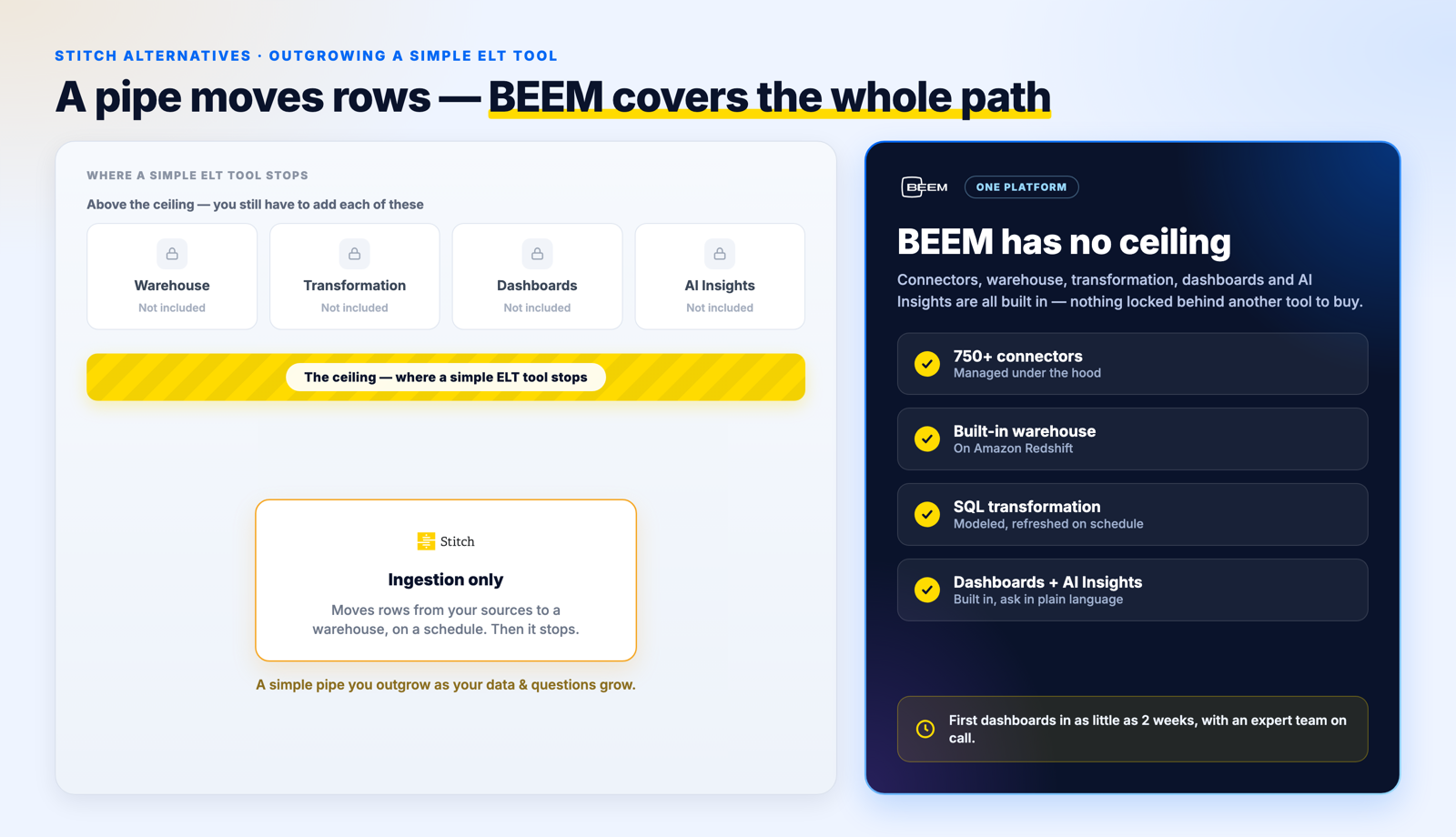
To be clear about fit, BEEM is not the cheapest way to move a small number of rows. If you only need simple, low-cost replication into a warehouse you already run, Stitch or a similar tool does that job. BEEM does not do real-time streaming, and it runs as a scheduled refresh in the cloud. It is the alternative when you want the whole path from source to dashboard managed as one thing, with security, RBAC, audit, and Canadian residency built in.
Want to see your own data in a dashboard before you decide? Book a demo and watch BEEM turn your sources into live dashboards, or explore the full platform.
