
Definition
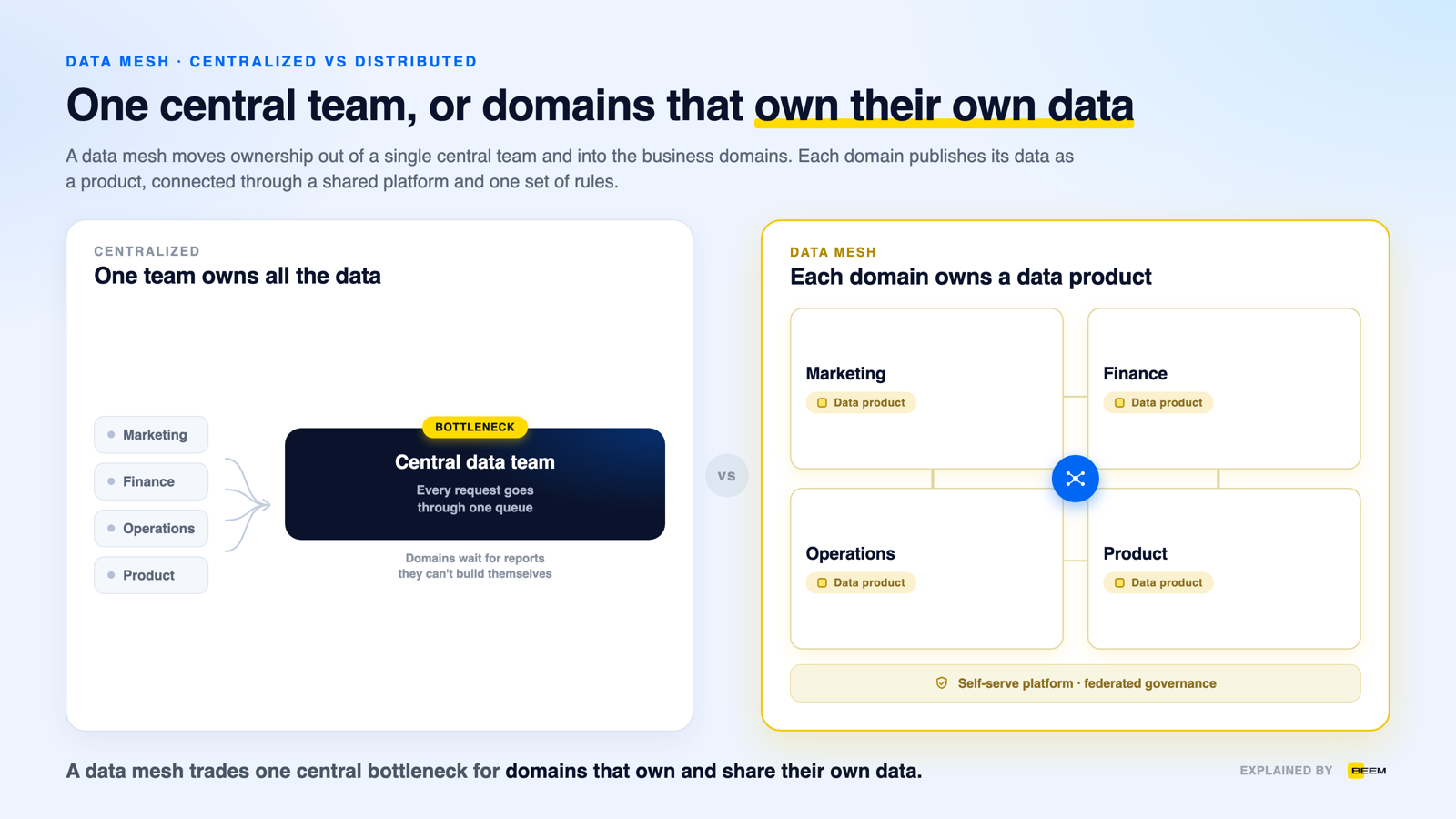
A data mesh is a decentralized approach to data architecture where individual domain teams own their data as products, instead of one central team owning all of it. Each team publishes its data for the rest of the company to use, while shared standards keep everything consistent.
It moves data ownership closer to the people who know the data best.
How it works
A data mesh works by giving each business domain ownership of its own data, which it publishes as a product for the rest of the company to use. A central platform team provides the shared tools, and a common governance model keeps every data product consistent and easy to find.
The four principles of data mesh
Data mesh rests on four principles set out by Zhamak Dehghani, who coined the term. Together they let data scale across a company without one team owning everything.
- Domain ownership — the teams that create the data own it end to end, from pipeline to quality to access.
- Data as a product — each dataset is treated like a real product, with an owner, documentation and service levels its users can rely on.
- Self-serve data platform — a central team builds shared infrastructure so any domain can publish a data product without deep engineering.
- Federated governance — common standards for security, quality and interoperability are agreed once and enforced automatically across domains.
How it compares
A data mesh is a decentralized way of organizing data ownership, a data warehouse is a centralized store for structured data, and a data fabric is a technology layer that connects data across systems. They solve different problems and often work together.
The key contrast is control. A data mesh distributes ownership to domains, while a data warehouse and a data fabric keep it central. Most companies still run a warehouse at the core, whether or not they adopt a mesh on top.
| Approach | What it is | Best for |
|---|---|---|
| Data mesh | Decentralized, domain-owned data products | Large orgs scaling data ownership |
| Data warehouse | Centralized store for structured data | Reporting and BI from one source |
| Data fabric | Integration layer across sources | Connecting and governing distributed data |
When your business needs one
- The organization has many distinct business domains, each generating data the others want.
- A single central data team has become the bottleneck for every request.
- There is enough platform engineering in place to give domains genuine self-service.
- Teams are data-literate enough to own quality, documentation and access for what they publish.
- Common standards for security and interoperability can be agreed once and enforced automatically.
Benefits and limits
- Faster delivery — domains publish and change their own data products without a central backlog.
- Better quality — the people closest to the data are the ones accountable for it.
- Scales cleanly — adding a new domain doesn't overload one central team.
- Needs strong foundations — a mesh depends on solid platform engineering and data-literate teams.
- Risk of drift — without firm federated governance, domains can pull apart into new data silos.
- Often too much for smaller teams — most mid-market companies don't have enough domains to justify the overhead.
- It is an organizational change first, so it succeeds or fails on ownership and incentives rather than tooling.
- A data mesh decentralizes ownership: each domain publishes its own data as a product, rather than one central team serving everyone.
- It rests on four principles — domain ownership, data as a product, a self-serve platform, and federated governance.
- It answers scale, not storage; most companies still keep a warehouse at the core, and smaller teams usually do better with one governed central platform.
Frequently Asked Questions
What is a data mesh in simple terms?
A data mesh is a way of organizing data so each team owns and shares its own data instead of relying on one central team. Marketing, finance and operations each publish their data as a product for others to use, with shared rules keeping it all consistent.
What are the four principles of data mesh?
The four principles are domain ownership, data as a product, a self-serve data platform, and federated governance. Together they spread data ownership across teams while keeping quality, security and interoperability consistent through shared standards enforced by a central platform.
What is the difference between data mesh and data fabric?
A data mesh is about who owns data, distributing responsibility to domain teams. A data fabric is about how data is connected, using a technology layer to integrate sources across the company. A mesh is decentralized and organizational, while a fabric is centrally controlled.
Is data mesh better than a data warehouse?
Neither is better, because they do different jobs. A data warehouse is a central store for structured, analytics-ready data. A data mesh is an ownership model that can sit on top of warehouses. Many companies keep a warehouse at the core and adopt mesh ideas selectively.
When should a company use a data mesh?
A data mesh suits large organizations with many business domains, a central data team that has become a bottleneck, and enough platform engineering to support self-service. Smaller and mid-market teams usually get more value from one centralized managed platform than from running a mesh.
Does BEEM use a data mesh?
No. BEEM is a centralized managed platform, not a data mesh implementation. It combines a warehouse on Amazon Redshift, 750+ connectors, transformation, dashboards and AI Insights in one service. For mid-market teams that want one governed platform rather than a mesh, plans start at $899 per month.
