
Definition
Data democratization is the practice of giving people across a business direct access to trustworthy data, rather than routing every question through a central data team. It combines three things: a shared source of governed data, permissions that make access safe by default, and tools non-technical people can actually use. The goal is not to remove the data team, but to free it from a queue of routine requests.
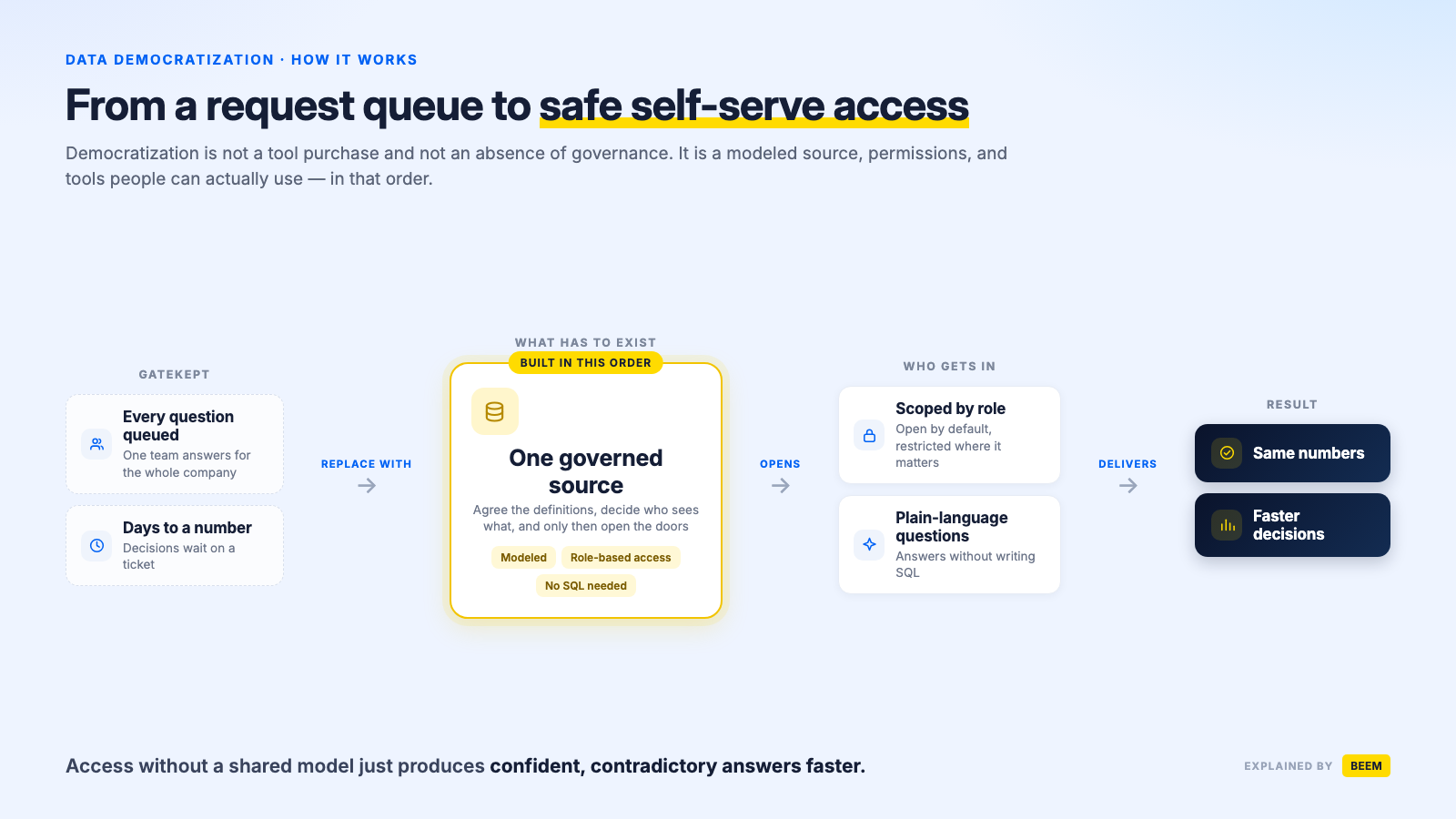
How it works
Democratization is usually approached in the wrong order. A self-serve tool is bought first, and people are handed a blank query window over inconsistent tables. It works better in the opposite direction: agree on the numbers, decide who can see what, and only then open the doors. Each stage builds the trust that the next one depends on.
How it compares
Democratized access is often mistaken for buying a self-serve tool, or for loosening governance. It is neither. The useful contrast is with the two states on either side of it: a queue that protects the numbers but slows every decision, and open access that is fast until two teams disagree.
| Gatekept | Democratized | Ungoverned | |
|---|---|---|---|
| Who can answer a question | Only the data team | Anyone with the right role | Anyone, on anything |
| What people read from | Ad hoc extracts and spreadsheets | One governed, modeled source | Whatever table they happen to find |
| Role of the data team | Runs a request queue | Owns the model and the permissions | Absent from the loop |
| Typical failure | Decisions wait days for a number | A definition drifts and has to be re-agreed | Two teams bring different revenue figures |
When your business needs one
- Simple questions, such as last month's sales by region, take days because they sit in a request queue.
- Two teams present different numbers for the same metric in the same meeting.
- Your analysts spend more time producing routine extracts than doing analysis.
- Business teams have started keeping private spreadsheets because it is faster than asking.
- Decisions are being made on instinct in areas where the data exists but is not reachable.
Benefits and limits
- Decisions get made closer to the people who own the outcome, and faster.
- The data team moves from a ticket queue to platform work: modeling, quality and enablement.
- Shared definitions cut down on duplicate and contradictory reporting.
- More people looking at the data means quality problems surface sooner.
- Access without literacy produces confident wrong answers. Training and documentation are part of the cost, not an optional extra.
- Self-serve tools do not remove the need for modeling. An open query window over raw source tables usually makes inconsistency worse.
- Broader access raises the stakes on permissions and privacy, particularly for HR, financial and personal data.
- Governance has to be maintained. Definitions drift, people change roles, and a permissions model that is never reviewed becomes a liability.
- Data democratization is about safe, direct access for non-technical teams, not about handing everyone raw database credentials.
- It depends on three things moving together: a governed shared source, permissions, and tools people can use without SQL.
- The common failure is access without modeling or literacy, which produces faster answers that are wrong more often.
Frequently Asked Questions
Is data democratization the same as self-service analytics?
They overlap but they are not identical. Self-service analytics is the tooling layer: dashboards, natural-language querying, exports. Data democratization is the wider practice that also includes the governed data model, the permissions and the training that make those tools safe to use.
Does data democratization mean everyone sees everything?
No. Access is scoped by role and by workspace or dataset. Democratization means removing unnecessary bottlenecks, not removing controls, and sensitive data such as payroll or personal records normally stays restricted.
What does it do to the data team's role?
It shifts it. Instead of answering routine requests one at a time, the team builds and maintains the shared datasets, definitions, quality tests and permissions that let other people answer those questions themselves.
Where do most data democratization efforts fail?
Usually by starting with a tool. When people are given query access to raw, unmodeled source tables, conflicting numbers appear quickly, trust drops, and the organization goes back to the request queue.
How does BEEM support data democratization?
BEEM keeps the modeled datasets, the permissions and the consumption tools in one place. Datasets are built and versioned in the Warehouse, access is governed by workspace roles (Organization Admin, Editor and Viewer), and business users can read dashboards, ask questions in plain language through AI Insights, or export results to CSV or XLSX without writing SQL. A dataset can also be shared with another workspace as results only, without exposing the underlying SQL.
