
Definition
Data profiling is the process of examining a dataset to describe its structure, its content and its relationships. It measures things such as data types, value ranges, null and distinct counts, patterns and duplicate keys, and produces a factual picture of the data's condition. Profiling is a diagnosis rather than a cure: it tells you what state the data is in so you can decide what to do about it.
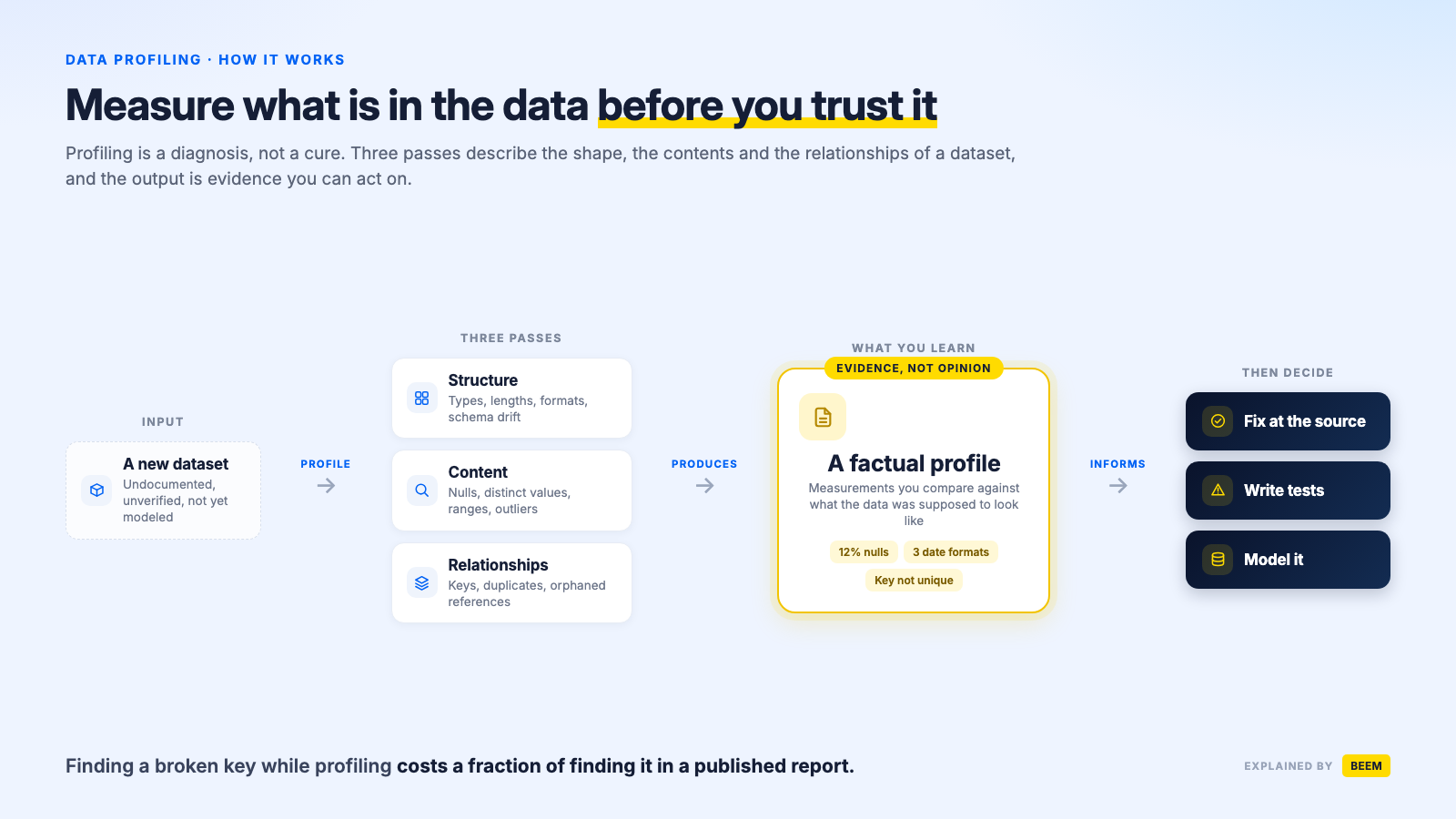
How it works
Profiling is usually described as three passes, each answering a different question: what shape is this data in, what is inside it, and how does it relate to everything else. In practice they run together, against a sample or the full table, and the output is a set of measurements you compare against what the data was supposed to look like.
How it compares
Profiling is often confused with data quality testing and data observability. They answer different questions at different moments: profiling looks at a dataset before you trust it, testing checks the rules you already wrote, and observability watches for changes nobody thought to predict.
| Data profiling | Data quality testing | Data observability | |
|---|---|---|---|
| When it runs | Before you model or trust a dataset | On every pipeline run | Continuously, in the background |
| What it answers | What is actually in this data? | Does it still meet the rules we wrote? | Has anything changed unexpectedly? |
| What you get | Measurements: types, nulls, ranges, duplicates | A pass or a fail against explicit rules | Alerts on freshness, volume and schema drift |
When your business needs one
- You are onboarding a new source system and do not yet know how clean it is.
- A join silently drops or multiplies rows and nobody can explain why.
- You are about to migrate or consolidate systems and need to size the cleanup.
- A metric has been questioned and you need to establish the condition of the data underneath it.
- You are writing quality tests and need to know what normal looks like before setting thresholds.
Benefits and limits
- Assumptions get tested before they are built on, and finding a broken key at profiling time costs a fraction of finding it in production.
- Cleanup effort can be estimated rather than guessed.
- The output gives you realistic thresholds for ongoing quality tests.
- It surfaces undocumented business logic hiding in the data, such as status codes nobody uses any more.
- A profile is a snapshot. A source that was clean last quarter can drift, so a one-off profile ages quickly.
- It measures the data, not its meaning. Only someone who knows the business can say whether a value that looks odd is actually wrong.
- Profiling a very large table in full is expensive, and sampling is cheaper but can miss rare, high-impact anomalies.
- It produces findings, not decisions. A profile with nobody to act on it changes nothing.
- Profiling describes a dataset's structure, content and relationships before you model it or trust it.
- It is a diagnostic step rather than a cleaning step: the output is measurements and findings, not corrected data.
- A profile ages, so where data keeps arriving the profile should become ongoing tests rather than a one-time report.
Frequently Asked Questions
What is the difference between data profiling and data quality?
Profiling is how you measure the current condition of a dataset. Data quality is the standard you are measuring against, meaning whether the data is accurate, complete and fit for its intended use. Profiling produces the evidence, and quality management decides what to do about it.
When should data profiling happen?
Early, and more than once. Profile a source when you first connect it, again before you model it, and again before any migration or major schema change.
Is profiling done by hand or automatically?
Both. A simple profile is straightforward SQL: counts, distinct values, minimums, maximums and null rates. Dedicated profiling tools automate the same measurements across many tables and keep a history of them.
How does profiling relate to data quality testing?
Profiling comes first and is exploratory, because you do not yet know what you will find. Testing comes afterwards and is assertive, because you have decided what should always be true and you check it on every run. Profiling findings are what good tests get written from.
Can I profile data in BEEM?
There is no dedicated profiling feature, but the pieces are there. The Datalake shows schemas, row counts and previews for every source table. The Warehouse SQL editor lets you run profiling queries against a source and preview the results before deploying anything. Dataset tests then turn what you learn into SQL assertions that run on every refresh.
