
Definition
iPaaS (Integration Platform as a Service) is a cloud platform for connecting apps, data and systems without building integrations from scratch.
It gives teams pre-built connectors, APIs and low-code tools to move data between software and automate workflows across the systems a business runs on, whether they sit in the cloud or on-premises.
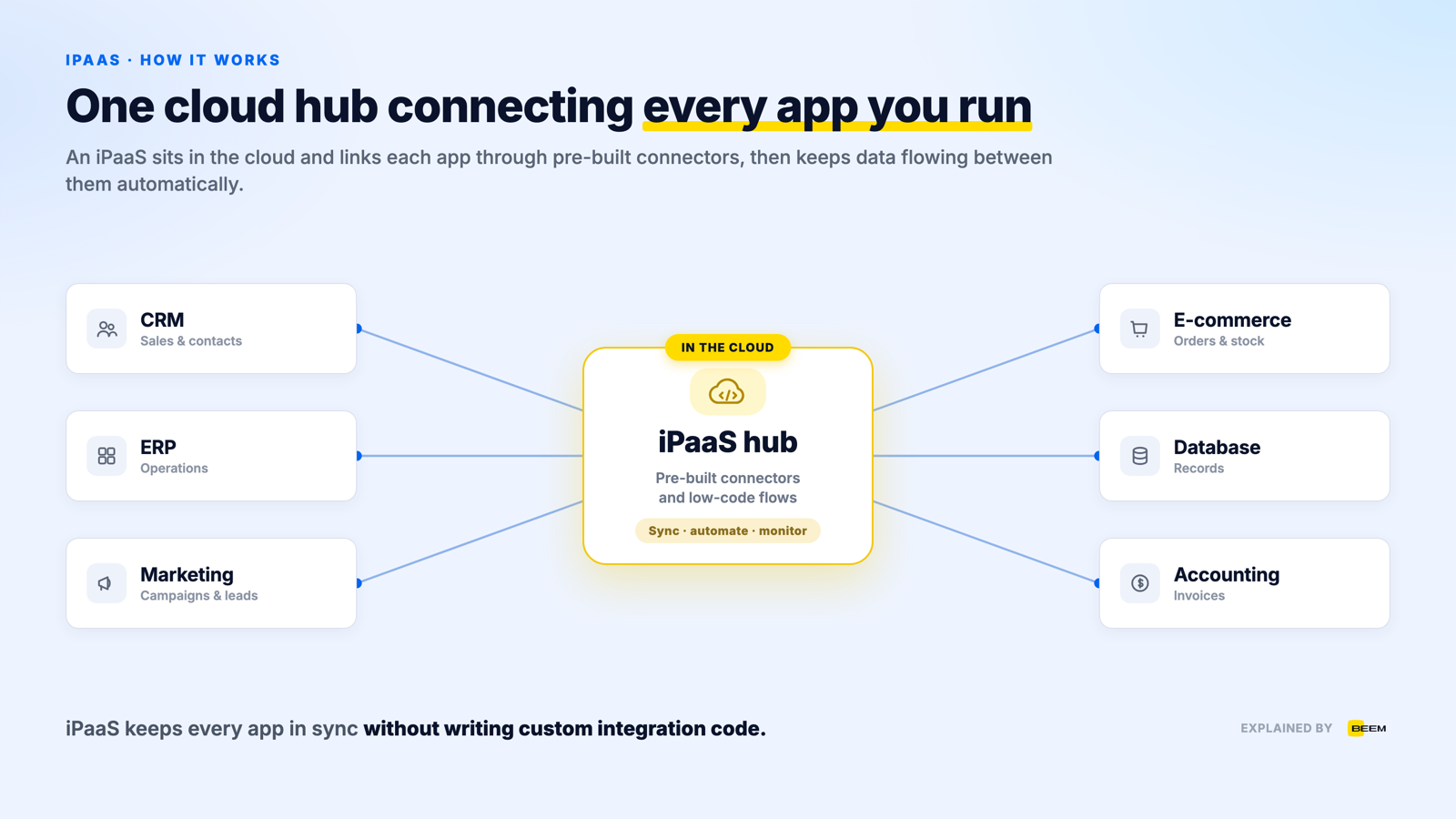
How it works
iPaaS works as a central hub in the cloud that connects to each of your apps through pre-built connectors, then moves data between them on rules you set. You design the flow once and the platform runs it for you.
How it compares
iPaaS, ETL and ESB all move data between systems, but they solve different problems. iPaaS is a cloud service for app-to-app workflows in real time. ETL is a batch process for moving data into a warehouse for analytics. ESB (Enterprise Service Bus) is older middleware that connects apps inside a single network, usually on-premises.
The lines blur in practice. Many iPaaS tools can run ETL-style jobs, and analytics platforms include connectors of their own. If your goal is reporting rather than workflow automation, data integration into a warehouse is usually the better fit.
| Approach | Main job | Where it runs |
|---|---|---|
| iPaaS | Real-time app-to-app workflows and automation | Cloud, hybrid |
| ETL | Batch data movement into a warehouse for analytics | Cloud or on-premises |
| ESB | App-to-app messaging inside one network | Mostly on-premises |
When your business needs one
- A CRM and a marketing tool have to stay aligned, so a lead score or status change updates in both.
- Online orders need to reach the ERP or fulfillment system without anyone re-keying them.
- Employee onboarding means creating accounts across HR, email and access tools every time someone joins.
- Events have to be routed between apps and handed on as clean records to a wider data pipeline.
- Someone is copying the same fields between two systems as a recurring task.
Benefits and limits
- Pre-built connectors remove most of the custom API work for common business tools.
- Flows are built once in a visual, low-code builder, so integration is not gated on engineering time.
- Syncs run on events rather than schedules, which keeps apps aligned close to real time.
- Retries, error handling and monitoring come with the platform instead of being written per integration.
- Every integration is visible from one dashboard, rather than scattered across scripts nobody owns.
- An iPaaS moves data between apps but is not built to store and model it, so analytics still needs a warehouse and a BI layer.
- Pricing usually scales with tasks or operations, which can climb sharply as automations multiply.
- Low-code flows are easy to create and easy to lose track of, so undocumented automations accumulate.
- You depend on the vendor's connector catalog; an unsupported or changed API still means custom work.
- Real-time syncing between apps spreads bad data faster when a source record is wrong.
- iPaaS is a cloud hub that connects applications through pre-built connectors and keeps them in sync automatically.
- It is app-centric and event-driven, which is what separates it from ETL, a batch process aimed at loading a warehouse for analytics.
- Common tools are Workato, Boomi and MuleSoft at the enterprise end, and Zapier and Make for lighter self-serve automation; none of them replace a warehouse for reporting.
Frequently Asked Questions
What is iPaaS in simple terms?
iPaaS is a cloud service that connects a company's software apps so they share data automatically. Instead of copying information between tools by hand, you set up a flow once and the platform keeps the apps in sync. It uses pre-built connectors so there's little or no custom code to write.
What does iPaaS stand for?
iPaaS stands for Integration Platform as a Service. It is a cloud platform that lets organizations connect applications, data and systems, whether they run in the cloud or on-premises, and automate workflows between them without building each integration from scratch.
What is the difference between iPaaS and ETL?
iPaaS connects apps and automates workflows between them, often in real time and triggered by events. ETL is a batch process that extracts data from sources, transforms it, and loads it into a data warehouse for analytics. iPaaS is broader and app-centric, while ETL is focused on preparing data for reporting.
What is the difference between iPaaS and ESB?
iPaaS is a cloud-based service for connecting cloud and on-premises apps, built for modern hybrid environments. ESB, or Enterprise Service Bus, is older middleware that connects applications inside a single network, usually on-premises. iPaaS is the cloud-native successor to the ESB pattern.
What are examples of iPaaS tools?
Common iPaaS tools include Workato, Boomi and MuleSoft for enterprise workflow automation, and Zapier and Make for lighter self-serve automations between popular apps. These tools move data between applications. Analytics platforms like BEEM instead connect sources into a warehouse for reporting.
What is iPaaS used for?
iPaaS is used to keep software apps in sync and automate work between them. Common uses include syncing a CRM with a marketing tool, pushing online orders into an ERP, automating employee onboarding across systems, and routing events between apps so data stays consistent everywhere.
